



News:
Brokerage
Posted: July 25, 2011
David Schiller - The National economy suffered pneumonia, but Buffalo caught the common cold
WNY Industrial Market
Transaction velocity in the Buffalo area remains relatively low due to the overall economic uncertainty.
WNY's saving grace in recent decades is the absence of booms and busts. The direct result is a market not overbuilt. While many parts of the country caught pneumonia during the major economic downturn we've suffered, the Buffalo area caught a cold.
"Good news" is the reputed sale of a 150,000 s/f crane served building in Cheektowaga, followed by the "less-than-good news" about the closing of the 800,000 s/f Quad/Graphics plant in neighboring Depew.
The future of "The Concourse Center" situated directly across from the Buffalo Niagara International Airport remains uncertain. The 469,000 s/f distribution building is managed by a special servicer at this time.
Several companies are expanding through new construction on their current sites.
Office: Suburban
Uncertainty in the office market manifests itself in "short term renewals." Small to medium office tenants are generally reticent to make long term commitments.
There is intense competition for small and medium tenants among the developers.
Airborne Business Park, adjacent to the Buffalo International Airport, is well on its way to filling its 108,000 s/f new build. Calpsan Office Park, directly across from the main entrance to the airport, absorbed the first building it put on the market. Recently, General Dynamics downsized in the Buffalo area opening up three 25,000 s/f floor plates at Calspan.
Two multi-tenanted office buildings are on the market for sale to investors. Last year at this time there was no such product. 95 John Muir and 338 Harris Hill are offered in the 9%-10% cap rate range.
Independent Health is expanding its presence at "Centerpointe" in Williamsville through acquisition of a neighboring building. Another freestanding building is available for sale in the "Centerpointe" vicinity, an availability which seldom occurs.
228,000 s/f. That is the total size of future projects developers seek to construct -and advertise as available in the future - in the vicinity of Millard Fillmore Suburban Hospital in Amherst. How much will be constructed and tenanted? That is the "228,000 s/f question."
Office: Larkin District
City View not only filled its 600,000 s/f building at 725 Exchange, but is executing new projects in its immediate vicinity allowing tenants to expand their operations.
Peter Krog, James Cornell, and Gordon Reger purchased 701 Seneca, the 1.2 million s/f complex immediately adjacent to 725 Exchange. Future tenants requiring large floor plates in the City of Buffalo will have few choices other than 701 Seneca. The building requires a new façade and new elevators, already planned and pending construction by the new owners.
Office: CBD
HSBC's plans for its future in "One HSBC Center" clouds the CBD office market's future which may be on the brink of tremendous oversupply.
300 Pearl ("Olympic Towers") remains for sale through a "call for offers" due in August.
However, the class "A" office market in the CBD remains relatively healthy, boasting low vacancy rates. Slow, conservative, but steady projects over the last few years achieved solid success. Two law firms plan redevelopment of two smaller downtown office buildings.
Buffalo Medical Campus
Kaleida, SUNY, Buffalo General Hospital, and Roswell are creating a vibrant and compelling setting for medical real estate development. A new and significant chapter in Buffalo's medical development history is being written at this time.
David Schiller, SIOR, is associate broker & director of sales for Pyramid Brokerage Company of Buffalo, Buffalo, N.Y.
Tags:
Brokerage
MORE FROM Brokerage
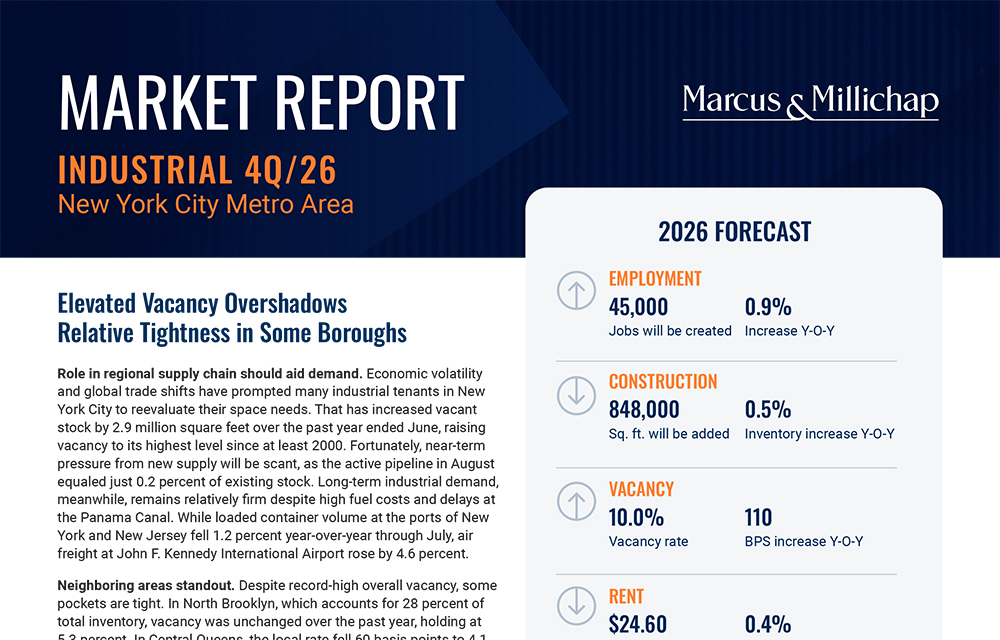
Marcus & Millichap releases fourth-quarter 2026 NYC industrial market report
Manhattan, NY Marcus & Millichap has published its fourth-quarter 2026 New York City Industrial Market Report. “New York City’s industrial market is showing a clear



Quick Hits
 (2).gif)

Columns and Thought Leadership

Hunt CRE question and answer: Choosing a real estate agent - by David Hunt
First, we will only work with one agent exclusively. The primary reason is that we want that agent to legally represent our client’s interests. In New York State, a real estate agent has a fiduciary

The art of investing in real estate - by Thomas Donovan
Real estate investing is as much an art as it is a skill. No one can time the market, or the factors that drive it, perfectly. Location, zoning, size, transportation, and neighborhood density give you a baseline for

Hunt commercial real estate question and answer: Fortune 500 wisdom - by David Hunt
Yes, there are lessons to be learned from the largest companies in America when comes to managing your real estate. But the decision to buy or lease real estate may not be one of

New York’s streets are full again, and the retail numbers prove it - by Noam Aziz
Walk down any New York block this year and you can feel it. The sidewalks are crowded, the storefronts are lit, and the energy that defines this city is back at full volume.
.gif)