



News:
Brokerage
Posted: April 28, 2026
Cushman & Wakefield report highlights divide in downtown Manhattan office market as Class A pulls further ahead on rents
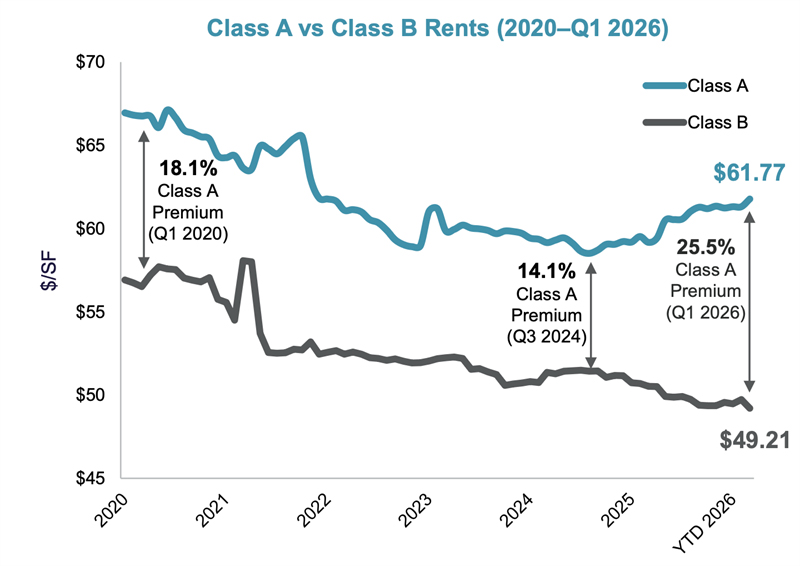
Manhattan, NY Cushman & Wakefield released a new research report highlighting a growing divide in downtown Manhattan’s office market, where demand for top-tier, amenitized buildings is driving an increasingly pronounced gap in both performance and pricing across asset classes.
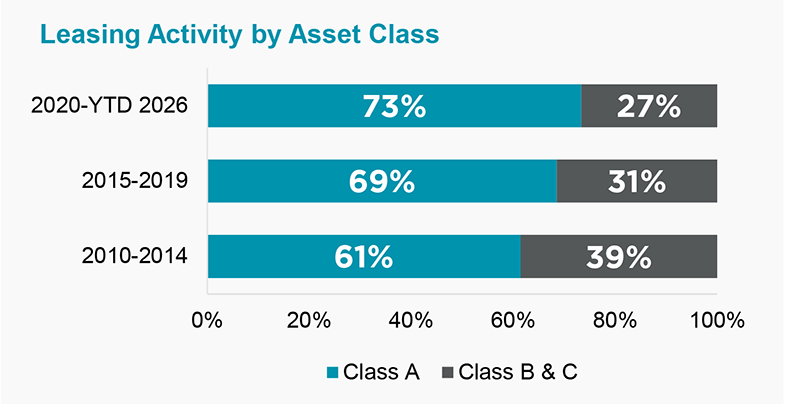
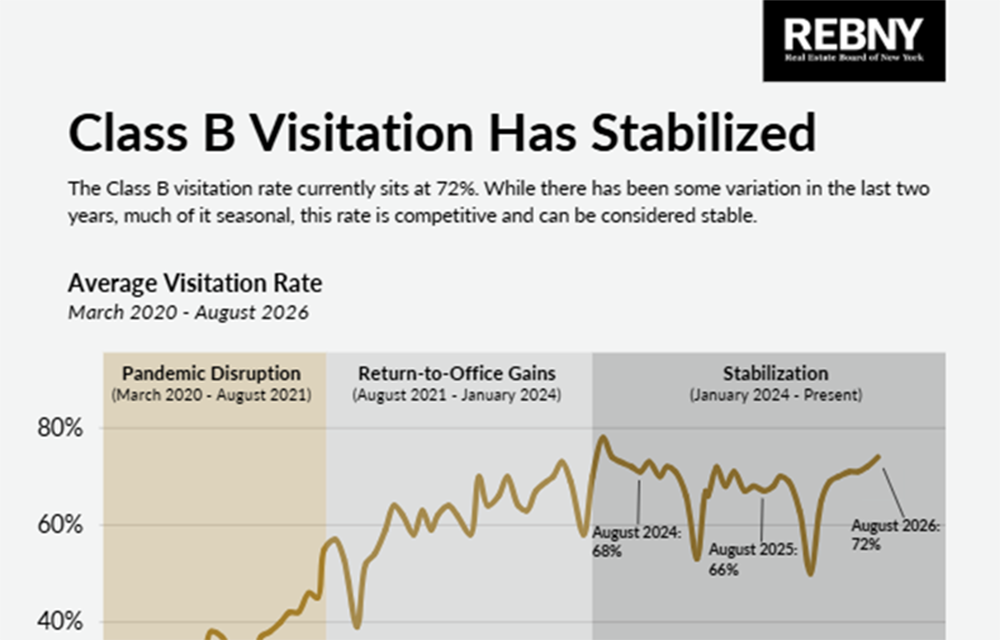
According to the report, since 2020, 73% of the downtown leasing activity was concentrated among Class A buildings, with Class B and lower-tier assets experiencing declining demand, longer marketing periods and reduced tour activity, underscoring a clear and sustained flight-to-quality trend. This is fueled by tenants that are seeking modern office environments with hospitality-driven amenities and thoughtfully curated retail offerings.
For Class A space downtown, the rent premium over Class B space was 25.5% as of Q1 2026 – this marks a more than 11% increase in the asking rent gap between the asset classes since mid-2024. This comes on the heels of strong Q1 for the downtown market, which recorded 2.9 million s/f of leasing activity, the second-highest quarterly total on record, and a $0.44 per s/f increase in rents, which averaged $56.67 for all asset classes in Q1. Class A rents rose by $0.54 per s/f to $61.77.
“Downtown’s office market is continuing to evolve into a distinctly bifurcated landscape, where the highest-quality assets are capturing the overwhelming share of demand and pricing power,” said Maddie Askeland, data specialist at Cushman & Wakefield. “What’s notable is that this divide is no longer just about the building quality or the amenity offerings, it is increasingly evident in the rent gap, which we expect will continue to widen as the year progresses.”
Jared Lewis, senior research analyst at Cushman & Wakefield,said, “As tenants prioritize quality, experience and long-term workplace strategy, the divergence between top-tier and lower-tier assets is expected to accelerate. Without significant reinvestment, repositioning, or conversion, older buildings will likely face continued downward pressure on rents, further reinforcing long-term value disparities across Downtown Manhattan’s office market.”
MORE FROM Brokerage
Investment Property Realty Group closes $1.75 million sale of 1094 Hancock Street in Brooklyn
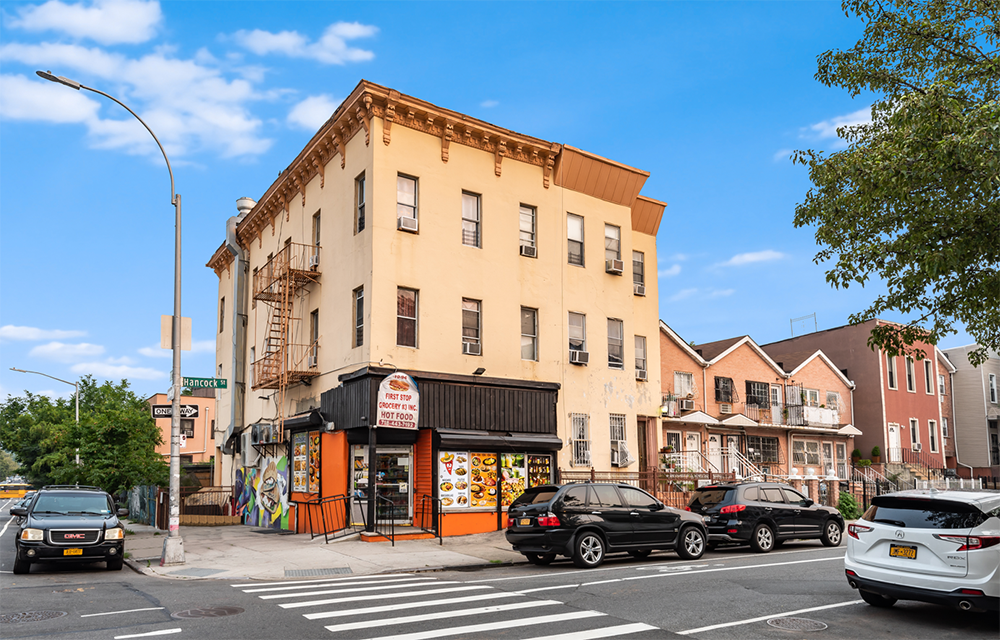
Brooklyn, NY Investment Property Realty Group (IPRG), a New York-based commercial investment firm, has closed the sale of 1094 Hancock St., a mixed-use building in the Bushwick section, for $1.75 million.


 (2).gif)

Columns and Thought Leadership

Hunt commercial real estate question and answer: Fortune 500 wisdom - by David Hunt
Yes, there are lessons to be learned from the largest companies in America when comes to managing your real estate. But the decision to buy or lease real estate may not be one of

Hunt CRE question and answer: Choosing a real estate agent - by David Hunt
First, we will only work with one agent exclusively. The primary reason is that we want that agent to legally represent our client’s interests. In New York State, a real estate agent has a fiduciary

New York’s streets are full again, and the retail numbers prove it - by Noam Aziz
Walk down any New York block this year and you can feel it. The sidewalks are crowded, the storefronts are lit, and the energy that defines this city is back at full volume.

A guide to finding the right NYC property management company - by Sanjay Gandhi
Being a small to midsize landlord in NYC is an increasingly demanding endeavor. From navigating complex regulations, increased compliance demands to dealing with tenant issues and remediating violations. It is wise to enlist the assistance of a partner, a professional
.gif)