



News:
Brokerage
Posted: October 17, 2023
CRE sector performance in August 2023
Washington, DC The unprecedented surge in delivered units has amplified the available space within the multifamily sector. Over the last 12 months leading up to August, there has been a notable 32% upswing in units delivered to the market compared to the previous year. Consequently, vacancy rates registered a 1.2% uptick in contrast to last year’s corresponding period. Nonetheless, absorption rates have sustained their upward trajectory into August, demonstrating a substantial 23% surge compared to a year prior. The multifamily sector is expected to remain strong compared to the other CRE sectors, owing to favorable demographics, a strong job market, and low housing affordability due to higher mortgage rates.
Despite the pandemic coming to an end, employees are lacking enthusiasm for returning to physical office spaces. Meanwhile, the amount of office space delivered to the market remains high.
These dynamics, coupled with the progression in remote technology and the rise of flexible work environments, have led to a massive surplus of 59.4 million s/f of unoccupied office space compared to occupied space in the 12 months ending in August. Consequently, the office vacancy rate has reached one of the highest in the past 10 years at 13.3%. With a growing number of office construction projects in progress and ongoing technological advancements, the office sector is poised to face considerable challenges in adapting to evolving work arrangements and demands.
Although the industrial sector of commercial real estate has tapered off from its peak last year, it has now reverted to pre-pandemic levels. Net absorption has fallen by 47% compared to the previous year. A record-high 525 million s/f of additional industrial spaces entered the market, coupled with decreased demand, have elevated the industrial vacancy rate to 5.4% and moderated rent growth to 7.5%. Nonetheless, rental expenses for industrial spaces have persisted in rising faster than in the pre-pandemic period.
The rise of e-commerce has posed challenges for the conventional retail sector over the past decade, and the pandemic has further exacerbated this decline in activity. However, the retail sector remains robust, with 12-month rent growth ending in August decreasing by 1.2% compared to the previous year’s record-breaking 4.4%, now at 3.2% but still higher than pre-pandemic levels. The vacancy rate has plateaued for the last five quarters at 4.2%, the lowest among all CRE sectors. As inflation continues to recede and interest rates are projected to stabilize later this year, the outlook for retail space demand remains strong.
Hotel demand has remained on the rise, leading to increased occupancy rates and higher room rates. The hospitality industry has made a noteworthy recovery, with hotel revenue receiving an additional boost after being impacted by COVID-19 restrictions and quarantine measures. The revenue per available room (RevPAR) is now more than 13% higher, and the average daily rate (ADR) is about 18% higher than their pre-pandemic levels. With business and leisure travel gaining momentum, the demand for hospitality establishments will continue its upward trend throughout 2023.
September 2023 Commercial Real Estate Market Insights (nar.realtor)
https://www.nar.realtor/commercial-real-estate-market-insights/september-2023-commercial-real-estate-market-insights
Tags:
Brokerage
MORE FROM Brokerage
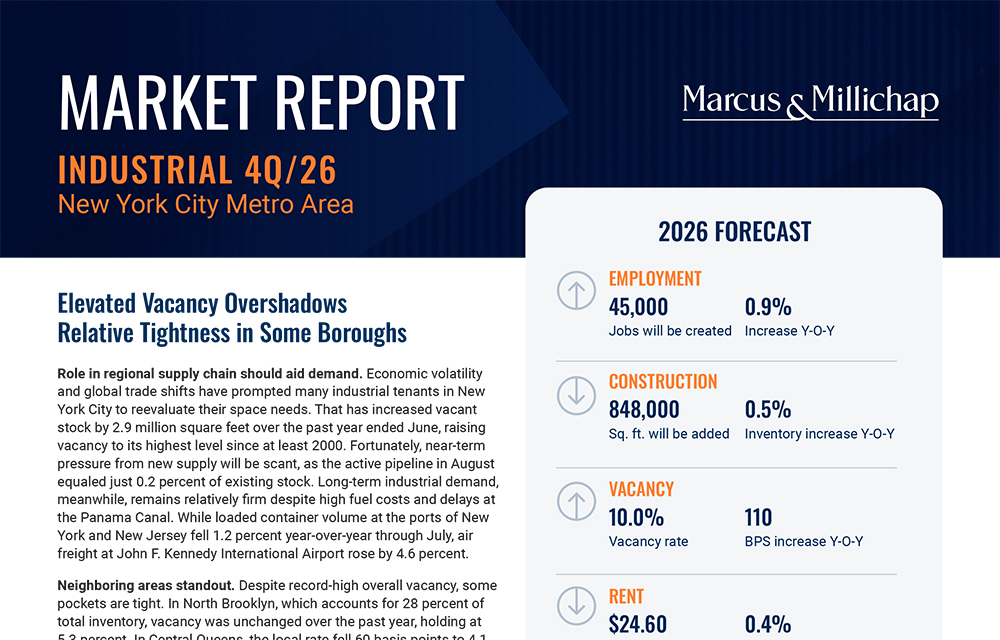
Marcus & Millichap releases fourth-quarter 2026 NYC industrial market report
Manhattan, NY Marcus & Millichap has published its fourth-quarter 2026 New York City Industrial Market Report. “New York City’s industrial market is showing a clear



Quick Hits
 (2).gif)

Columns and Thought Leadership

Hunt CRE question and answer: Choosing a real estate agent - by David Hunt
First, we will only work with one agent exclusively. The primary reason is that we want that agent to legally represent our client’s interests. In New York State, a real estate agent has a fiduciary

Hunt commercial real estate question and answer: Fortune 500 wisdom - by David Hunt
Yes, there are lessons to be learned from the largest companies in America when comes to managing your real estate. But the decision to buy or lease real estate may not be one of

New York’s streets are full again, and the retail numbers prove it - by Noam Aziz
Walk down any New York block this year and you can feel it. The sidewalks are crowded, the storefronts are lit, and the energy that defines this city is back at full volume.

The art of investing in real estate - by Thomas Donovan
Real estate investing is as much an art as it is a skill. No one can time the market, or the factors that drive it, perfectly. Location, zoning, size, transportation, and neighborhood density give you a baseline for
.gif)