



News:
Brokerage
Posted: December 15, 2020
Contactless parking technology helps commercial properties suffering from lower profits during COVID-19 pandemic - by Jerry Skillett

Over six years ago when Apple Pay was unveiled, it was a watershed moment for the mobile payment industry. The technology was being hailed a “contactless mobile” payment. It boosted growth for many businesses to reconfigure their point of purchase systems. However, because of the COVID-19 pandemic, mobile payments which was considered a convenience transformed into a requirement.
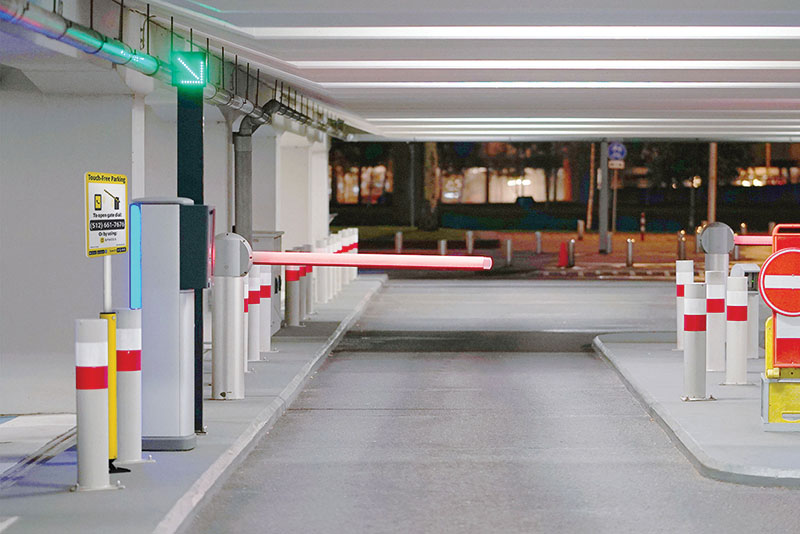
It is simple to see how the global pandemic has impacted the parking industry. In attempts to press the ticket button without physically touching the surface, drivers are using objects like keys, pens or even their sleeves to cover their hands and fingers. People do not want to touch parking equipment or any surface that has been touched by many others previously. The demand has been building up for a long time. Mobile payments have given consumers the ability to get food delivered, order a ride share, book a hotel, or reserve a plane ticket. The application has expanded into parking.
Natural disasters and unforeseen events have a way of changing lives permanently. The pandemic has increased sensitivity to touching surfaces and that will remain for a long time. It is an issue that companies need to address as more workers are called back to the office. Commercial real estate properties are struggling with how to keep people safe when they congregate in common building areas and even garages. In the U.S., 86% of workers commute to work by personal vehicle. Employees often park in a paid parking facility and come into contact with other commuters while accessing the parking facility through the parking equipment (i.e. touching a screen or button to get a ticket and lift the gate).
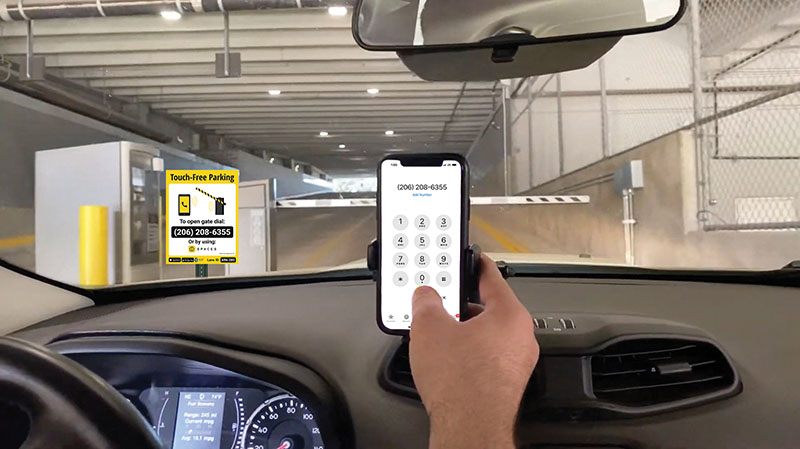
It has been reported that overall mobile payments have increased by over 40% since March. The figure would be higher if the point of purchase systems were easily convertible. Parking is particularly challenging; executing a mobile payment while driving requires a high level of physical coordination. Before the pandemic, there was not a system that could be universally utilized to make parking access and payment from inside a car.
In major U.S. cities, parking is a major component within portfolios of commercial real estate developers. The pandemic has hurt profits as office spaces and parking spaces have not been filled. For employees coming back to the office, who are driving and parking, entry to the parking garage will be their first experience as they are entering a safe, contact-conscious environment. If an employee is confident with a safer parking experience, that will bolster their belief in their safety at the office, and trust is key when encouraging people to return to work and filling those empty office spaces.
But parking poses a unique set of problems. Parking garage equipment is not uniform. Many of which is aging and outdated. Also, there are many different types of lots, and many different landlords and operating companies that manage the parking properties. From private condos that have a consistent number of monthly parkers to office complexes that see thousands of cars a day, to modest surface lots, there is no single formula when it comes to parking. However, for contactless parking technology to achieve mass integration, it must fit all parking.
Parking operators have a lot to gain by installing an effective contactless solution. This will be a challenge to prioritize, however, as operating companies are tasked with absorbing the 80% decrease in parking demand. Those that install a contactless solution will have an advantage over non-contactless facilities, as the concern over safety might just be enough to divert drivers to safer, touch-free facilities.
The benefit of mobile technologies is that it does not traditionally require a significant human resource commitment to operate. Once a parking facility goes contactless, ideally the system should sustain itself. So, if operators can manage the technology installation process, it will pay off in the long term. Regarding the consumer experience, going mobile with parking also unlocks a wealth of inventory, data and revenue management opportunities which are often under-supported by legacy parking equipment.
“Contactless Parking” has become a means for technological revolution. There are technologies now that allow drivers to enter, park, pay and exit from their mobile device from inside a vehicle. It is a technological advance that will change parking forever. The mobile adoption cycle is growing quickly with an immediate 25% adoption rate in installed locations that increases rapidly. Some parking locations across the country have now adopted 100% of all transactions from a mobile device and this will be the primary system of the future. Consumers are demanding convenience from an industry where that was not a main priority.
In most major cities, contactless parking is quickly expanding across all types of parking facilities. Parking is very diverse. And, if a technology can support a few key operators or real estate companies, a nationwide portfolio can be developed in a short period of time. Contactless parking will eventually be available everywhere with major cities adopting the technology early on.
Jerry Skillett is the executive chairman of SPACES USA, New York, N.Y.
Tags:
Brokerage
MORE FROM Brokerage
United Properties Corp. expands Wisconsin and Illinois retail presence adding 200,000 s/f
West Allis, WI United Properties Corp. completed two retail acquisitions totaling $27.4 million across Illinois and Wisconsin, adding 205,000 s/f of shopping center space to its portfolio




Quick Hits

Columns and Thought Leadership

Hunt commercial real estate question and answer: Fortune 500 wisdom - by David Hunt
Yes, there are lessons to be learned from the largest companies in America when comes to managing your real estate. But the decision to buy or lease real estate may not be one of

New York’s streets are full again, and the retail numbers prove it - by Noam Aziz
Walk down any New York block this year and you can feel it. The sidewalks are crowded, the storefronts are lit, and the energy that defines this city is back at full volume.

A guide to finding the right NYC property management company - by Sanjay Gandhi
Being a small to midsize landlord in NYC is an increasingly demanding endeavor. From navigating complex regulations, increased compliance demands to dealing with tenant issues and remediating violations. It is wise to enlist the assistance of a partner, a professional

Positive forecast for New York’s pro-housing push? - by Philip Butler
New York’s housing crisis remains a hot button topic despite growing consensus that varied and affordable housing is desperately needed statewide. Governor Hochul has recently introduced several initiatives to overcome N.Y.’s anti-housing
.gif)