



News:
Brokerage
Posted: November 19, 2007
Buffalo development climate gaining traction
From the Medical Corridor to the Historic Waterfront, Buffalo Niagara is witnessing a renaissance in new construction and renovation projects. Planned investments exceed $4 billion. Most people are in agreement. Buffalo is experiencing the beginning of a construction boom.
More than $500 million already has been invested in the Buffalo Niagara Medical Campus, attracting world-class scientists and medical manufacturers to this unique port city, rich in brain power, culture, natural amenities, and affordable mansions. Health Now recently celebrated the grand opening of its $110 million downtown headquarters. Over $1 billion is being invested in the ongoing Buffalo Public Schools Reconstruction Program. The Statler Towers is undergoing a $130 million renovation. Ground breaking for the new $123 million federal courthouse was recently celebrated in Niagara Sq. The Larkin Building received a $30 million renovation, part of a recently unveiled 10-year neighborhood restoration plan that will include residential, retail, and office developments and an additional investment exceeding $20 million. The Dulski Federal Office Building will undergo a $64 million renovation and conversion. The Park Ln. restaurant site at Gates Circle is slated for construction of a $55 million luxury condominium tower. The University at Buffalo will invest an additional $300 million in its North Campus and just a few weeks ago gained control of the Trico and M. Wile manufacturing sites on the edge of the 100-acre Buffalo Niagara Medical Campus to provide expansion space for life sciences research and commercialization.
The Seneca Nation of Indians is moving forward with plans for the $333 million Buffalo Creek Casino at Michigan and South Park.
If there was ever a time to take a good look at a city on the verge of a comeback, it would be Buffalo and it would be now.
The New York State Commercial Association of Realtors (NYSCAR) WNY chapter also recently launched the region's first commercial listing system.
For information on real estate investment opportunities and to find a qualified broker, log into the new Buffalo Niagara Commercial Listing System at www.buffaloniagaracls.com.
Kristin Badger-Bach is the 2007 president of the WNY chapter of NYSCAR and an associate broker at Hunt Commercial Real Estate Corp., Buffalo, N.Y.
Tags:
Brokerage
MORE FROM Brokerage
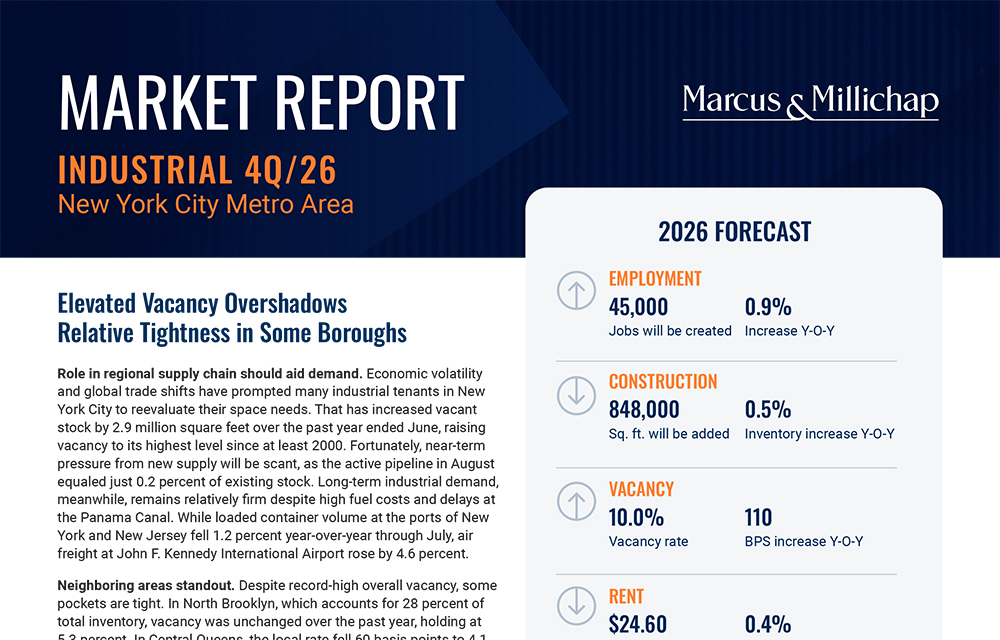
Marcus & Millichap releases fourth-quarter 2026 NYC industrial market report
Manhattan, NY Marcus & Millichap has published its fourth-quarter 2026 New York City Industrial Market Report. “New York City’s industrial market is showing a clear




Quick Hits
 (2).gif)

Columns and Thought Leadership

Hunt commercial real estate question and answer: Fortune 500 wisdom - by David Hunt
Yes, there are lessons to be learned from the largest companies in America when comes to managing your real estate. But the decision to buy or lease real estate may not be one of

Hunt CRE question and answer: Choosing a real estate agent - by David Hunt
First, we will only work with one agent exclusively. The primary reason is that we want that agent to legally represent our client’s interests. In New York State, a real estate agent has a fiduciary

The art of investing in real estate - by Thomas Donovan
Real estate investing is as much an art as it is a skill. No one can time the market, or the factors that drive it, perfectly. Location, zoning, size, transportation, and neighborhood density give you a baseline for

New York’s streets are full again, and the retail numbers prove it - by Noam Aziz
Walk down any New York block this year and you can feel it. The sidewalks are crowded, the storefronts are lit, and the energy that defines this city is back at full volume.
.gif)