



News:
Brokerage
Posted: August 3, 2021
Are collapses of multi-owner properties inevitable? - by Thomas Kearns

The recent collapse of a Miami condominium building and the investigative journalism that followed revealed the difficulties in managing multi-owner properties like condominiums and cooperatives in the face of serious repair issues as buildings age. The scenario: Problems are discovered but the fix is expensive. Unit owners are either resistant to expensive projects or distrustful of the board managing the building or both. Board members cycle through with limited progress.
Are multi-owner properties truly governable in these circumstances? In addition to condominiums and cooperatives, what about properties owned by tenants-in-common, a frequent arrangement in commercial properties? All of these legal arrangements have the same issue: A group of owners with varying degrees of interests, experience, judgment and financial wherewithal.
For the Miami collapse, using hindsight, one answer was to sell the property when the extent of the problem was discovered. By admitting that the project is too expensive, too difficult to manage, and too disruptive, the board could have taken the necessary vote to sell the building to a developer who would redevelop the property bigger and better. But it is very hard to get owner consensus on decisions like that.
What should a purchaser of a unit in a multi-owner property do to protect themselves from disastrous results from the failure to make expensive repairs? While municipal building departments may be able to help, the Miami example shows the limits of that reliance. Unfortunately for purchasers of units in multi-owner properties, the answer may lie in old-fashioned diligence that should be done on each purchase. Talking to building staff, reviewing board and shareholder minutes and owner correspondence are among the suggested actions before investing. While engineering inspections of condo or co-op units in large buildings were not common in New York before the Miami collapse, lawyers will be more likely to recommend them now.
My favorite diligence method was to walk around the neighborhood and property and talk to owners, tenants and staff (although I will admit my wife is much better at talking to strangers). Check for friends on the board who might be candid with you. Look for second- or third-level connections to board members or owners. Make sure you have a broker you can trust. Check with contractors in the neighborhood for the building’s reputation. Walk the building with the broker or the building manager and see things for yourself. And then once the closing occurs make sure you are well insured.
Thomas Kearns is a partner with Olshan Frome Wolosky LLP’s real estate department, New York, N.Y.
Tags:
Brokerage
MORE FROM Brokerage
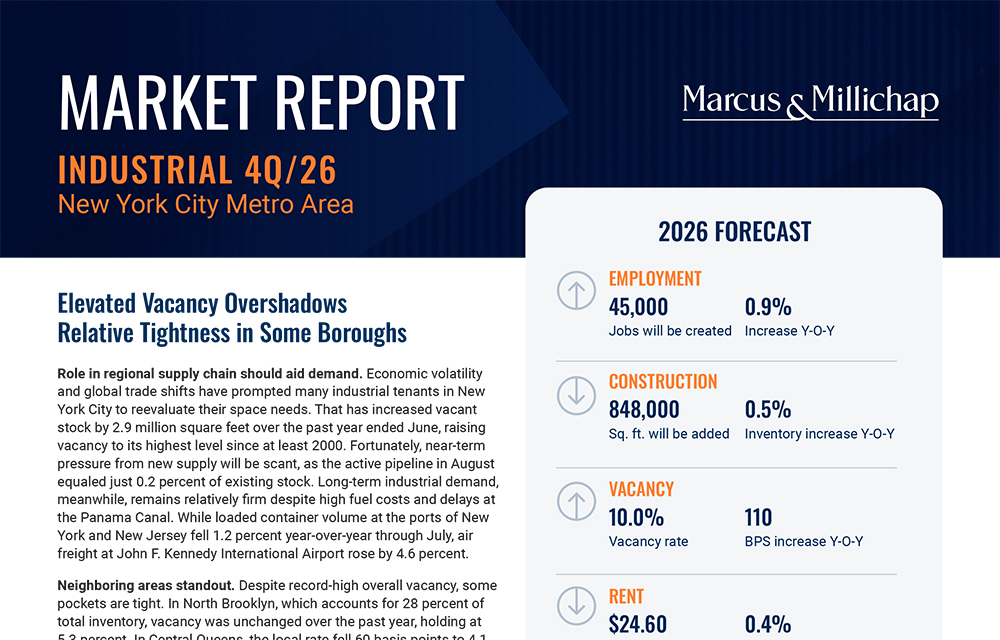
Marcus & Millichap releases fourth-quarter 2026 NYC industrial market report
Manhattan, NY Marcus & Millichap has published its fourth-quarter 2026 New York City Industrial Market Report. “New York City’s industrial market is showing a clear




Quick Hits
 (2).gif)

Columns and Thought Leadership

Hunt CRE question and answer: Choosing a real estate agent - by David Hunt
First, we will only work with one agent exclusively. The primary reason is that we want that agent to legally represent our client’s interests. In New York State, a real estate agent has a fiduciary

The art of investing in real estate - by Thomas Donovan
Real estate investing is as much an art as it is a skill. No one can time the market, or the factors that drive it, perfectly. Location, zoning, size, transportation, and neighborhood density give you a baseline for

Hunt commercial real estate question and answer: Fortune 500 wisdom - by David Hunt
Yes, there are lessons to be learned from the largest companies in America when comes to managing your real estate. But the decision to buy or lease real estate may not be one of

New York’s streets are full again, and the retail numbers prove it - by Noam Aziz
Walk down any New York block this year and you can feel it. The sidewalks are crowded, the storefronts are lit, and the energy that defines this city is back at full volume.
.gif)