



News:
Brokerage
Posted: October 25, 2022
Arch Companies takes over portfolio of three Bushwick apartment development sites
New York, NY Arch Companies has closed a portfolio of three luxury apartment development projects in the Bushwick, Brooklyn market.
The portfolio totals 61 units and is located at 435 Central Ave., 1010 Bushwick Ave. and 1351 Dekalb Ave. The restructuring with the existing ownership group lead by Denis Saklakov is a positive step towards restarting construction on the previously stalled properties.
The deal was brokered by Eli Terry and Jonathan Aghravi of JBA Equities.
Construction has commenced at all three properties. Each property is at a different stage of completion with 435 Central Ave.’s construction about 85% complete and will total 14 units. Additionally, 1010 Bushwick, which will total 20 units has a completed superstructure, and 1351 Dekalb, which will total 27 units, is in foundations. Arch is using its in-house construction affiliate, Arch Builders to carry out the developments.
Jeff Simpson, Managing Partners of Arch Companies stated, “We are pleased to assume the ownership of this prime Bushwick luxury residential portfolio. We will prioritize rerouting construction and are thrilled to deliver these fully amenitized luxury properties to a market where a product of this kind is rare.”
Arch will complete and deliver three luxury, amenitized and professionally operated apartment buildings in the positively evolving and highly desirable neighborhood of Bushwick. Bushwick is quickly emerging as a cultural epicenter as renowned restaurants, unique bars and nightlife, vintage shopping, and music venues increase in the area. Each property is strategically located within blocks of a J/Z or M Subway line, and within a 15-minute walk of an L Subway line. Additionally, each property will provide parking spaces exclusive to the residents. These buildings will cater to the growing neighborhood and provide a new high quality affordable housing stock to the neighborhood.
Eli Terry added, “The neighborhood only benefits from these buildings being finished and brought to life by the Arch team. They are well located in the active Bushwick neighborhood and will be delivered with a high standard of construction to ensure that they will maximize their potential as high-quality luxury residential developments.”
Tags:
Brokerage
MORE FROM Brokerage
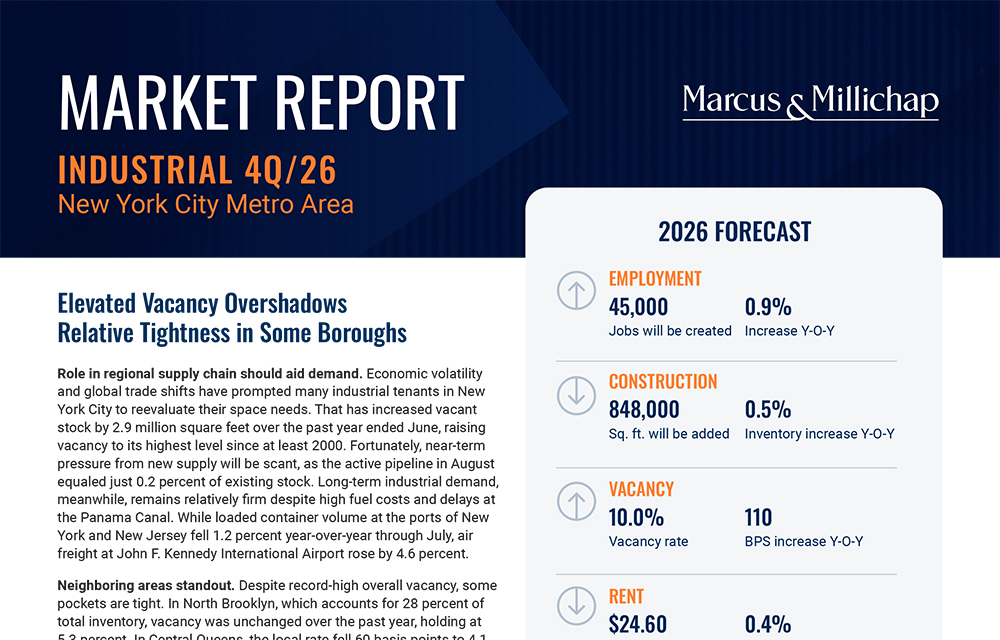
Marcus & Millichap releases fourth-quarter 2026 NYC industrial market report
Manhattan, NY Marcus & Millichap has published its fourth-quarter 2026 New York City Industrial Market Report. “New York City’s industrial market is showing a clear




Quick Hits

Columns and Thought Leadership

Hunt CRE question and answer: Choosing a real estate agent - by David Hunt
First, we will only work with one agent exclusively. The primary reason is that we want that agent to legally represent our client’s interests. In New York State, a real estate agent has a fiduciary

Hunt commercial real estate question and answer: Fortune 500 wisdom - by David Hunt
Yes, there are lessons to be learned from the largest companies in America when comes to managing your real estate. But the decision to buy or lease real estate may not be one of

New York’s streets are full again, and the retail numbers prove it - by Noam Aziz
Walk down any New York block this year and you can feel it. The sidewalks are crowded, the storefronts are lit, and the energy that defines this city is back at full volume.

The art of investing in real estate - by Thomas Donovan
Real estate investing is as much an art as it is a skill. No one can time the market, or the factors that drive it, perfectly. Location, zoning, size, transportation, and neighborhood density give you a baseline for
.gif)