



News:
Brokerage
Posted: June 5, 2018
Overview of the 2018 Buffalo apartment market - by Brian Heine
Multifamily sales totaled $117 million in the Buffalo area market in 2017 again exceeding the $100 million dollar level achieved in each of the last five years. Local management companies remain the most active buyers, adding to their portfolios any sizable asset that becomes available. Activity is strong across all market segments, property sizes, and price levels.
The Warehouse Lofts on Ellicott St. in the CBD, originally developed as 30 apartments on six floors of an eight-story building in 2007, finished selling out as individual condominium apartments for a total of $8 million with the one floor of office space remaining to be sold at $925,000. A profitable exit as the Erie County IDA shows the total project cost at $7.6 million including a 20% Federal Historic Tax Credit. One of the first of the many downtown loft apartment conversion projects and the first to be sold out as individual condominiums, a strategy expected to be employed more frequently in the coming years as the other owners of these properties look for an out as the property tax abatements granted to help subsidize the projects operations expire. Raising the rents to cover the additional property tax expense may not be practicable as the rental market may not allow the significant increases necessary to maintain cash flow.
In the suburban Amherst market, Legacy Development sold the 78 unit Strathmore Apartments for $14.5 million in the largest market sale in 2017. Recently built in 2016 at a cost of $14 million and sold at a cap rate of 6%, this represents the high end here for valuation in multifamily sales. A $12.9 million Freddie Mac was assumed producing a cash on cash return of 13.8% on the required equity; rents are $1,206 to $1,814 or $1.35 per s/f per month. Typical cap rates on other investment quality apartment complex sales are in the 7% to 8% range.
New construction in the suburban markets includes smaller projects on infill locations and owners adding additional units to existing successful properties. Venture Properties Group opened Erie Woods built on greenspace in the town of Evans, the 16 two-bedroom apartment complex in two buildings cost $2.2 million with starting rents of $1,175. Bevilacqua Development completed the mixed use Lymstone Lofts on a brownfield lot in the village of Williamsville in the town of Amherst, the 20 apartments and four retail stores cost $9.2 million with $930,000 in tax breaks from the Amherst IDA, the project qualified for tax breaks because of the retail component and brownfield siting, rents range from $1,600 to $2,800. Rane Management is adding Phase III of its 500 plus unit Dockside Village East Amherst complex with rents starting at $1,147.
In the city of Buffalo, as the supply of historic properties suitable for apartment conversion and also eligible for historic tax credits in desirable locations is exhausted, new development is moving to lesser locations, mixed use development, and brownfield sites. Ellicott Development completed a mixed-use residential and office building at 301 Ohio St. along the Buffalo River, the 21 apartments rent from $1,300 to $2,500 and were fully occupied in 30 days. O’Dalaigh Real Estate is planning a five-story 32-unit apartment complex with first floor retail on Hertel Ave. in North Buffalo on the site of a former gas station. The building height conflicts with the recently enacted Green Building Code and newly active community advisory committees are forming to complicate this and other new development plans. Also, the Erie County executive, the mayor of Buffalo, and various housing groups are backing a proposed “inclusionary zoning” policy requiring developers to rent up to 30% of a new developments’ apartments at below-market rent rates if tax incentives are granted. With all new construction receiving some form of tax break, these requirements will have a real market impact as the loss of income reduces the yield and hence the desirability of the proposed investment.
Brian Heine is a licensed real estate broker in New York State
Tags:
Brokerage
MORE FROM Brokerage
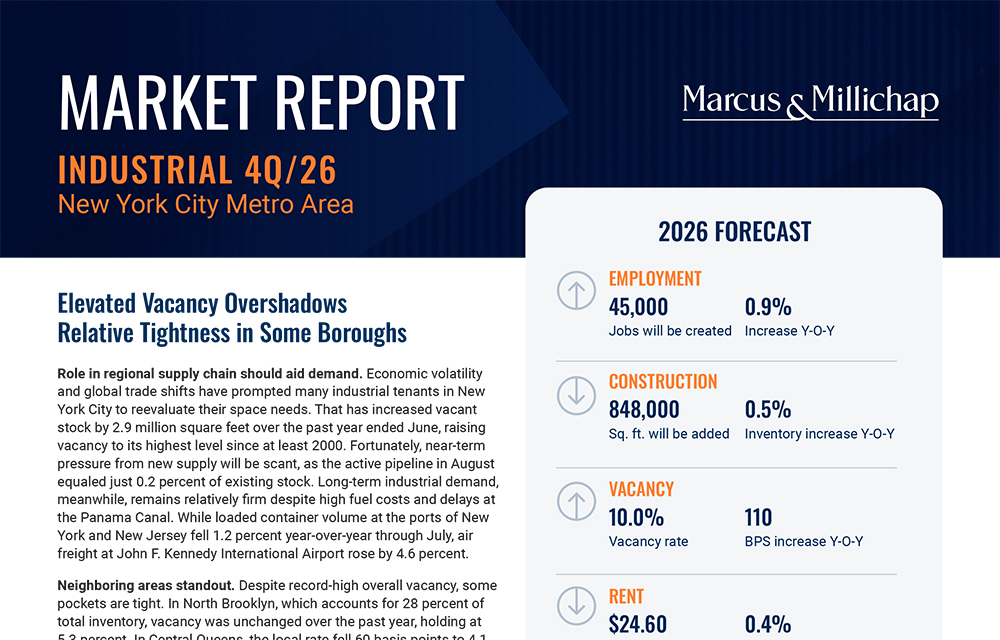
Marcus & Millichap releases fourth-quarter 2026 NYC industrial market report
Manhattan, NY Marcus & Millichap has published its fourth-quarter 2026 New York City Industrial Market Report. “New York City’s industrial market is showing a clear



Quick Hits

Columns and Thought Leadership

The art of investing in real estate - by Thomas Donovan
Real estate investing is as much an art as it is a skill. No one can time the market, or the factors that drive it, perfectly. Location, zoning, size, transportation, and neighborhood density give you a baseline for

New York’s streets are full again, and the retail numbers prove it - by Noam Aziz
Walk down any New York block this year and you can feel it. The sidewalks are crowded, the storefronts are lit, and the energy that defines this city is back at full volume.

Hunt commercial real estate question and answer: Fortune 500 wisdom - by David Hunt
Yes, there are lessons to be learned from the largest companies in America when comes to managing your real estate. But the decision to buy or lease real estate may not be one of

Hunt CRE question and answer: Choosing a real estate agent - by David Hunt
First, we will only work with one agent exclusively. The primary reason is that we want that agent to legally represent our client’s interests. In New York State, a real estate agent has a fiduciary
.gif)