



News:
Brokerage
Posted: November 24, 2014
Just what is "Gross Negligence"?
Management and service contracts and LLC Agreements all have indemnification and waiver-of-liability clauses to protect the parties, depending on custom and the market. The classic example is a property management agreement under which the property owner indemnifies for claims arising under the manager's duties. Invariably, there are carve-outs from the owner's duty to indemnify, e.g., the owner typically does not indemnify a manager's intentional wrongdoing. Managers' lawyers usually ask that any carve-out for negligence of the manager be limited to his "gross negligence."
In New York and Delaware, the use of the term "gross negligence" makes a difference. However, the standard may not help the accused avoid a jury since the determination of whether an act or omission was negligent or grossly negligent is one for a jury. Courts in both states often describe it as closer to willful conduct than mere heightened negligence and acts of aggravated character rather than a failure to exercise ordinary care.
First, Delaware has a consistent view of the "gross negligence" standard:
"a higher level of negligence representing an extreme departure from the ordinary standard of care. . . . [and] involves a devil-may-care attitude or indifference to duty amounting to recklessness. . . . [A] plaintiff must plead and prove that the defendant was recklessly uninformed or acted outside the bounds of reason."
Metropolitan Life Ins. Co. v. Tremont Gp. Holdings, Inc. [Del Ch 2012]. Delaware law is important because most LLCs in New York transactions are organized under Delaware law and LLC agreements often have indemnification provisions favoring the managing member.
New York decisions vary based on the equities of the situation. For example, a court held a home inspector liable for missing a hazardous condition. Johnson v. Smith (Jefferson Co. 2006). However, other New York decisions define gross negligence as a "reckless indifference to the rights of others." In Kalisch-Jarcho v. City of New York (1983), the city continuously delayed a contractor from performing a contract with a "no-damage-for-delay" clause. The court held that the plaintiff was entitled to a trial to determine whether the city acted so recklessly as to be grossly negligent, thereby vitiating the no-damages clause on policy grounds.
The New York opinions described involved defendants trying to avoid jury trials. In 1993, the court held that an alarm company was not liable for gross negligence granting summary judgment, i.e. the defendant avoided a jury trial. In Colnaghi, U.S.A. v. Jewelers Protection Services, the alarm company forgot to alarm a skylight in a gallery. Burglars entered through the vulnerable skylight and stole 23 paintings. The court held that failing to wire the skylight was not for a jury to decide - it was clear that it was not so grossly negligent as to overcome the contractual exculpation on negligence.
As a practical matter, should you let your lawyer fight for a gross negligence standard in your contract? Yes. It does make a difference but it may not help you avoid a jury trial. Alternatively, just get the best insurance you can and hope a jury sees it your way.
Tom Kearns is a partner at Olshan Frome Wolosky, New York, N.Y.
Tags:
Brokerage
MORE FROM Brokerage
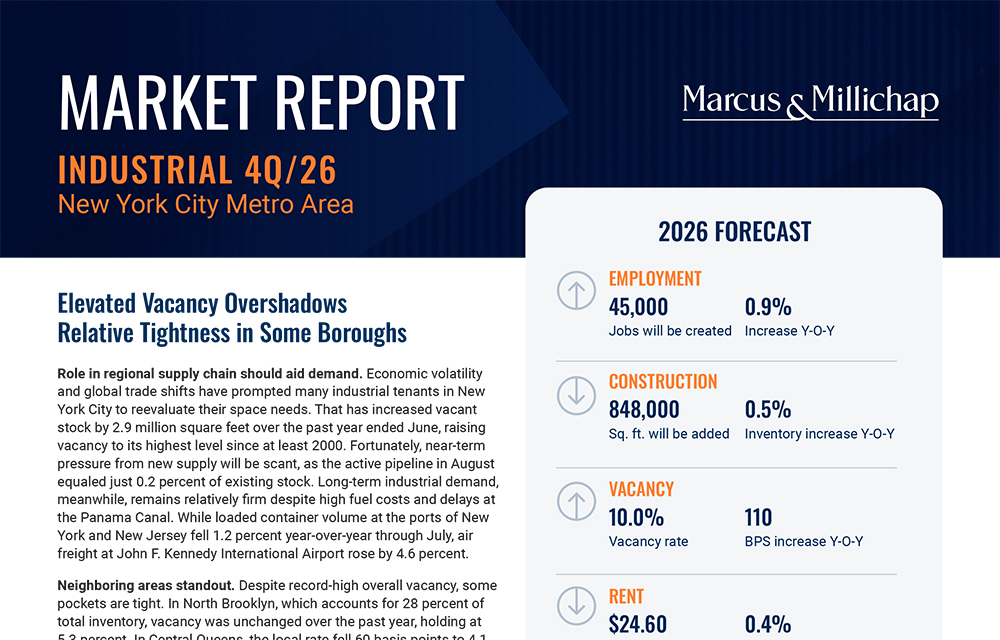
Marcus & Millichap releases fourth-quarter 2026 NYC industrial market report
Manhattan, NY Marcus & Millichap has published its fourth-quarter 2026 New York City Industrial Market Report. “New York City’s industrial market is showing a clear






 (2).gif)

Columns and Thought Leadership

Hunt CRE question and answer: Choosing a real estate agent - by David Hunt
First, we will only work with one agent exclusively. The primary reason is that we want that agent to legally represent our client’s interests. In New York State, a real estate agent has a fiduciary

Hunt commercial real estate question and answer: Fortune 500 wisdom - by David Hunt
Yes, there are lessons to be learned from the largest companies in America when comes to managing your real estate. But the decision to buy or lease real estate may not be one of

The art of investing in real estate - by Thomas Donovan
Real estate investing is as much an art as it is a skill. No one can time the market, or the factors that drive it, perfectly. Location, zoning, size, transportation, and neighborhood density give you a baseline for

New York’s streets are full again, and the retail numbers prove it - by Noam Aziz
Walk down any New York block this year and you can feel it. The sidewalks are crowded, the storefronts are lit, and the energy that defines this city is back at full volume.
.gif)