



News:
Brokerage
Posted: February 25, 2013
What are workplace strategies? How businesses find the right way to work
As companies continue to embrace the ongoing trend of creating open workspaces to enable greater efficiency and foster better communication, the most popular, ubiquitous term floating around is "workplace strategies." Everyone-from architects, to developers and owners, to tenants, have their own detailed interpretation-yet what does the term truly mean? Is there an overall definition? The simplest answer is the ability to realign a space according to how a company wants to work to maximize efficiency. Generally, offices have four major space functions for collaboration (conference room), socializing (cafeteria or lunch room), individual focusing (offices) and learning (library or research room). The idea behind work place strategy is to create a flexible, multifunctional space that addresses each necessary aforementioned area, but utilizes a smaller, streamlined and more cost-effective footprint.
Although technology and media companies seem to be the poster children for the face of the newly modeled office design, the concept is not industry specific. Businesses from traditional high-end financial firms, powerful cosmetic companies, large defense contractors and even real estate service companies are all looking for ways to increase efficiencies and decrease the amount of physical workspace required.
Workplace strategies can work for any industry and any requirement - the customized plan is modified to meet the needs of that particular group. Since the financial industry tends to cling to the more traditional corner office model, the workspace plan used for this industry will reserve open office or benching areas for more junior staff, with large conference rooms placed adjacent to corner offices (which most likely will be smaller than the previous norm). Smaller lounge-type rooms often dubbed, deal rooms encourage collaboration, socializing and learning all in one space as opposed to three.
Cosmetics firms are also looking at more open and mixed-use spaces as a way to pool resources and connect corporate team members. Cafeterias often double as meeting or event rooms; designed in innovative and inviting ways with smaller tables and larger communal tables. These firms are also taking the opportunity to reinforce their brand identity and encourage creativity by using company products as artwork throughout the larger, more open space to inspire the next level of consumer success.
A client in the defense industry comes to mind as one of the most vivid examples of how changing the physical office environment can boost morale, productivity and reinvent a corporate image. Through strategic, thoughtful, planning space efficiency was increased by 3% (an impressively large number in context). It was achieved by literally taking down walls, moving away from the outdated idea that productive work needs to take place in a dedicated office. Instead of the office being a mere hive of worker bees plugging along, it became a central location for motivated staff to work together in teams, share knowledge and address strategic questions. In addition, large conference rooms were outfitted with sophisticated technology for global interaction. Flexible room design empowered the company to use the space for multiple purposes including lectures and classes, meetings and breakout sessions.
In Cassidy Turley's New York office, we lead by example and truly practice what we preach by implementing our own preferred work place strategy model. Rather than a large office in every corner, we have teaming rooms. Our reception area includes multiple glass-walled conference rooms and an open café/kitchen. Much of our seating is open or cubicled with no or low-glass walls, and walls of offices and conference rooms are whiteboards. The changes are noticeable in many ways, including interaction and collaboration between different groups. Our agile ability to work remotely also allowed for a quicker response in the wake of an emergency like superstorm Sandy.
Every company can incorporate, at least on some level, a work place strategy by breaking down and understanding exactly how they run day-to-day business. Easy and inexpensive modifications range from incorporating flexible design in conference rooms so tables can be reconfigured from one larger table to individual smaller ones. Even looking and questioning the role walls play in an office can be a solution. Walls are not merely dividers they can also be conversation or brainstorm igniters with a simple (and cost-effective) application of whiteboard paint. Ultimately, workplace strategy is about increasing productivity-whether it be through bottom line impact of decreasing the space per employee or through increased production and productivity through creative design solutions. The flexibility of an office space to accommodate multiple work styles has never been more critical to the success of the enterprise.
Joseph Yacovone, LEED, AP is the senior managing director at Cassidy Turley, New York, N.Y.
Tags:
Brokerage
MORE FROM Brokerage
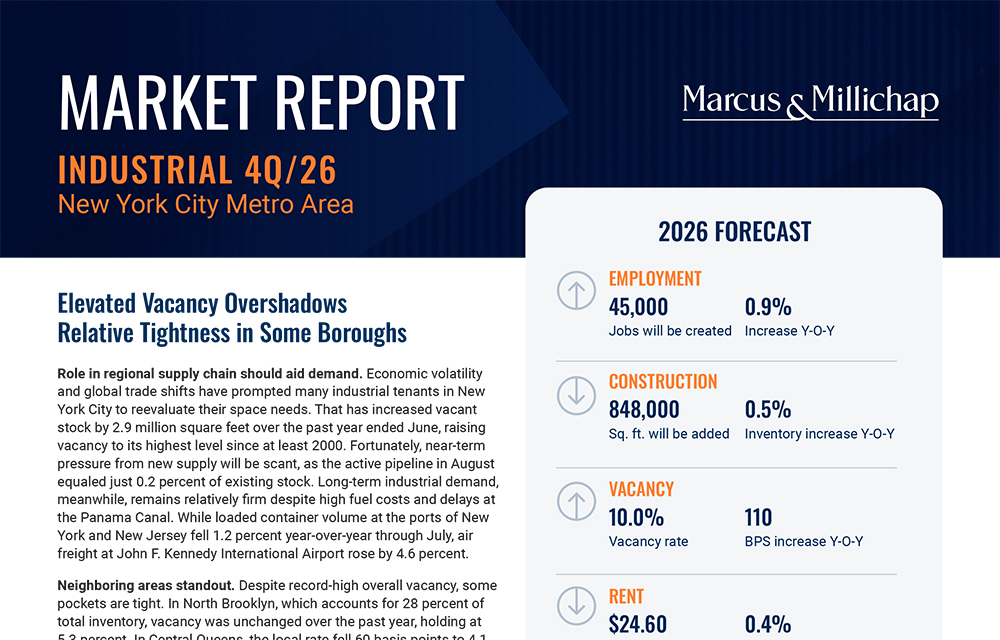
Marcus & Millichap releases fourth-quarter 2026 NYC industrial market report
Manhattan, NY Marcus & Millichap has published its fourth-quarter 2026 New York City Industrial Market Report. “New York City’s industrial market is showing a clear




Quick Hits
 (2).gif)

Columns and Thought Leadership

Hunt commercial real estate question and answer: Fortune 500 wisdom - by David Hunt
Yes, there are lessons to be learned from the largest companies in America when comes to managing your real estate. But the decision to buy or lease real estate may not be one of

Hunt CRE question and answer: Choosing a real estate agent - by David Hunt
First, we will only work with one agent exclusively. The primary reason is that we want that agent to legally represent our client’s interests. In New York State, a real estate agent has a fiduciary

New York’s streets are full again, and the retail numbers prove it - by Noam Aziz
Walk down any New York block this year and you can feel it. The sidewalks are crowded, the storefronts are lit, and the energy that defines this city is back at full volume.

The art of investing in real estate - by Thomas Donovan
Real estate investing is as much an art as it is a skill. No one can time the market, or the factors that drive it, perfectly. Location, zoning, size, transportation, and neighborhood density give you a baseline for
.gif)