



News:
Brokerage
Posted: December 14, 2021
The Doe Fund affordable/supportive housing residence wins Queens & Bronx building association award

New York, NY The Doe Fund‘s Villa House residence won the Excellence in Residential Apartment Buildings Award from the Queens & Bronx Building Association. With more than 300 member companies, the QBBA has been one of New York City’s leading construction-related trade organizations since 1967.
Villa House, located at 3188 Villa ave. in the Bronx, is home to over 68 residents. Originally opened in 2020, Villa House was designed by DeLaCour Ferrara & Church Architects and the building contractor was Mega Contracting Group, LLC.
Sixty percent of the 10-story building’s units are reserved for formerly homeless individuals, while the remaining 40 percent are occupied by individuals and households formerly on the NYCHA waitlist. The Doe Fund provides onsite supportive services to residents, including comprehensive case management, linkages to health care, and other critical services..
“We are very proud and fortunate to have worked with The Doe Fund’s amazing team and the talented DeLaCour Ferrara & Church Architects to construct this beautiful building that will provide much needed quality affordable housing to many New York families.” Hercules Argyriou of Mega Contracting Group, a member of the QBBA.
“The Villa Avenue project is a testament to The Doe Fund’s commitment to affordable and supportive housing. QBBA is excited and honored to present the Excellence in Residential Apartment Buildings to The Doe Fund,” said George Poulon, president of the Queens & Bronx Building Association.
John McDonald, executive vice president of The Doe Fund, said, “We are honored to receive this acknowledgment from the Queens & Bronx Building Association. Villa House—and more supportive and deeply affordable housing—will be an essential component of New York City’s inclusive recovery. When we invest in this kind of desperately needed housing, we’re investing in entire communities that for too long have gone underserved. We’re investing in solutions to the homelessness and housing crises. We’re investing in human capital and dignity.”
Tags:
Brokerage
MORE FROM Brokerage
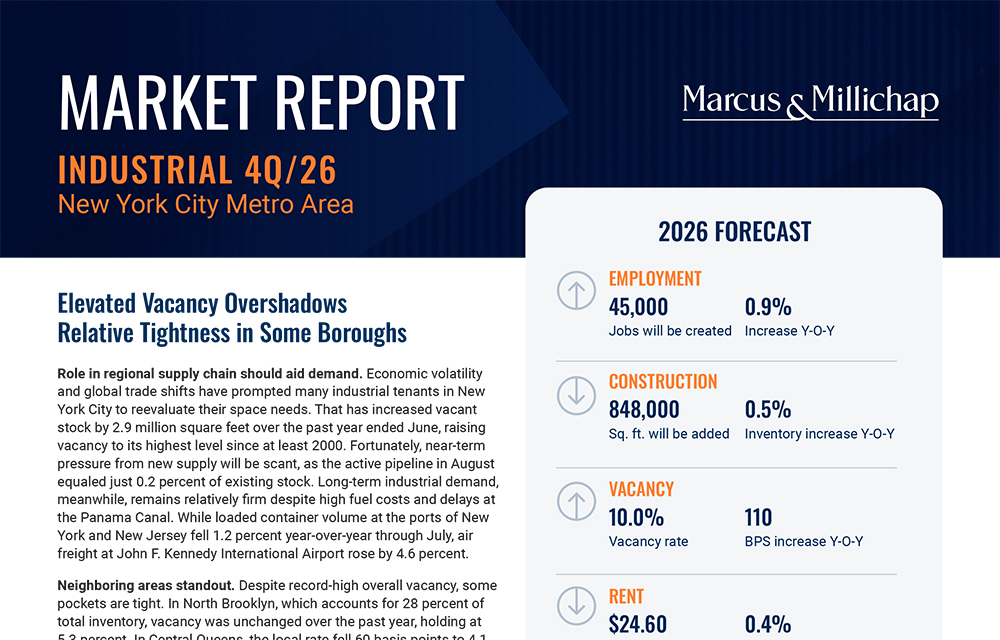
Marcus & Millichap releases fourth-quarter 2026 NYC industrial market report
Manhattan, NY Marcus & Millichap has published its fourth-quarter 2026 New York City Industrial Market Report. “New York City’s industrial market is showing a clear





Quick Hits

Columns and Thought Leadership

Hunt commercial real estate question and answer: Fortune 500 wisdom - by David Hunt
Yes, there are lessons to be learned from the largest companies in America when comes to managing your real estate. But the decision to buy or lease real estate may not be one of

New York’s streets are full again, and the retail numbers prove it - by Noam Aziz
Walk down any New York block this year and you can feel it. The sidewalks are crowded, the storefronts are lit, and the energy that defines this city is back at full volume.

Hunt CRE question and answer: Choosing a real estate agent - by David Hunt
First, we will only work with one agent exclusively. The primary reason is that we want that agent to legally represent our client’s interests. In New York State, a real estate agent has a fiduciary

The art of investing in real estate - by Thomas Donovan
Real estate investing is as much an art as it is a skill. No one can time the market, or the factors that drive it, perfectly. Location, zoning, size, transportation, and neighborhood density give you a baseline for
.gif)