



News:
Brokerage
Posted: February 18, 2011
The benefits of a downtown location for businesses and employees
Downtowns offer unique opportunities that cannot be found in suburban office parks. They are steeped in history, have amazing architecture, and offer a rich diversity of people and businesses. Our urban cores provide the following benefits: economic development tools, increased quality of life, networking opportunities, and amenities.
Many downtowns have Business Improvement Districts (BID) or Local Development Corporations (LDC) that are focused on developing and revitalizing our central business districts. Both organizations serve as great tools for businesses, developers, property owners, and residents. BIDs provide free and discounted marketing opportunities for businesses through their websites, newsletters, publications, social media outlets, and advertising campaigns. Both BIDs and LDCs can identify and help secure grant programs to make improvements to buildings or public spaces within the downtown area. They also offer business development seminars on topics ranging from small business assistance like public relations and social media training to succession planning and human resources issues to seminars for developers with larger development project that outline available grants and incentives. Many have attraction and retention programs that a business can access to assist with low interest loans, parking incentives, energy efficiency, and more.
The quality of the life that companies and employees can enjoy is enhanced in a downtown environment. With a downtown office location gone are the days of needing to walk to another building for the cafeteria or get in your car to drive to the one or two lunch options close by. In Downtown Albany alone there are more than 85 restaurant choices all within walking distance. In the summer districts offer farmers' markets, a public art exhibits, music concerts, and special events. Downtowns offer great park/green spaces and many are connected to riverfronts which employees can access on their lunch hour or after work. Most downtowns have a thriving entertainment district with premier arts and cultural organizations that attract a younger workforce.
With the high density of employees in the central business district, networking happens on the way to the bank or grabbing your morning coffee. In Albany we have roughly 40,000 employees within a 50 block area. These are all potential customers right outside your front door. More business is done on the sidewalks of downtown or at nearby bar or restaurant just steps from one's office. BIDs also offer free or nominally priced networking events and opportunities for the businesses in their districts. Many offer business to business promotions working to encourage purchasing services from other downtown companies.
Downtowns offer numerous amenities that provide ease or convenience for both employers and employees. Public transportation runs more frequently. Designated car pooling options are available because of the number of employees traveling into the downtown area. Copy stores, office supply stores, shipping options and Post Offices are all within walking distance. Pharmacies, hair salons, and retailers offer the ease of running errands during breaks in the workday rather than invading personal time at the end of the day.
These are the things that today's employee is looking for which are uniquely offered in an urban setting. Businesses and employees are seeking out of the box experiences and interactions on a daily basis and downtowns are where they can be found.
Georgette Steffens is the executive director for the Downtown Albany Business Improvement District, Albany, N.Y.
Tags:
Brokerage
MORE FROM Brokerage
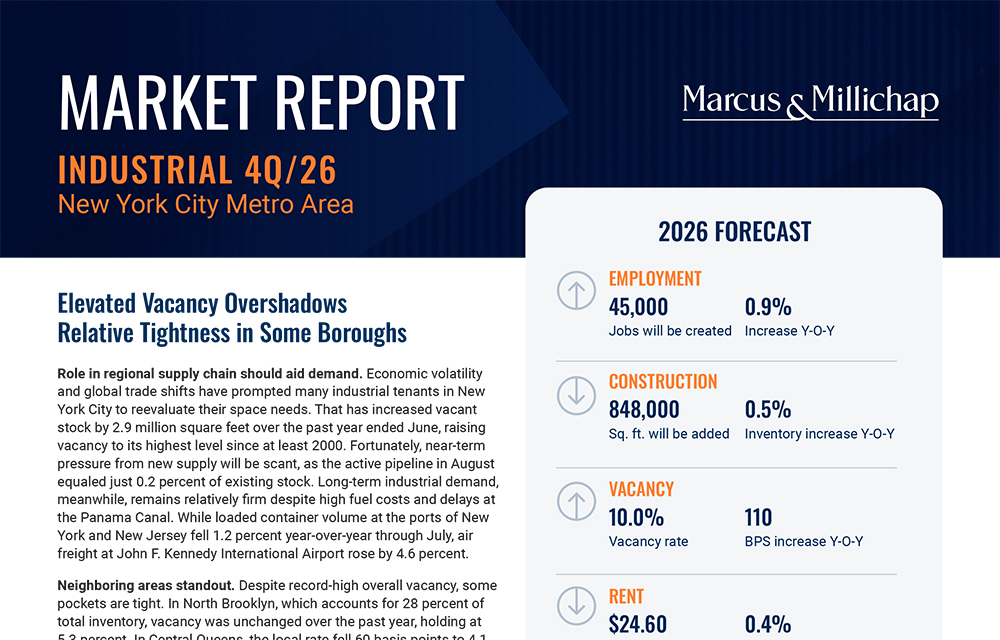
Marcus & Millichap releases fourth-quarter 2026 NYC industrial market report
Manhattan, NY Marcus & Millichap has published its fourth-quarter 2026 New York City Industrial Market Report. “New York City’s industrial market is showing a clear




 (2).gif)

Columns and Thought Leadership

Hunt commercial real estate question and answer: Fortune 500 wisdom - by David Hunt
Yes, there are lessons to be learned from the largest companies in America when comes to managing your real estate. But the decision to buy or lease real estate may not be one of

The art of investing in real estate - by Thomas Donovan
Real estate investing is as much an art as it is a skill. No one can time the market, or the factors that drive it, perfectly. Location, zoning, size, transportation, and neighborhood density give you a baseline for

New York’s streets are full again, and the retail numbers prove it - by Noam Aziz
Walk down any New York block this year and you can feel it. The sidewalks are crowded, the storefronts are lit, and the energy that defines this city is back at full volume.

Hunt CRE question and answer: Choosing a real estate agent - by David Hunt
First, we will only work with one agent exclusively. The primary reason is that we want that agent to legally represent our client’s interests. In New York State, a real estate agent has a fiduciary
.gif)