



News:
Brokerage
Posted: February 18, 2011
NYSERDA provides incentives to reduce energy costs
According to the New York State Energy Research and Development Authority (NYSERDA), 212 Western New York businesses are reducing energy costs by a total of $2.4 million annually as a result of energy efficiency upgrades and sustainable building projects supported by NYSERDA during 2010.
The energy savings - 15.5 million kilowatt hours - is equivalent to the amount of electricity consumed by 2,246 single-family homes annually.
"NYSERDA commends these leaders in the Western New York business community for their commitment to more environmentally sustainable business practices," said Francis Murray Jr., president and CEO of NYSERDA. "We encourage other companies to apply for the incentives available in 2011."
Statewide, NYSERDA commercial and industrial incentives supported more than 2,800 projects during 2010, helping companies reduce operating costs by $40 million.
NYSERDA provided more than $2 million in incentives to Western New York companies to make energy efficiency projects more affordable, enhance competitiveness and cut costs for businesses. These incentives are available in every sector of the economy, including retail, manufacturing, hospitality, health care, agricultural, commercial and industrial, and others.
Payback on these projects is approximately three to five years. Western New York businesses that made performance-based upgrades are saving an average of $33,660 annually. Performance-based projects not only save energy but also improve productivity by lowering equipment maintenance and operating costs.
Examples of 2010 energy-saving projects at Western New York companies include:
* Exel Logistics Inc., in Lockport, replaced inefficient high-pressure sodium light fixtures with more efficient lighting and occupancy sensors at its 250,000 s/f warehouse and distribution center. The project will help reduce annual energy costs by more than $100,000, decrease electricity consumption by more than 620,000 kilowatt hours.
* The Walker Center, in Williamsville, installed 14 high-efficiency HVAC units. The project will help reduce the plaza's annual energy costs by more than $4,000 and decrease electricity consumption by more than 25,000 kilowatt hours.
* APP Pharmaceuticals, in Grand Island, installed a 250-horsepower energy-efficient air compressor at its manufacturing facility. The project will help reduce annual energy costs and decrease electricity consumption by nearly 1 million kilowatt hours.
* Rite Aid pharmacies in Buffalo, Niagara Falls, Depew, Cheektowaga, Alden, North Tonawanda, Derby, Hamburg, Lockport and Silver Creek replaced existing store lighting systems with new energy-efficient fixtures and ballasts. The project will help reduce annual energy costs by more than $41,000 and decrease annual electricity consumption by more than 255,000 kilowatt hours.
In existing facilities, NYSERDA incentives can be used for lighting retrofits, upgrades to motors, heating and cooling systems, and other operations, as well as co-generation combined heat and power systems. Assistance also is available for energy audits to identify additional opportunities to increase energy efficiency, greenhouse gas emission inventories and more.
For new construction, NYSERDA offers technical support to building design teams and financial incentives to building owners for using green building practices.
Since 2000, NYSERDA has supported approximately 1,000 commercial and industrial energy efficiency projects in Western New York.
These projects are realizing more than $15 million in energy cost savings annually and have reduced electricity consumption by 93 million kilowatt hours-the equivalent to the annual amount of electricity consumed by more than 14,000 single-family homes. NYSERDA provided $11.3 million in funding for the projects.
Tags:
Brokerage
MORE FROM Brokerage
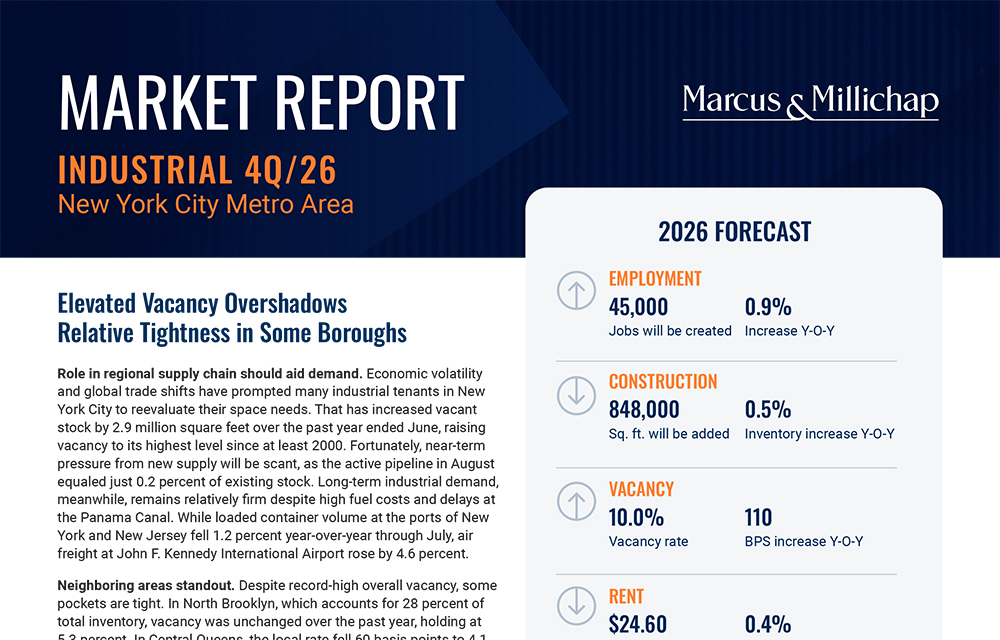
Marcus & Millichap releases fourth-quarter 2026 NYC industrial market report
Manhattan, NY Marcus & Millichap has published its fourth-quarter 2026 New York City Industrial Market Report. “New York City’s industrial market is showing a clear





Quick Hits

Columns and Thought Leadership

New York’s streets are full again, and the retail numbers prove it - by Noam Aziz
Walk down any New York block this year and you can feel it. The sidewalks are crowded, the storefronts are lit, and the energy that defines this city is back at full volume.

The art of investing in real estate - by Thomas Donovan
Real estate investing is as much an art as it is a skill. No one can time the market, or the factors that drive it, perfectly. Location, zoning, size, transportation, and neighborhood density give you a baseline for

Hunt commercial real estate question and answer: Fortune 500 wisdom - by David Hunt
Yes, there are lessons to be learned from the largest companies in America when comes to managing your real estate. But the decision to buy or lease real estate may not be one of

Hunt CRE question and answer: Choosing a real estate agent - by David Hunt
First, we will only work with one agent exclusively. The primary reason is that we want that agent to legally represent our client’s interests. In New York State, a real estate agent has a fiduciary
.gif)