



News:
Brokerage
Posted: October 7, 2011
Small and large stores: A winning combination
A neighborhood shopping strip with no pharmacies? No banks nearby? Desirable new stores discouraged from opening? Local retail businesses unable to expand in their own neighborhoods? Sounds like a recipe for retail disaster. Nonetheless, the New York City Department of City Planning is considering advancing zoning regulations that would limit the types and size of stores that could locate in our neighborhoods and make it harder for the stores and services we all use regularly to open.
Healthy neighborhoods welcome a diverse mix of uses that complement each other. Manhattan's Upper West Side, one of the most popular residential neighborhoods, hosts several vibrant retail corridors that serve both local residents and eager shoppers from around the city. What makes these retail streets tick? Quite simply it's the mix of uses and types of stores that meet the needs of every audience. In the course of the day, one can pick up groceries and health products, do some banking and get pet supplies. On the same streets, one can explore home décor, clothing and jewelry shops, buy books and wine and kid's clothes and toys. As well as enjoy the exciting bars and restaurants as well as more casual coffee, sandwich and pizza shops.
The city's retail proposal would put artificial and unnecessary limits on the size of each storefront in each building along Broadway from 72nd to 110th St., Amsterdam Ave. from 73rd to 87th St. and to 97th St. in addition to Columbus Ave. from 72nd to 87th St. On Amsterdam and Columbus, the proposal would limit store frontage to 40 ft. and no more than two establishments per 50 ft. of frontage. On all three avenues, banks would be limited to 25 ft. of frontage. Banks typically fill a larger storefront and this rule would force banks to locate on inconvenient and often non-existent second floor space.
Zoning restrictions on storefront size would be devastating from both from an economic perspective and a neighborhood planning perspective. Use restrictions legislated in the zoning resolution tend to long outlast any relevance they may have once had, since market and consumer preferences change frequently and zoning laws intended to protect and promote small stores would be extremely hard to change once they are enacted. The city has actually tried zoning regulations of this type before in the Garment Center for apparel manufacturers only to realize later that it was ineffective and hurt our economy and it has been difficult to modify or undo those rules.
Many retail brokers agree that this plan ignores the natural market forces that lead different types of stores to locate on Broadway, Amsterdam and Columbus Aves., based on the configuration of space needed and the rental rates. The type of uses on these avenues continues to change as the market for goods and services changes. The city says it is responding to concerns voiced by some in the community that there are too many banks or too many large stores. Whatever the cause of these perceptions, the reality is that banks, larger stores and smaller boutiques are all thriving on the Upper West Side, providing jobs, tax revenue and a diverse shopping experience. Let's not try to "fix" something that isn't broken and put an end to this ill-advised zoning proposal.
Steven Spinola is the president of REBNY, New York, N.Y.
Tags:
Brokerage
MORE FROM Brokerage
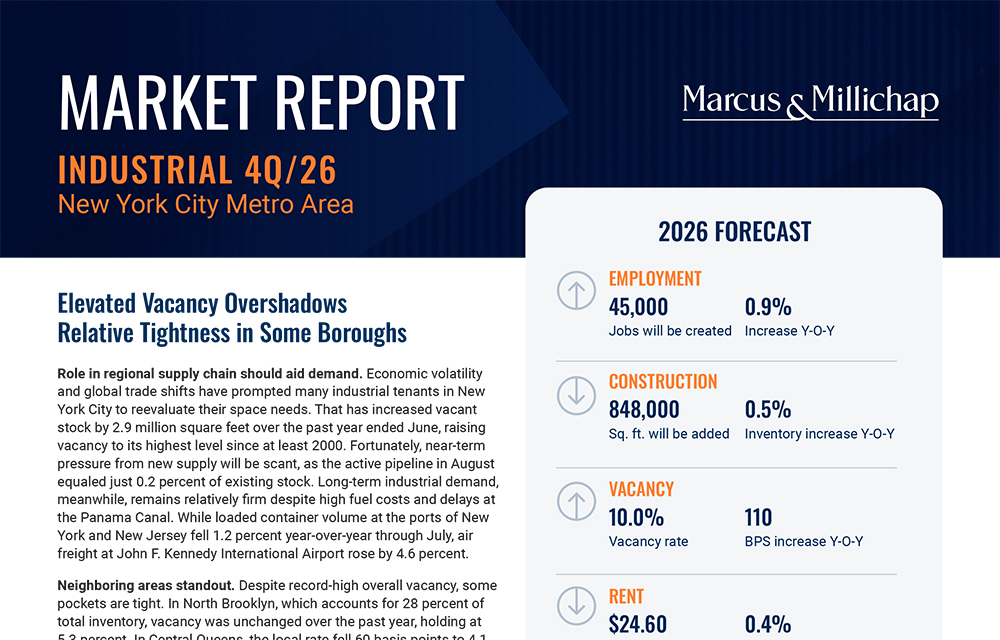
Marcus & Millichap releases fourth-quarter 2026 NYC industrial market report
Manhattan, NY Marcus & Millichap has published its fourth-quarter 2026 New York City Industrial Market Report. “New York City’s industrial market is showing a clear






Quick Hits
 (2).gif)

Columns and Thought Leadership

Hunt CRE question and answer: Choosing a real estate agent - by David Hunt
First, we will only work with one agent exclusively. The primary reason is that we want that agent to legally represent our client’s interests. In New York State, a real estate agent has a fiduciary

New York’s streets are full again, and the retail numbers prove it - by Noam Aziz
Walk down any New York block this year and you can feel it. The sidewalks are crowded, the storefronts are lit, and the energy that defines this city is back at full volume.

Hunt commercial real estate question and answer: Fortune 500 wisdom - by David Hunt
Yes, there are lessons to be learned from the largest companies in America when comes to managing your real estate. But the decision to buy or lease real estate may not be one of

The art of investing in real estate - by Thomas Donovan
Real estate investing is as much an art as it is a skill. No one can time the market, or the factors that drive it, perfectly. Location, zoning, size, transportation, and neighborhood density give you a baseline for
.gif)