



News:
Brokerage
Posted: August 16, 2016
Seeking Infrastructure: Letting the river flow by Barbara Champoux
 Barbara Champoux, Champoux Law Group
As discussed in the first series article, “Seeking Infrastructure: The Problem” (http://nyrej.com/80812), countries around the world are experiencing severe infrastructure needs because of growing populations, economic growth, increasing urbanization, and aging legacy assets. Continuing a necessary infrastructure discussion, this month’s article focuses on water – simple, overlooked and critically important to our survival.
Safe drinking water is a prerequisite for protecting public health and all human activity. Properly treated wastewater and stormwater is vital for preventing disease and protecting the environment. Furthermore, critical services, such as firefighting and healthcare (hospitals), and other dependent and interdependent sectors, such as energy, food and agriculture, manufacturing and transportation systems would suffer adverse impacts from a denial of water and wastewater infrastructure (i.e., the network for collection, treatment, and disposal of sewage and stormwater in a community including pipes, sewage treatment plants, outfalls, etc.). Ensuring the supply of drinking water and wastewater treatment and service is therefore essential to modern life and the nation’s economy.
There are approximately 153,000 public drinking water systems and more than 16,000 publicly owned wastewater treatment systems in the United States. More than 80% of the U.S. population receives their potable water from these drinking water systems, and about 75% of the U.S. population has its sanitary sewerage treated by these wastewater systems.
Buried drinking water infrastructure is estimated to need more than $1.7 trillion nationwide through 2050, assuming pipes (comprising about 75% of aggregate needs) are replaced at the end of their service lives and systems are expanded to serve growing populations. Replacement needs account for about 54% of the national total, with about 46% attributable to population growth and migration over that period.
With many of its treatment facilities operating beyond their useful life, and facing more stringent water quality requirements, and newly created and larger numbers of industrial and household chemicals, New York anticipates approximately $36 billion will be required to meet its wastewater infrastructure needs over the next 20 years. Every year, old sewers flooded by stormwater release more than 27 billion gallons of untreated sewage into the New York Harbor alone.
Overlooking, delaying and/or postponing infrastructure renewal investments in the near term will only add to the scale of the challenge we face in the years to come from increasing rates of pipe breakage and deteriorating water service, and suboptimal use of utility funds, such as paying more to repair broken pipes than the long-term cost of replacing them. If left unaddressed, the effects of aging sewage treatment plants will result in severe degradation of the nation’s waterbodies and other water resources from under-treated and untreated sewage, street waste, and nutrient pollution, jeopardizing the viability of current and future businesses, stymying economic growth and development, and threatening our quality of life.
Upcoming Infrastructure Series articles will discuss the financing and other challenges we must overcome to ensure that we do not face the dire consequences of inadequate and deteriorating water and wastewater infrastructure.
Barbara Champoux, Esq., is a board member and past president of the CREW New York Network, New York, N.Y.
Tags:
Brokerage
MORE FROM Brokerage
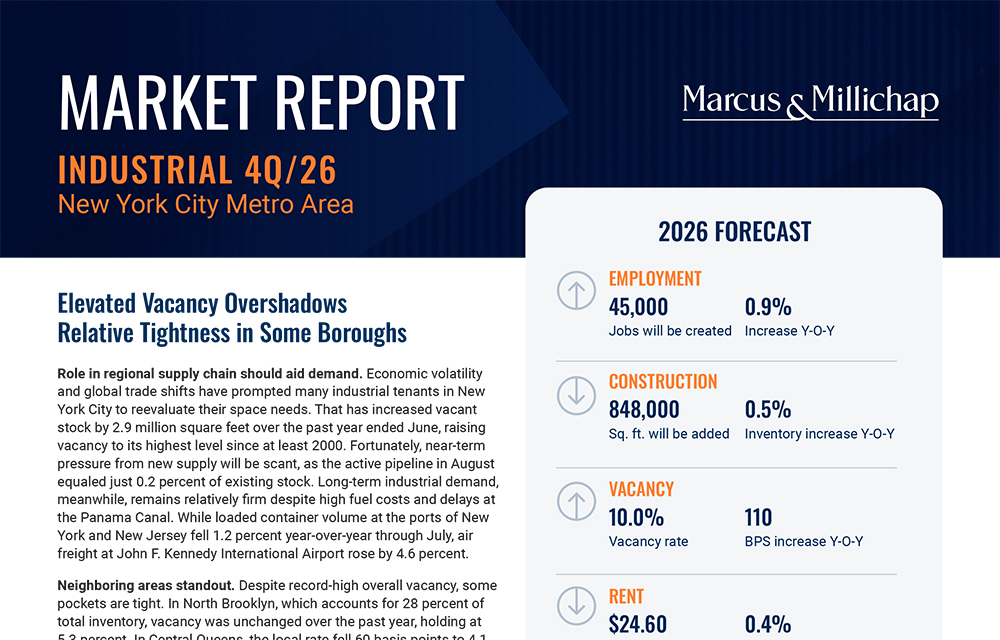
Marcus & Millichap releases fourth-quarter 2026 NYC industrial market report
Manhattan, NY Marcus & Millichap has published its fourth-quarter 2026 New York City Industrial Market Report. “New York City’s industrial market is showing a clear






Columns and Thought Leadership

The art of investing in real estate - by Thomas Donovan
Real estate investing is as much an art as it is a skill. No one can time the market, or the factors that drive it, perfectly. Location, zoning, size, transportation, and neighborhood density give you a baseline for

Hunt commercial real estate question and answer: Fortune 500 wisdom - by David Hunt
Yes, there are lessons to be learned from the largest companies in America when comes to managing your real estate. But the decision to buy or lease real estate may not be one of

New York’s streets are full again, and the retail numbers prove it - by Noam Aziz
Walk down any New York block this year and you can feel it. The sidewalks are crowded, the storefronts are lit, and the energy that defines this city is back at full volume.

Hunt CRE question and answer: Choosing a real estate agent - by David Hunt
First, we will only work with one agent exclusively. The primary reason is that we want that agent to legally represent our client’s interests. In New York State, a real estate agent has a fiduciary
.gif)