



News:
Brokerage
Posted: April 25, 2023
REBNY Manhattan office building visitation report shows prime class A buildings continue to post higher visitation rates than class B properties

The Real Estate Board of New York (REBNY) released analysis of Q1 2023 Placer.ai location data in 250 Manhattan office buildings representing approximately 180 million s/f. The report, the first in what will become a regular quarterly report from REBNY, highlights a year-over-year increase in building visitations, while also finding that visitation rates have remained relatively stable for the last several quarters. Of note, the report also found a widening gap between activity in prime Class A properties compared to other property classes.
This report comes at a time of significant demand from real estate industry participants and policymakers for data that can help identify the health of New York City’s office sector. In light of recent challenges in the banking system and discussions about the future of the City’s central business districts, the data in this report sheds light on the performance of the various segments of the Manhattan office market. Given that office buildings account for about 20% of the City’s property tax collection in any given year, a nuanced understanding of building visitation and performance is also critical to the City’s finances moving forward.
Key findings from REBNY’s analysis of Placer.ai mobile device data from Manhattan office buildings in Q1 2023 indicates:
- Average building visitation rates were 61% of the pre-pandemic baseline, a significant increase from 51% during Q1 2022. However, visitation rates have essentially plateaued since reaching a peak of 65% in mid-2022
- Visitation rates in nearly 60% of buildings exceeded 50% of pre-pandemic baselines.
- The highest quality Class A+ properties outperformed Class B by more than 10 percentage points
- Midtown posted an increase in visitation rates of 14 percentage points from Q1 2022, surpassing year-on-year gains of 6 percentage points in Downtown and 8 percentage points in Midtown South
Read the full analysis here.
“A healthy office market is critical to the future of New York City’s economy given the vital role that these buildings play in our central business districts and to the City’s finances,” said Keith DeCoster, director of Market Data and Policy at the Real Estate Board of New York. “The data provided in this report illuminates how different segments of the market are performing, which is vital to understanding the policy responses that are needed to further New York’s economic recovery. We look forward to continuing to provide timely insightful data that can help the public and private sectors work together to make smart decisions about how to help our city continue to grow.”
Accurately assessing the pace of office building visitations is helpful to understand the city’s overall economic recovery from the pandemic. A 10% increase in office occupancy could represent a potential return of between 100,000 and 200,000 workers to certain neighborhoods. Some studies have suggested that office workers spend an average of over $6,000 each per year on retail and services such as meals and dry cleaning, sustaining economic activity in submarkets across the city.
The office buildings analyzed in the report represent a diverse sample of office building classes and neighborhoods across New York City’s commercial districts. The combined s/f studied in this report accounts for roughly one-third of Manhattan's office stock.
Tags:
Brokerage
MORE FROM Brokerage
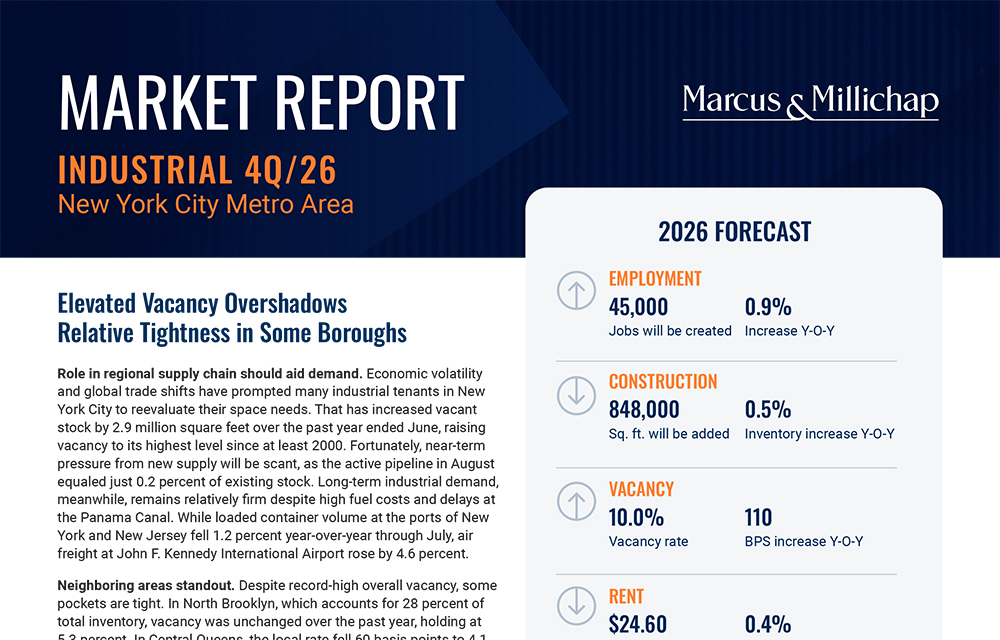
Marcus & Millichap releases fourth-quarter 2026 NYC industrial market report
Manhattan, NY Marcus & Millichap has published its fourth-quarter 2026 New York City Industrial Market Report. “New York City’s industrial market is showing a clear



Quick Hits
 (2).gif)

Columns and Thought Leadership

The art of investing in real estate - by Thomas Donovan
Real estate investing is as much an art as it is a skill. No one can time the market, or the factors that drive it, perfectly. Location, zoning, size, transportation, and neighborhood density give you a baseline for

Hunt CRE question and answer: Choosing a real estate agent - by David Hunt
First, we will only work with one agent exclusively. The primary reason is that we want that agent to legally represent our client’s interests. In New York State, a real estate agent has a fiduciary

Hunt commercial real estate question and answer: Fortune 500 wisdom - by David Hunt
Yes, there are lessons to be learned from the largest companies in America when comes to managing your real estate. But the decision to buy or lease real estate may not be one of

New York’s streets are full again, and the retail numbers prove it - by Noam Aziz
Walk down any New York block this year and you can feel it. The sidewalks are crowded, the storefronts are lit, and the energy that defines this city is back at full volume.
.gif)