



News:
Brokerage
Posted: April 22, 2013
REAP holds kick-off event for 2013 class at ICSC office
The Real Estate Associate Program (REAP) hosted a kick-off event for the incoming class of 2013 at the International Council of Shopping Centers office in the McGraw-Hill Building on Tuesday, March 5.
Hosted by Gregg McCort, REAP executive director and president, the event welcomed the 2013 class of professionals to a 13-week, 26-class horizontal education program. The program promotes diversity in commercial real estate by providing minority professionals with classes covering a variety of disciplines within the major real estate models, from financial analysis, to investment sales and property management. At the event, members of the incoming class heard alumni working in all facets of the industry share their experiences before attending a cocktail reception and networking hour.
REAP was originally founded in 1997 by Mike Bush in Washington, D.C. and has since expanded to operate in seven cities with major markets. The program serves as a bridge between minority professionals and commercial real estate companies looking for talent. Over 80 REAP Associates now work for leading firms in the industry, from Los Angeles to New York.
Many of the market's most prominent companies sponsor REAP, bringing in industry leaders to teach financial analysis, market analysis, brokerage, asset management, leasing and development. Instructors include experts from the International Council of Shopping Centers, Building Owners and Managers Association, the Apartment and Office Building Association, the Urban Land Institute, NAIOP and the National Multi Housing Council. Sponsors of the program also include Walmart, McDonald's, American Express, Simon Malls, Gap, Inc., Sperry Van Ness and Platinum Maintenance.
About the Real Estate Associate Program:
The Real Estate Associate Program (REAP) is an industry-backed, market-driven program that serves as a bridge between talented minority professionals and commercial real estate companies looking for talent. REAP exists because the commercial real estate industry's professional ranks are less than 1% minority at management levels—less than 1,000 people of color in an industry with over 125,000 professionals. During its short existence, REAP has increased that minority cohort by 10%—by spotlighting a talent pool that was always there, but previously unacknowledged. For further information on the Real Estate Associate Program, visit their website at www.projectreap.org.
Tags:
Brokerage
MORE FROM Brokerage
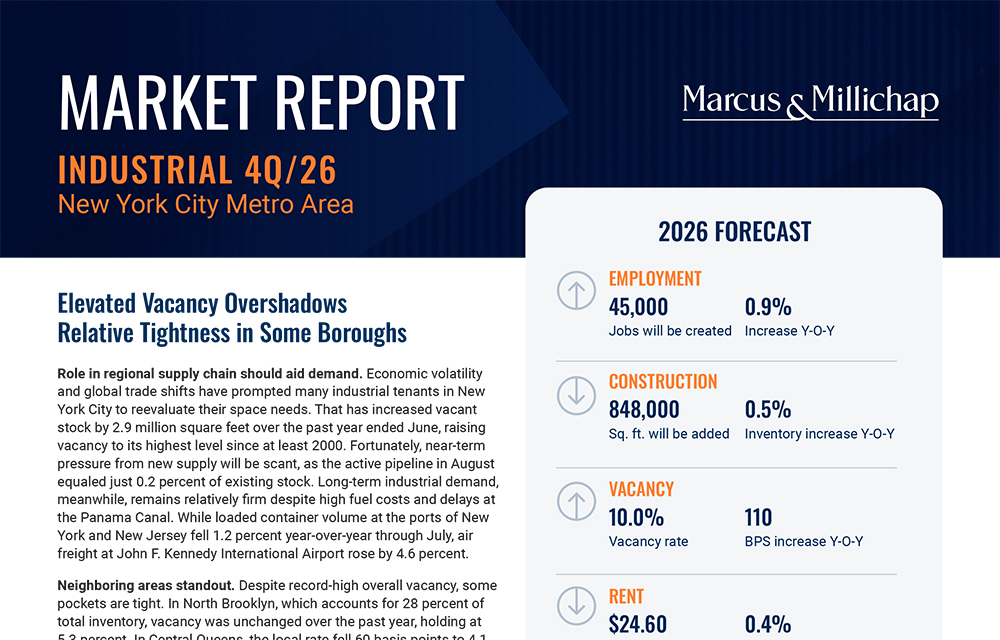
Marcus & Millichap releases fourth-quarter 2026 NYC industrial market report
Manhattan, NY Marcus & Millichap has published its fourth-quarter 2026 New York City Industrial Market Report. “New York City’s industrial market is showing a clear





Quick Hits
 (2).gif)

Columns and Thought Leadership

Hunt CRE question and answer: Choosing a real estate agent - by David Hunt
First, we will only work with one agent exclusively. The primary reason is that we want that agent to legally represent our client’s interests. In New York State, a real estate agent has a fiduciary

Hunt commercial real estate question and answer: Fortune 500 wisdom - by David Hunt
Yes, there are lessons to be learned from the largest companies in America when comes to managing your real estate. But the decision to buy or lease real estate may not be one of

The art of investing in real estate - by Thomas Donovan
Real estate investing is as much an art as it is a skill. No one can time the market, or the factors that drive it, perfectly. Location, zoning, size, transportation, and neighborhood density give you a baseline for

New York’s streets are full again, and the retail numbers prove it - by Noam Aziz
Walk down any New York block this year and you can feel it. The sidewalks are crowded, the storefronts are lit, and the energy that defines this city is back at full volume.
.gif)