



News:
Brokerage
Posted: February 14, 2023
Question of the Month: What is a Uniform Land Use Review Procedure (ULURP)? - by Christopher Wright

The New York City Zoning Resolution was enacted in 1961 to provide the city with a comprehensive urban planning scheme consisting of different zoning designations based on a property’s location within a neighborhood. The drafters of the Zoning Resolution understood that NYC’s urban landscape would evolve over time. Therefore, an amendment process was incorporated into the Zoning Resolution, no different in concept than the process to amend the U.S. Constitution. Both are living documents. The Uniform Land Use Review Procedure (ULURP) is the mechanism used to amend a property’s zoning designation within the NYC Zoning Resolution.
A ULURP rezoning application can have a public or private applicant. Public applications are filed by a city agency often seeking changes to an entire neighborhood to address growth. Private applications are filed by property owners seeking changes to their parcels, usually covering a few blocks.
Recent examples of public applications are DUMBO and Williamsburg, both for essentially the same purpose. Both neighborhoods were initially zoned in 1961 for manufacturing uses that reflected the port and waterfront industrial uses at that time. Over the years, pier use declined and vacant industrial buildings became attractive for residential use. However, this created an explosion of illegal residential conversions, since residential use is not permitted in the manufacturing zoning district. The city stepped in and rezoned both neighborhoods via ULURP to allow residential use. In these cases, the city planning agencies made a policy decision to change the zoning designations to reflect the neighborhood’s changing needs. The pier industry was gone and the vacant buildings and underdeveloped land offered prime residential development opportunities along the waterfront. Large scale rezoning of neighborhoods such as these usually include the creation of public amenities, for example, the creation of public esplanades, as occurred in these zoning actions.
Private ULURP applications tend to be smaller in scale, usually covering only a few city blocks. The applicant is usually a private developer that owns multiple properties within a city block. The private application makes the case that the current zoning is obsolete and a that a rezoning will foster a project by the developer that addresses community needs such as housing, parking, schools or all of the above.
However, a private application will also rezone parcels not owned by the developer because it is not permissible to simply rezone a few midblock parcels. The entire block must be rezoned to provide planning continuity, similar to the objectives of a public application.
There are two main phases to a ULURP application. The first phase is application review. The applicant drafts the application and then conducts meetings with the applicable city agencies and community leaders. This always includes the city planning commission, but may also include other agencies such as transportation, housing, buildings and even the MTA, depending on the reach of the application. The objective is to prepare an application that measures the impact on the subject neighborhood and mitigates any negative impacts. For example, if the rezoning causes an increase in traffic this may require the installation of turning lanes or possibly traffic lights to keep pedestrians safe. In some cases, subway station improvements are required to address usage increases. Another example is that land contaminated by prior uses may need to be cleaned up to make it safe for residential use.
The second phase is the public hearing process. This requires public hearings by the local community board, borough president, city planning commission and the city council. All four conduct public hearings, where the application is presented and the community testifies. Each agency then casts a vote either for or against approval and in some cases with approval conditions, such as installing traffic lights.
It should be noted that the community board and borough president votes are advisory. These votes cannot defeat an application, but negative votes will raise issues of concern that must be addressed at the city planning and city council hearings. The votes of city planning and the city council are mandatory and both must vote in favor or the application is denied.
The application review phase will take at least a year and perhaps more depending on the complexity of the rezoning. The DUMBO and Williamsburg applications were internally reviewed for years. This timeframe is needed to make sure that every impact of the rezoning, both positive and negative, is fully identified and addressed before commencing the public hearing phase.
The public hearing phase has a fixed time frame that is set by statute at no more than seven months. Collectively, the four city agencies have seven months to conduct hearings and cast votes. The mayor has final veto power, but this is rarely used since by that time all issues have usually been resolved.
Although it may seem that the ULURP timeframe to rezone is too long and complex to promote timely development, it should be noted that a rezoning can permanently change a neighborhood’s character. Rezoning a manufacturing district to residential or rezoning a city block to allow larger buildings alters the urban landscape. There is an existing community that will have to absorb and live with these revisions, so it is important that the application is comprehensive in its analysis of impacts. It is also important to give the impacted community a chance to express its concerns and seek mitigation measures. This will avoid legal challenges to the application on the grounds that negative impacts were not addressed. Ideally, a ULURP application is a private-public partnership that promotes and achieves comprehensive urban planning for the City’s evolving communities.
Christopher Wright, Esq., is a partner with Lasser Law Group, PLLC, Manhattan, NY.
Tags:
Brokerage
MORE FROM Brokerage
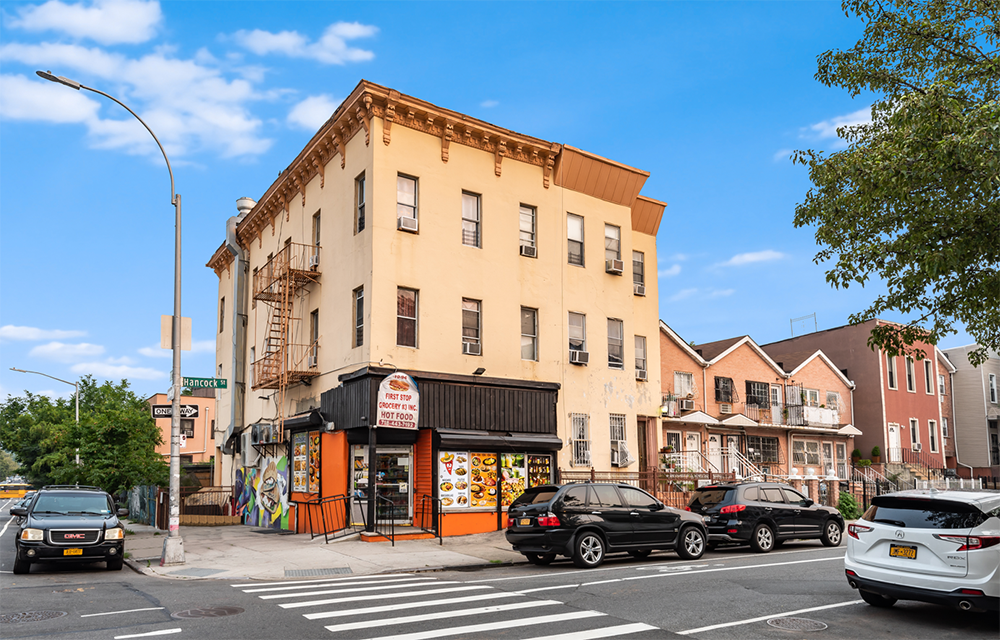
Investment Property Realty Group closes $1.75 million sale of 1094 Hancock Street in Brooklyn
Brooklyn, NY Investment Property Realty Group (IPRG), a New York-based commercial investment firm, has closed the sale of 1094 Hancock St., a mixed-use building in the Bushwick section, for $1.75 million.


Quick Hits

Columns and Thought Leadership

Hunt CRE question and answer: Choosing a real estate agent - by David Hunt
First, we will only work with one agent exclusively. The primary reason is that we want that agent to legally represent our client’s interests. In New York State, a real estate agent has a fiduciary

New York’s streets are full again, and the retail numbers prove it - by Noam Aziz
Walk down any New York block this year and you can feel it. The sidewalks are crowded, the storefronts are lit, and the energy that defines this city is back at full volume.

Hunt commercial real estate question and answer: Fortune 500 wisdom - by David Hunt
Yes, there are lessons to be learned from the largest companies in America when comes to managing your real estate. But the decision to buy or lease real estate may not be one of

A guide to finding the right NYC property management company - by Sanjay Gandhi
Being a small to midsize landlord in NYC is an increasingly demanding endeavor. From navigating complex regulations, increased compliance demands to dealing with tenant issues and remediating violations. It is wise to enlist the assistance of a partner, a professional
.gif)