



News:
Brokerage
Posted: May 7, 2019
Question of the Month: Can a zoning lot consisting of more than one tax lot include partial tax lots, or must it include the full lot? - by Christopher Wright

Capell Barnett Matalon & Schoenfeld LLP
There was a recent Manhattan Supreme Court decision regarding the definition of a zoning lot. The matter involved three proceedings. First, an application was submitted to the Dept. of Buildings seeking permits to construct a 55-story residential building based on a zoning lot that included partial tax lots. Second, the zoning lot was appealed to the Board of Standards and Appeals (BSA) alleging that the zoning lot’s use of partial tax lots did not comply with zoning regulations. Third, after the BSA upheld the zoning lot, a lawsuit was filed alleging that the zoning lot was faulty and that the BSA was in error. The court reversed the BSA.
Although these proceedings involved complex zoning arguments, the central issue is relatively straight forward. The question to be decided is: Can a zoning lot that consists of more than one tax lot (a “combined zoning lot”) include a portion of another tax lot or must it include the entire tax lot?
Tax lots are combined into a single zoning lot for the purpose of transferring development rights or other zoning requirements between the tax lots to achieve a more efficient development scenario.
The combined zoning lot was being used to construct a 55-story building located at 200 Amsterdam Ave. that abuts the Lincoln Towers residential complex located between Amsterdam and West End Aves. between 66th and 70th Sts. Lincoln Towers houses several thousand apartments and has large open areas between the buildings that are used as yards and driveways for the residents.
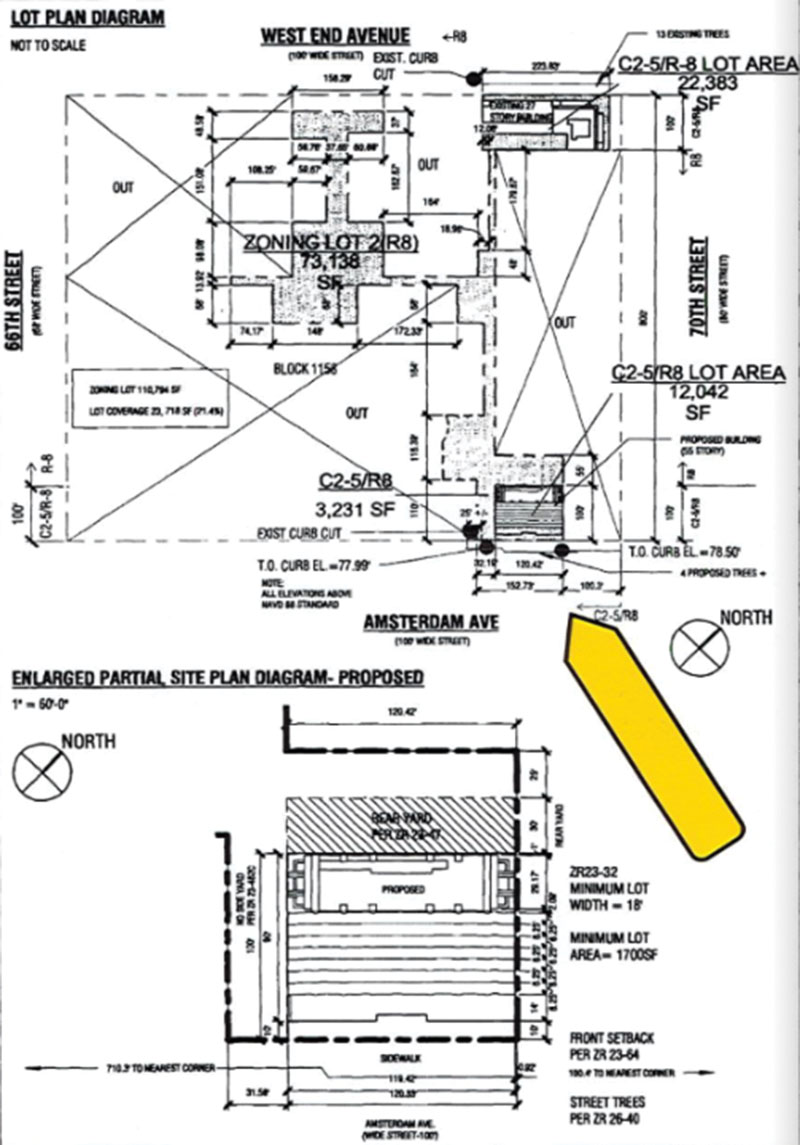 The developer of 200 Amsterdam Ave. was looking to create a combined zoning lot to transfer development rights and open space. The transfer of development rights was significant, totaling over 200,000 s/f of floor area. The open space transfer was to provide the required open space to develop the transferred development rights.
Certain residential zoning districts do not have building height limits. These are called height factor buildings. Height factor requires a series of setbacks as the building goes higher, causing the building to taper at the higher floors. However, as the building grows–goes higher–more open space is required, the theory being that taller buildings must be narrower to allow light and air to reach the ground.
The Zoning Diagram of the proposed building submitted to DOB demonstrated that a tapering 55-story building could be built on the development site using the height factor zoning envelope. However, the development site was not large enough to provide the required open space. To solve this problem a combined zoning lot was created that included portions of the Lincoln Tower open areas, including yards and driveways. These open areas were located on portions of various tax lots. The combined zoning lot allowed the development site to claim these open areas as satisfying the open space requirement for the 55-story building. Essentially, the open areas created on the Lincoln Tower complex were transferred to the development site, not physical like development rights, but for the purpose of satisfying open space zoning calculations.
The development site is at the corner of West 69th St. and Amsterdam Ave. As shown on the zoning diagram, the combined zoning lot basically extends tentacles from the development site to encircle the Lincoln Towers yards and drive ways. The combined zoning lot crosses several of the Lincoln Towers tax lot lines to reach the open areas.
During these proceedings, the parties on both sides referenced numerous zoning regulations that used the terms “zoning lot” and “tax lot.” The proponents of partial tax lots argued that the zoning regulations were vague and never explicitly stated that a combined zoning lot must always include the entire tax lot. The parties in opposition argued that the plain language of the zoning regulations clearly inferred that full tax lots must be included in any combined zoning lot.
The proponents also referenced a DOB memorandum (the “Minkin Memo”), written in 1978, that stated that zoning lots could include “parts of tax lot” and argued that this had been the standard interpretation for 50 years. The developer identified 34 examples of zoning lots containing partial tax lots. However, the court distinguished all of these lots as applying to special circumstances not applicable to the subject zoning lot. Interestingly, although the BSA upheld the use of partial tax lots, the BSA did not reference any of these examples as legal justification for its decision, instead relying on the language of the zoning regulations. DOB supported the zoning lot (DOB had issued the permits) but opined that the Minkin Memo was in error and a revised DOB memo would be issued requiring full tax lots. The court gave great weight to DOB’s pending retraction of the Minki Memo.
In my experience, I have never dealt with a zoning lot using partial tax lots. The intent of zoning is to locate required open areas in proximity to the building for the purpose of providing an amenity to the residents of the building. Here, the open areas had no physical relationship to the 55-story building. Open space designed for use by Lincoln Towers was being used to give the proposed building open space credits. The proposed building was not creating any new open space.
Christopher Wright is of counsel at Capell Barnett Matalon & Schoenfeld LLP, New York, N.Y.
Tags:
Brokerage
MORE FROM Brokerage

Adirondack Capital Partners arranges $45 million sale of West Chelsea development site to Toll Brothers
Manhattan, NY Adirondack Capital Partners (ACP) closed the $45 million sale of 126/128 Tenth Ave. and 456 W. 18th St. to Toll Brothers City Living. The acquisition forms part of a broader






Quick Hits
 (2).gif)

Columns and Thought Leadership

A guide to finding the right NYC property management company - by Sanjay Gandhi
Being a small to midsize landlord in NYC is an increasingly demanding endeavor. From navigating complex regulations, increased compliance demands to dealing with tenant issues and remediating violations. It is wise to enlist the assistance of a partner, a professional

Hunt commercial real estate question and answer: Fortune 500 wisdom - by David Hunt
Yes, there are lessons to be learned from the largest companies in America when comes to managing your real estate. But the decision to buy or lease real estate may not be one of

Positive forecast for New York’s pro-housing push? - by Philip Butler
New York’s housing crisis remains a hot button topic despite growing consensus that varied and affordable housing is desperately needed statewide. Governor Hochul has recently introduced several initiatives to overcome N.Y.’s anti-housing

New York’s streets are full again, and the retail numbers prove it - by Noam Aziz
Walk down any New York block this year and you can feel it. The sidewalks are crowded, the storefronts are lit, and the energy that defines this city is back at full volume.
.gif)