


 (2).gif)
News:
Spotlight Content
Posted: November 19, 2019
Question of the Month: What is the “Next Act” for struggling shopping centers and malls? - by Anthony Amenta
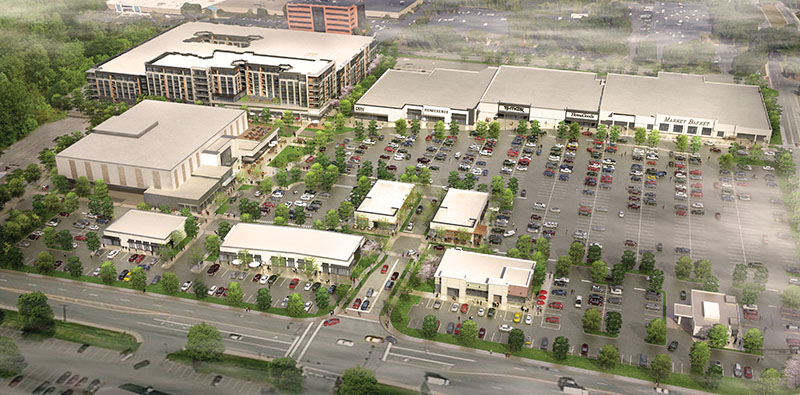

Amenta Emma Architects
As we continue to write obits for major retailers – among them ToysRUs, Kmart and dozens of others – I think we can officially announce the death of retail, as we know it. Even the most conservative form of retail shopping – grocery – is being challenged by Internet buying and home delivery.
The silver lining is the extreme value that exists in the suffering shopping centers and malls. There is an incredible opportunity, through mixed-use development, to create a second vibrant life for these properties if developers are willing to take the chance. It may be the only way to survive!
In our old economy, the automobile drove development, hence our extensive highway system, suburbs and shopping sprawl. Nobody thought much about the need to drive everywhere. Today’s Millennials and Gen Z’ers want something different. With the disappearance of the stay-at home mom as family shopper, the consumer world has morphed into a buy it now from anywhere at any time. Time is valuable. Young workers are done with long commutes to the office. They want convenience in a new way – in holistic communities where they can live, work and play. Even better if there is a transit hub nearby. They also want a more affordable alternative than what is available in urban centers.
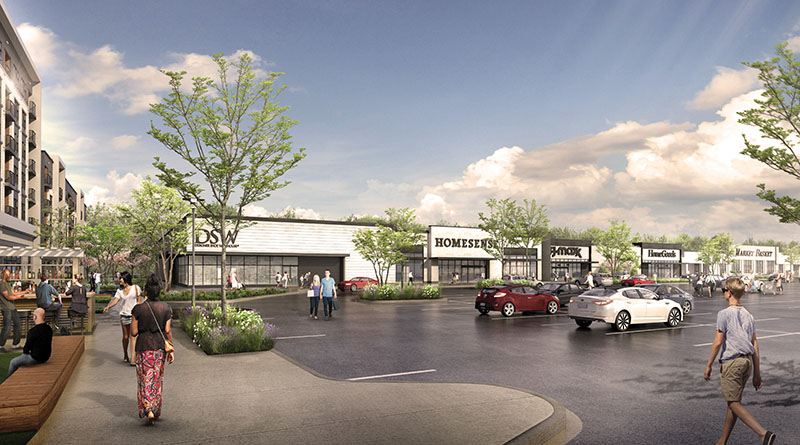
What better opportunity to create an affordable community than our existing retail centers? Many of these centers already have the criteria for success – a large land area, well-located in suburban locations, flexible zoning and vacancies to enable a complementary mix of uses. The best mixed-use communities combine office, residential, entertainment and small retail – places to go to the gym, get a haircut, or buy a gift at a pop-up shop – within a mini ecosystem. Adding a residential component to these centers will almost always be a no brainer. In fact, they may become the essential ingredient. Residential renters and buyers will be attracted to a walkable environment, where cars can be relegated to the periphery. And traditional retailers and other uses will benefit from the built-in additional foot traffic.
There is no one recipe for success. As developers evaluate individual markets, some communities might be anchored by office, and others by entertainment (restaurants, bars, movie theaters) as a destination. Ideally, these new centers are pedestrian oriented and large enough to create critical mass. Size matters, as do a number of other factors. But risks to developers are tempered by the strengths and opportunities still viable at existing development sites.
There is a tremendous pent-up demand for the type of lifestyle today’s consumers want. Our retail centers are the answer. And the sooner our centers make the transition to a true mixed-use community, the easier and less costly it will be. The time is now, and the remaining tenants in our centers are watching.
We encourage developers to wake up and embrace the potential of mixed-use. It’s a fantastic opportunity for the new paradigm.
Tony Amenta, AIA, LEED AP, is a founding partner and principal at Amenta Emma Architects, New York, N.Y.
Tags:
Spotlight Content
MORE FROM Spotlight Content
Participate in Developing New York Featuring Westchester County - November 24, 2026
Choose how you’d like to participate in this edition of NYREJ’s Developing New York series featuring Westchester County.




.png)

Quick Hits


Columns and Thought Leadership

2026 Developing Queens: Long Island Board of Realtors advances commercial growth and advocacy in Queens
The Long Island Board of Realtors (LIBOR) Commercial Network continues to play a key role in advancing opportunities and strengthening the commercial real estate landscape across Queens. Through targeted programming and global outreach

CRE Guide Featured Company: Merritt Environmental Consulting Corp.
Merritt Environmental Consulting Corp. (MECC) was established in June of 2009 after being part of a larger engineering firm for almost 20 years. The focus of the company is to assist lending institutions, attorneys, real estate investors, and property owners with environmental concerns. Today, MECC has offices in New York, Florida, and Vermont and has grown into a regional consulting firm serving clients along the East Coast.

2026 Developing Long Island: ERG Commercial Real Estate launches its new Retail Leasing division
North Hempstead, NY ERG Retail Leasing is the dedicated leasing division of ERG Commercial Real Estate, an established full-service commercial real estate brokerage for over 35 years.

From vacancy to vitality: How adaptive reuse is reshaping Long Island’s CRE landscape - by Andrea Tsoukalas Curto
Adaptive reuse has become one of the most important conversations in commercial real estate today. Long Island has a large inventory of aging retail, office and industrial