



News:
Brokerage
Posted: April 7, 2014
Pliskin Realty contracted to manage 33 new properties totaling 278,300 s/f
Pliskin Realty & Development, one of the prominent New York-Metropolitan area retail real estate brokerage, property management and investment firms, has landed a contract with eight real estate holding companies owned by real estate investor, Norman Rappaport. He is a principal of Plentino Real Estate Ltd., Pitrock Realty Corp., Rapville LLC, Rap Heart LLC, Rap East LLC, Rap West LLC, Three Cloud Realty and Quality Warehouses, LLC which together own the 33 properties representing 278,300 s/f of retail, mixed-use, office, apartment, R&D and warehouse space. The square footage represents 23% of Pliskin's total s/f under management.
The new properties are located throughout Manhattan, Brooklyn, Queens, the Bronx, N.J., South Florida, Penn., VA., TN., TX., Illinois, Michigan, Minnesota, CO., OK., and UT.
Pliskin president and CEO Jeffrey Pliskin said, "Norman Rappaport has been a smart real estate investor and property owner for over 40 years. While he has no interest in selling his properties, he recently decided that he was no longer interested in managing them himself. With our longstanding relationship as partners in a number of properties, which we at Pliskin have been managing for at least 20 years, he was confident that our organization would provide him with the best property management services to address his needs."
Prior to the contract awards, Pliskin did not have any properties under management in Illinois, Colorado, Michigan, Minnesota, Oklahoma, Pennsylvania, Tennessee, Texas and Utah. In addition to these states, the company manages properties in California and upstate New York. Of the company's entire portfolio of properties under management, approximately one third is owned by Pliskin.
Pliskin added that the new properties his company will be managing house a high number of tenants. This factor further makes a strong case for using a firm such as Pliskin Realty & Development, recognized for its hallmark high standards of property management including strong tenant relations.
"As a property owner, I recognize what it takes to effectively manage properties, maximize income, minimize expenses and retain and attract high quality tenants," said Pliskin. "We manage our clients' properties exactly like we manage our own, paying attention to every detail, and giving owners complete peace of mind."
Tags:
Brokerage
MORE FROM Brokerage
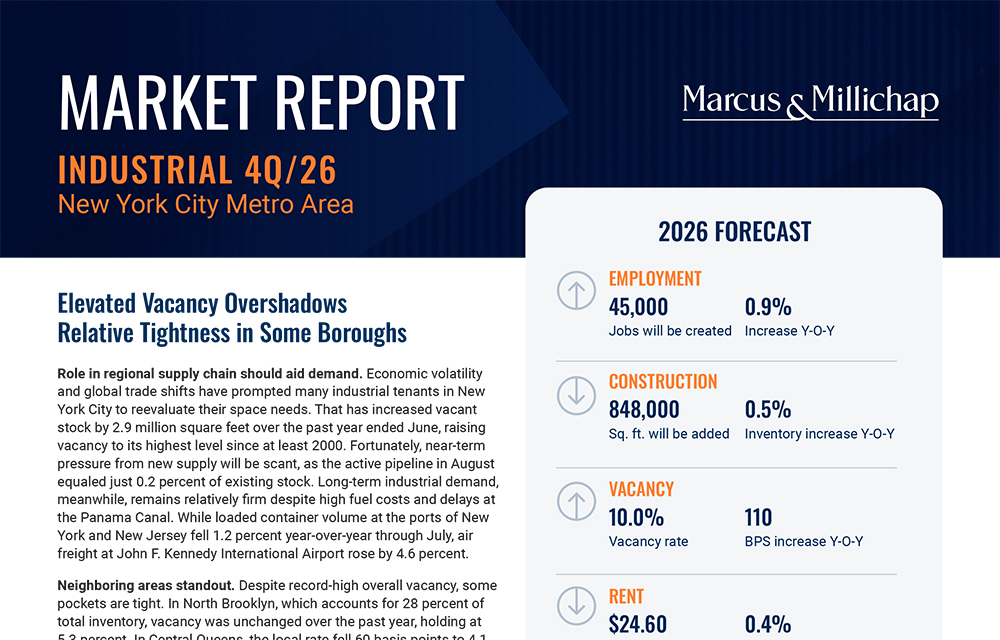
Marcus & Millichap releases fourth-quarter 2026 NYC industrial market report
Manhattan, NY Marcus & Millichap has published its fourth-quarter 2026 New York City Industrial Market Report. “New York City’s industrial market is showing a clear





Quick Hits
 (2).gif)

Columns and Thought Leadership

Hunt CRE question and answer: Choosing a real estate agent - by David Hunt
First, we will only work with one agent exclusively. The primary reason is that we want that agent to legally represent our client’s interests. In New York State, a real estate agent has a fiduciary

The art of investing in real estate - by Thomas Donovan
Real estate investing is as much an art as it is a skill. No one can time the market, or the factors that drive it, perfectly. Location, zoning, size, transportation, and neighborhood density give you a baseline for

Hunt commercial real estate question and answer: Fortune 500 wisdom - by David Hunt
Yes, there are lessons to be learned from the largest companies in America when comes to managing your real estate. But the decision to buy or lease real estate may not be one of

New York’s streets are full again, and the retail numbers prove it - by Noam Aziz
Walk down any New York block this year and you can feel it. The sidewalks are crowded, the storefronts are lit, and the energy that defines this city is back at full volume.
.gif)