



News:
Brokerage
Posted: May 9, 2011
Peter Charapko - Considering value: Five items to use as an evaluation guide
Everybody tries to determine value in a building, either in an existing structure or as the object of renovation. There is no discounting the opinion of a broker, a customer, a developer or an architect, but there are ways to evaluate a property that can give guidance in the process. This article lists a few points that can be part of an evaluation; it does not address plan re-design of a building or apartment, or siting a building at the first stages of planning and design. The aspects listed here are familiar to all, and part of a method that can give clarity to observations.
Whether you are contemplating a sale, purchase, or considering renovations, these items can guide you:
1. Hardware: Few things catch the eye as directly as the hardware appointments throughout a space. Is the hardware consistent in the various rooms, and of a similar type? Are the finishes coordinated - brass, stainless steel, nickel and so forth? At a first view, this is an item to note; in a modest renovation, it is something to include.
Older, pre-war buildings, may have original hardware installations. These may be of a lightweight gauge, compared to many of today's pieces, but still of exceptional design and continuing usefulness.
2. Baseboards, mouldings, trim: Especially in older residential buildings, this woodwork can be the most compelling feature, and , in renovation, items to try to repeat. Despite different needs from a century ago, the baseboard still creates an important visual element in a room, perhaps the single most significant decorative piece. Tiny baseboards in most spaces seem to diminish the scale of the wall and the size of the room.
Trim around doorways and windows historically follows from - or is related to - baseboard design. Certain wood profiles may likely repeat from the floor trim. It should be mentioned that a different kind of detailing exists in Modernist design, although these buildings will still have a carefully crafted array of design details.
3. Doors: The inclusion here of doors is almost appended to the consideration of hardware, movement through rooms and buildings will evoke experiences of doors, and even "favorite" doors of one's experience. A short list will include flush (flat) doors, paneled doors, and doors with inset decorative glass. It is fair to say that the opinions of most persons should be considered, but that one condition be given a strong warning: This is the lightweight, hollow-core wood door, which affords little assurance with its swing, almost no acoustical separation between rooms, and greatly cheapens a space. The presence of these doors will usually indicate a lack of care and overall maintenance over prior years.
4. Windows: The prevailing interest in the "views" from a space, for residential spaces in particular, cannot be attacked, but spaces with generous windows, irrespective of the quality of view, should be factored into value. Windows will provide comforting through-ventilation and of course light. Many older buildings' window sizes will equal 20 to 30% of the spaces' floor area - not to be overlooked.
5. Floors: Just one note here about the always popular wood floors: These are usually well-installed from a former lifetime of the building. If it becomes desirable to re-partition in such spaces, a good flooring installer can match and continue for the new layout, economically preserving the original and creating the new.
This is a small list of items, to which one can add many times over. It does not comprise design or many aspects of real estate evaluation, but it sets out a way of looking for sale, purchase or renovation.
Peter Charapko is the principal of the office of Peter W. Charapko Architect, New York, N.Y.
Tags:
Brokerage
MORE FROM Brokerage
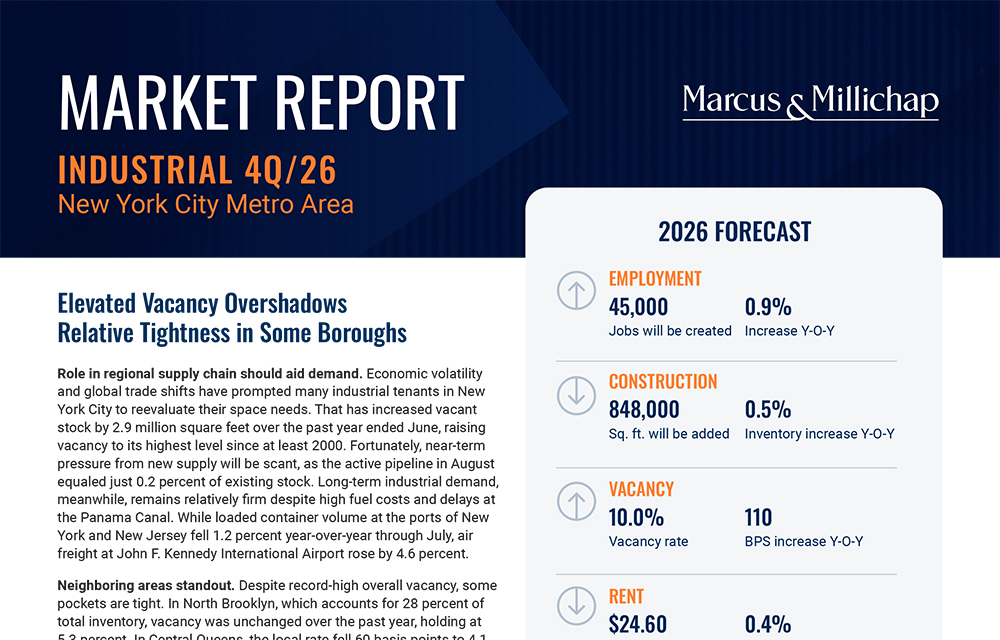
Marcus & Millichap releases fourth-quarter 2026 NYC industrial market report
Manhattan, NY Marcus & Millichap has published its fourth-quarter 2026 New York City Industrial Market Report. “New York City’s industrial market is showing a clear






 (2).gif)

Columns and Thought Leadership

Hunt CRE question and answer: Choosing a real estate agent - by David Hunt
First, we will only work with one agent exclusively. The primary reason is that we want that agent to legally represent our client’s interests. In New York State, a real estate agent has a fiduciary

Hunt commercial real estate question and answer: Fortune 500 wisdom - by David Hunt
Yes, there are lessons to be learned from the largest companies in America when comes to managing your real estate. But the decision to buy or lease real estate may not be one of

The art of investing in real estate - by Thomas Donovan
Real estate investing is as much an art as it is a skill. No one can time the market, or the factors that drive it, perfectly. Location, zoning, size, transportation, and neighborhood density give you a baseline for

New York’s streets are full again, and the retail numbers prove it - by Noam Aziz
Walk down any New York block this year and you can feel it. The sidewalks are crowded, the storefronts are lit, and the energy that defines this city is back at full volume.
.gif)