



News:
Brokerage
Posted: January 30, 2024
New York’s ‘City of Yes’ spurs urban decarb plus growth by zoning reform
Manhattan, NY Following on the 2023 debut of its “City of Yes” strategy to permit more housing, faster in New York City, the mayor Eric Adams administration is unveiling a raft of zoning changes this winter intended to make the proposed growth carbon neutral, according to Adam Friedberg, a Buro Happold expert behind similar initiatives in the region and worldwide.
Commenting on the new zoning approach, Friedberg says the three new zoning initiatives include the “City of Yes for Carbon Neutrality,” which removes onerous zoning requirements to accelerate decarbonization work across New York City. “This bolsters the City’s efforts in addressing the climate crisis by freeing building owners and developers to make better choices,” Friedberg said. “As we’re seeing around the world, modernizing zoning regulations truly does open the door to retrofits and major green investments in buildings.”
Buro Happold has led a number of efforts for New York City, including its former mayor’s 80x50 plan following the Paris Agreement to reduce greenhouse gas (GHG) emissions by 80% by 2050. The firm is also consulting on the New York Climate Exchange and has implemented statewide funding for real estate holders such as Empire Realty Trust and Battery Park City Authority seeking decarbonization pathways to achieve net-zero carbon.
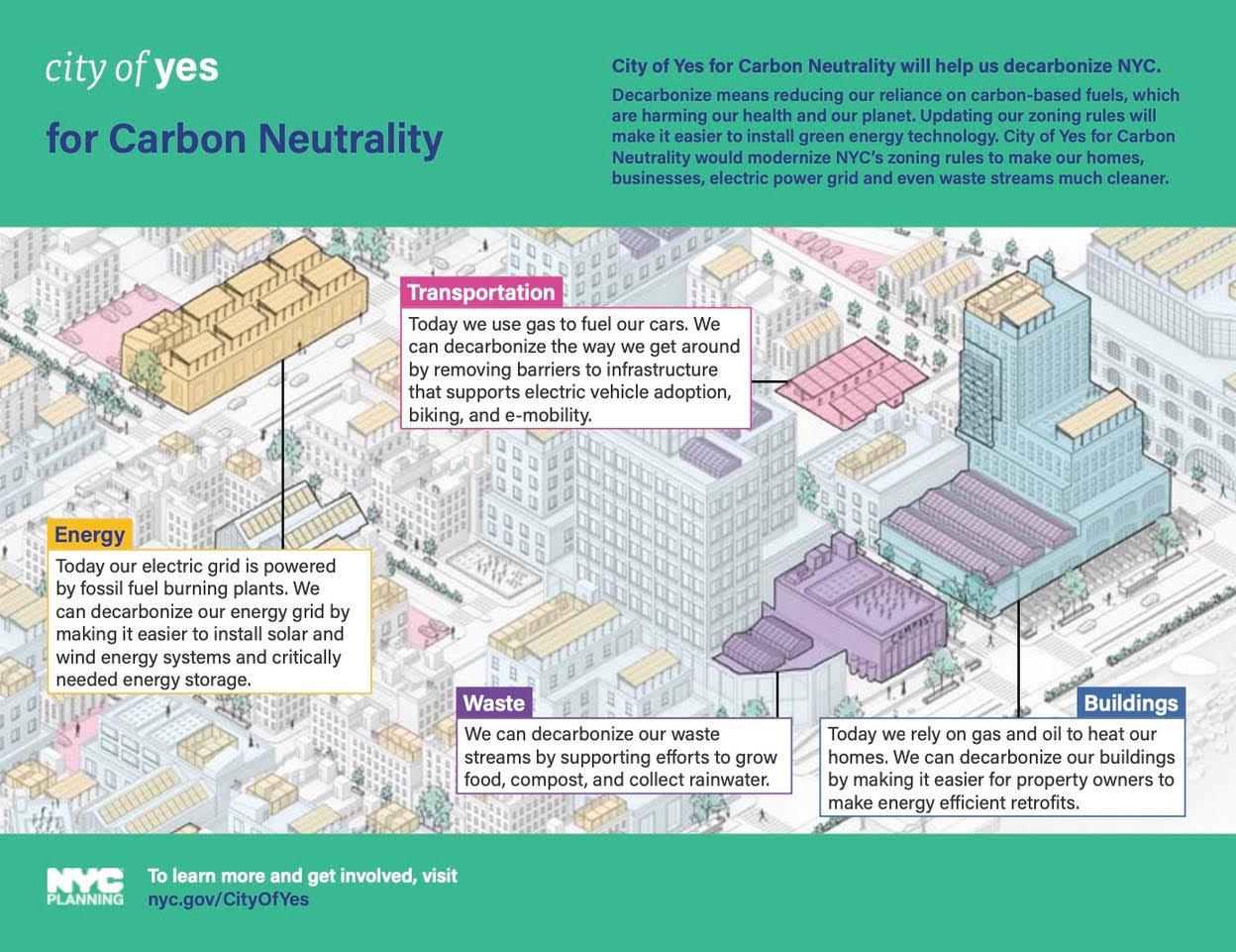
This year, City of Yes rules focus on increasing housing construction, removing outdated restrictions on businesses, and boosting green investments that slash GHG emissions. In fact, the City of Yes code reforms offer far-reaching and highly effective changes for decarbonization, says Friedberg. Key elements of the zoning updates that directly cut carbon emissions include:
- Easing restrictions on adding rooftop solar panels.
- Removing hurdles to greener renovation approaches, such as striking from building floor area ratio (FAR) calculations the areas for bike storage rooms and rooms that are retrofitted with heat pumps and batteries, which allows more flexibility to building owners in gross floor area, or GFA.
- Allowing more curbside EV charging stations.
- Reducing landfill waste and stormwater processing
Because of Buro Happold’s role in supporting New York City’s efforts to combat climate change and improve regional resiliency, the firm’s leadership attended a high-level briefing in December. The firm’s team is also working with the American Institute of Architects (AIA) New York Chapter to provide commentary on the City of Yes components such as building code changes and the calculating of FARs related to implementation of the targeted reforms.
Friedberg adds there is growing support for the impact of City of Yes on local businesses and the accelerating of new building investments.
Decarbonization Leadership: Buro Happold

In New York and beyond, Buro Happold is one of the world’s leading decarbonization experts. Unique in capacity, the firm nurtures a global, multidisciplinary team offering capabilities ranging from public policy and portfolio strategy to highly technical design solutions for enterprises and individual buildings. Its worldwide portfolio of results touches on every facet of the decarbonization challenge: from laws and regulations, to climate action plans for major cities, to Buro Happold implementation of the first municipal action plan fulfilling the Paris Agreement.

Equally well known for their on-the-ground work crafting engineering solutions and portfolio strategies for tech industry giants and major REITs including Empire State Realty Trust, Buro Happold is a valuable source on implementation plans for city districts such as Battery Park City, and campus decarbonization pathways for universities. The firm is cited widely for authoritative studies of building electrification, alternative refrigerants, and replacing aging utility gas pipes statewide with ground-source heat pump systems.
Tags:
Brokerage
MORE FROM Brokerage

Residential real estate consultancy and brokerage firm Nancy Packes, Inc. rebrands as NPI
Manhattan, NY The NYC-based premier residential real estate consultancy and brokerage firm, Nancy Packes Inc., has rebranded as NPI. Helmed by Seth Rosner, most recently the firm’s managing partner and now president, the company has been intricately involved in hundreds of Tri-State new developments and conversions, spearheading the full project life cycle, from assessment/pre-dev.






Quick Hits
 (2).gif)

Columns and Thought Leadership

Hunt commercial real estate question and answer: Fortune 500 wisdom - by David Hunt
Yes, there are lessons to be learned from the largest companies in America when comes to managing your real estate. But the decision to buy or lease real estate may not be one of

New York’s streets are full again, and the retail numbers prove it - by Noam Aziz
Walk down any New York block this year and you can feel it. The sidewalks are crowded, the storefronts are lit, and the energy that defines this city is back at full volume.

A guide to finding the right NYC property management company - by Sanjay Gandhi
Being a small to midsize landlord in NYC is an increasingly demanding endeavor. From navigating complex regulations, increased compliance demands to dealing with tenant issues and remediating violations. It is wise to enlist the assistance of a partner, a professional

Hunt CRE question and answer: Choosing a real estate agent - by David Hunt
First, we will only work with one agent exclusively. The primary reason is that we want that agent to legally represent our client’s interests. In New York State, a real estate agent has a fiduciary
.gif)