Herrick, Feinstein





Part 3 of this four-part series appeared in the January 2nd edition.
While the pandemic has significantly disrupted the retail space market in New York City, grocery stores have remained resilient, which makes them an increasingly attractive tenant. Grocery stores provide a neighborhood retail anchor by serving residents and maintaining jobs. The NYC Food Retail Expansion to Support Health program (FRESH) offers zoning and tax incentives to encourage the development and retention of grocery stores in designated zones in the city. FRESH is a development tool that can improve a project’s economics, which is particularly valuable given trends in the retail sector.
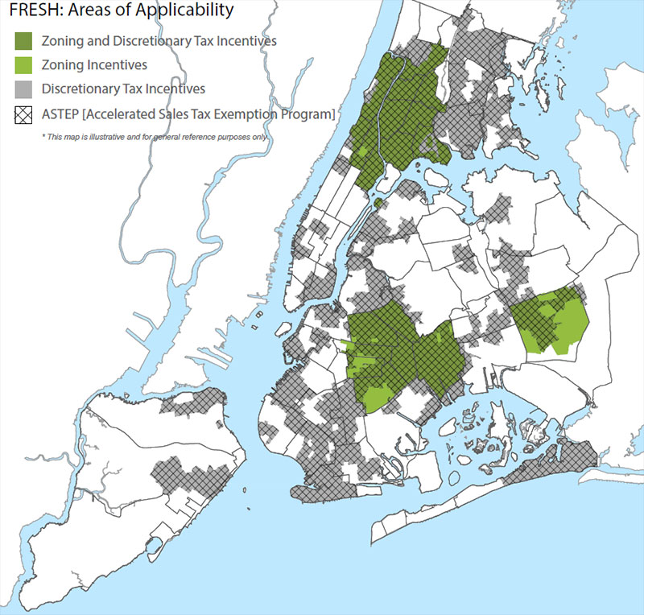 FRESH is available in the “underserved” neighborhoods identified on the included map.
While in most FRESH areas both zoning and tax incentives are available, in certain areas only one set of incentives is available.
Zoning Incentives
The New York Department of City Planning (DCP) administers the FRESH zoning incentives, which include:
• Additional residential floor area of up to 20,000 s/f beyond what is otherwise permitted as-of-right;
• Reduced required parking for the grocery store in certain districts to one parking space per 1,000 s/f of floor area; and
• Additional height of up to 15 ft. above the maximum building height that is otherwise permitted as-of-right, provided that the first story occupied by a FRESH food store has a minimum finished floor to finished ceiling height of 14 ft. with the finished ceiling height at least 14 ft. above the curb.
For the zoning incentives, the proposed grocery store must meet the following minimum requirements:
• 6,000 s/f of retail space;
50% of such retail space dedicated to the sale of general line food products;
• 30% of such retail space dedicated to the sale of perishable goods;
• 500 s/f of perishable goods retail space allotted to the sale of fresh produce;
• At least half of the ground floor frontage glazed with a transparent material; and
• At the primary entrance, a sign indicating the grocery store is a FRESH food store.
Provided the above requirements are met, the project can seek a certification from the chairperson of the City Planning Commission. The application needs to include a project description, FRESH food store plans and floor plans showing the reallocation of the bonus floor area and a signed letter of intent from a prospective grocery store operator. The certification is a “ministerial” action that does not require a presentation to the City Planning Commission. The item is referred to the local community board, which
may request a presentation from the applicant team. In connection with the certification, DCP requires a restrictive declaration be recorded on the property to memorial the commitment to use the identified space as a FRESH food store.
Tax Incentives
FRESH tax incentives are administered by the New York City Industrial Development Agency (IDA) and include benefits for operators and developers building or renovating new retail space for a supermarket:
• An abatement on building and land taxes for up to 25 years;
• A waiver of sales taxes on construction materials; and
• A reduction in mortgage recording taxes from 2.8% to 0.3%.
The proposed grocery store needs to meet the following minimum requirements: 5,000 s/f of retail space; 30% of such retail space dedicated to the sale of perishable goods; and 500 s/f of perishable goods retail space allotted to the sale of fresh produce.
Because FRESH tax benefits are discretionary, the IDA accesses each project’s need for financial assistance and economic impact. Once IDA staff confirms a project’s eligibility, sponsorship can formally apply. The application needs to include information regarding the size of capital investment; jobs retained and/or created, average wages and benefits; applicant’s financial picture; and tenanting strategy and timeline. Since a discretionary action is being taken, an environmental review is required. The IDA board will need to vote to approve the granting of tax benefits.
While serving as head of NYCEDC’s Real Estate Transaction Services department, Patrick O’Sullivan helped launch the FRESH Program. At Herrick, he now helps developers navigate through the program.
Michael Smith and Patrick O’Sullivan, Jr. are partners at Herrick, Feinstein, New York, N.Y.


 (2).gif)





.gif)