



News:
Brokerage
Posted: October 7, 2011
Nelson of Massey Knakal reps Beck Street Capital in $6.1 million sale; Gonzalez of Halstead reps buyer of the mixed-use property
Beck Street Capital, a private real estate investment firm, has closed on the sale of 82 Christopher St., a five-story mixed-use retail and residential property located in the Greenwich Village neighborhood. The transaction with Jayvanka, LLC is valued at $6.1 million.
Beck Street Capital purchased the building in December 2005 for $3.7 million and undertook renovations including a façade restoration, common area upgrades, and extensive apartment improvements.
"The successful sale of 82 Christopher St. is a validation of Beck Street Capital's disciplined and focused approach to value creation for our properties," said Kevin Comer, senior managing director of Beck Street Capital. "We continue to seek out high value-add mixed-use properties like 82 Christopher St. in dense urban markets that offer opportunities for Beck Street to earn above average returns for our investors."
James Nelson of Massey Knakal represented Beck Street Capital and Rex Gonzalez of Halstead represented the buyer.
Nelson said, "We received a tremendous amount of interest due to the quality product that Beck Street delivered on this world-renowned retail strip. With the help of Rex Gonzales at Halstead, we identified an international buyer who sought the stability and upside of New York City real estate, and who ultimately prevailed in this asset purchase. As always, it was a pleasure closing another successful transaction with Beck Street."
82 Christopher St. is a mixed-use building featuring two retail spaces and eight apartments. Steps from the Bleecker St. luxury retail corridor, the building is located on historic Christopher St. in Greenwich Village, one of the most widely-recognized addresses in the country.
Tags:
Brokerage
MORE FROM Brokerage
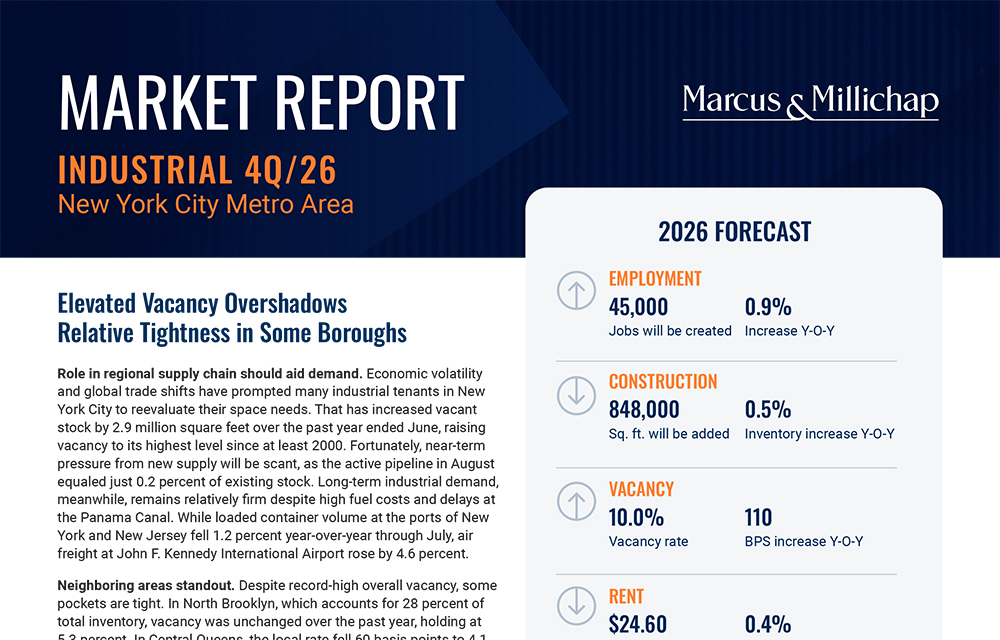
Marcus & Millichap releases fourth-quarter 2026 NYC industrial market report
Manhattan, NY Marcus & Millichap has published its fourth-quarter 2026 New York City Industrial Market Report. “New York City’s industrial market is showing a clear



Quick Hits

Columns and Thought Leadership

New York’s streets are full again, and the retail numbers prove it - by Noam Aziz
Walk down any New York block this year and you can feel it. The sidewalks are crowded, the storefronts are lit, and the energy that defines this city is back at full volume.

The art of investing in real estate - by Thomas Donovan
Real estate investing is as much an art as it is a skill. No one can time the market, or the factors that drive it, perfectly. Location, zoning, size, transportation, and neighborhood density give you a baseline for

Hunt CRE question and answer: Choosing a real estate agent - by David Hunt
First, we will only work with one agent exclusively. The primary reason is that we want that agent to legally represent our client’s interests. In New York State, a real estate agent has a fiduciary

Hunt commercial real estate question and answer: Fortune 500 wisdom - by David Hunt
Yes, there are lessons to be learned from the largest companies in America when comes to managing your real estate. But the decision to buy or lease real estate may not be one of
.gif)