



News:
Brokerage
Posted: March 8, 2022
Mayor Rolison, The Community Preservation Corporation, and Hudson Valley Family celebrate opening of Upstream Café
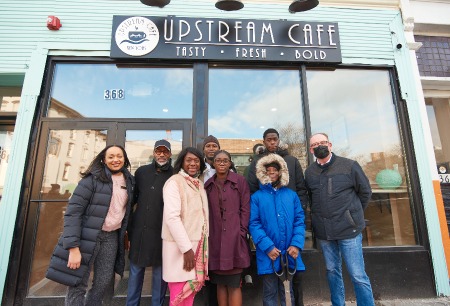
Poughkeepsie, NY The Community Preservation Corporation (CPC), a nonprofit multifamily housing finance company, Garfield and Shereen Salmon, and Poughkeepsie Mayor Robert Rolison celebrated the grand opening of Upstream Café with a ribbon cutting ceremony for the newly renovated building at 368 Main St.
CPC, a leading nonprofit multifamily housing finance company, provided a $465,000 construction and permanent loan to help the Salmon’s renovate the long-vacant property into a mixed-use building that will create five (5) new rental apartments and the newly opened Upstream Café. Financing was provided through CPC’s ACCESS initiative, which provides BIPOC borrowers with guidance and technical assistance in addition to traditional financing through a professional development consultant, if needed, to help ensure their success as they navigate their projects.
“We are really gratified and happy that Garfield and Shereen Salmon have looked to Poughkeepsie to help revitalize and redevelop this building on our Main Street. I also want to thank CPC for once again being a financial partner here in the City as they help individuals reenergize our downtown,” said Mayor Rolison.
“We are truly grateful to see the light at the end of the tunnel. The completion of this project was made possible because of The CPC’s commitment to reach BIPOC investors as they change the investor landscape. We’re excited to be opening our café, welcoming new tenants, and look forward to being a part of the Poughkeepsie community,” said Garfield Salmon.
“With the construction coming to an end and the building now open, Garfield can replace his construction supervisor hat with his chef hat as he focuses on his passion for culinary arts and our family’s new venture with the UpStream Café. My thanks to Mayor Rolison, CPC and all of the partners who believed in our dream and vision,” said Shereen Salmon.
“It is incredibly gratifying to see the Salmon’s dream of revitalizing this property become a reality,” said Lawrence Hammond, senior vice president and director of ACCESS at CPC. “Small building owners and entrepreneurs like the Salmon’s are critical to the health and vitality of our State’s housing stock. Providing BIPOC developers with a hand-up and access to resources and support they need to be successful is why CPC created the ACCESS initiative.”
“Small multifamily and mixed-use properties like 368 Main St. are the backbone of communities in the Hudson Valley. It’s been a pleasure working with Garfield and Shereen, and helping them realize their vision of renovating these apartments and opening their very own café,” said Mary Paden, senior vice president and mortgage officer at CPC’s Hudson Valley regional office. “My thanks to the Salmon’s, to Mayor Rolison, and the Poughkeepsie community.”
Historically, the ability of BIPOC entrepreneurs to access pre-development funding, such as capital for property acquisition, has been a barrier that has impeded their ability to grow and build their capacity as a business. After having been unable to obtain financing from other lending institutions, the Salmon’s sold another property to help raise the equity to acquire and renovate 368 Main St. However, additional capital was required. The Dutchess County Community Development Office referred them to CPC’s regional office in Chappaqua, who worked with the couple to determine how much additional financing would be needed, and were able to provide it through ACCESS.
In addition to providing the traditional loan support, CPC’s ACCESS initiative offers guidance and technical assistance by providing their borrowers with a professional development consultant, if needed, to help ensure their success as they navigate their projects.
CPC’s ACCESS initiative has delivered millions of dollars in financing to BIPOC developers for multifamily projects across New York State, with a robust pipeline of projects currently under consideration. The company launched its $20 million ACCESS initiative in the summer of 2020 to provide financial resources, capacity building opportunities, and technical assistance to entrepreneurs of color who have historically faced barriers to entry in the real estate development market, with the goal of promoting and enabling greater racial diversity, equity, and inclusion in the industry.
Tags:
Brokerage
MORE FROM Brokerage

200E20TH sells out in Gramercy, penthouse A closes out sales at the CetraRuddy-designed condominium residences
Manhattan, NY 200E20TH, the CetraRuddy-designed architectural masterwork that brought a curved, contemporary sensibility to Gramercy’s Beaux-Arts streetscape, has





Quick Hits
 (2).gif)

Columns and Thought Leadership

Hunt commercial real estate question and answer: Fortune 500 wisdom - by David Hunt
Yes, there are lessons to be learned from the largest companies in America when comes to managing your real estate. But the decision to buy or lease real estate may not be one of

New York’s streets are full again, and the retail numbers prove it - by Noam Aziz
Walk down any New York block this year and you can feel it. The sidewalks are crowded, the storefronts are lit, and the energy that defines this city is back at full volume.

The art of investing in real estate - by Thomas Donovan
Real estate investing is as much an art as it is a skill. No one can time the market, or the factors that drive it, perfectly. Location, zoning, size, transportation, and neighborhood density give you a baseline for

Hunt CRE question and answer: Choosing a real estate agent - by David Hunt
First, we will only work with one agent exclusively. The primary reason is that we want that agent to legally represent our client’s interests. In New York State, a real estate agent has a fiduciary
.gif)