


 (2).gif)
News:
Spotlight Content
Posted: May 26, 2026
Local Law 97 gets all the attention. These three NYC local laws are writing the fines - by Lucas Giacalone

Every building owner in New York City has heard about Local Law 97. The carbon emissions caps, the $268-per-ton penalty rate, the May 1 annual report deadline: LL97 has dominated the compliance conversation for years. That attention is warranted.
But while owners are focused on LL97, three other local laws are running their own penalty clocks, on their own cycles, with their own enforcement teeth. Most building owners either don’t know they apply or assume they’ve been handled when they haven’t.
Local Law 126: Two Requirements, Twice the Exposure
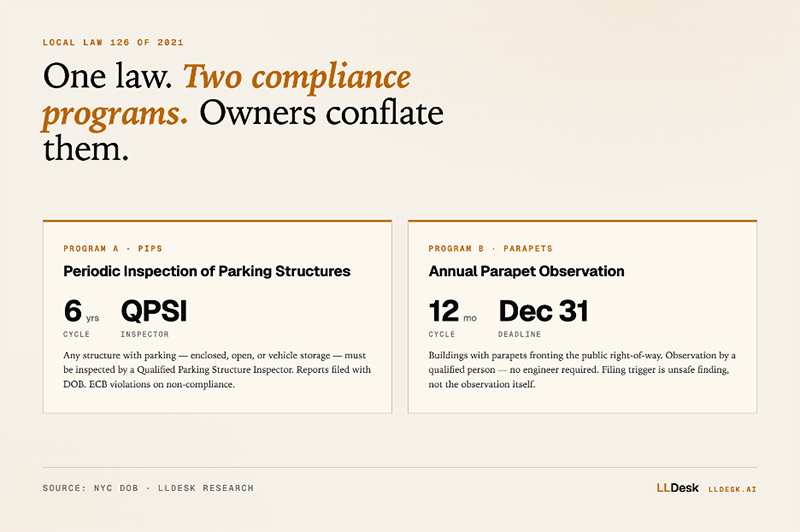
LL126 of 2021 creates two distinct compliance obligations that owners routinely conflate.
The first is the Periodic Inspection of Parking Structures (PIPS) program. Any building with a parking garage or open parking structure must have it inspected every six years by a Qualified Parking Structure Inspector, a New York State licensed Professional Engineer with specialized structural experience. Reports must be filed with the NYC Department of Buildings (DOB). The law followed a series of high-profile garage collapses, and enforcement is active.
The second is the annual parapet observation. Buildings with parapets fronting the public right-of-way must have an observation performed by December 31 each year. Unlike the parking requirement, this does not require a licensed engineer; a qualified person capable of identifying hazards can perform it. Results are maintained on record by the owner. DOB notification is only required if an unsafe condition is found, at which point public protection must be installed immediately.
Two programs, one law. Different inspectors, different cycles, different filing triggers. Treating them as one is how owners end up non-compliant on both.

Local Law 152: Gas Piping Enforcement Is Escalating Now
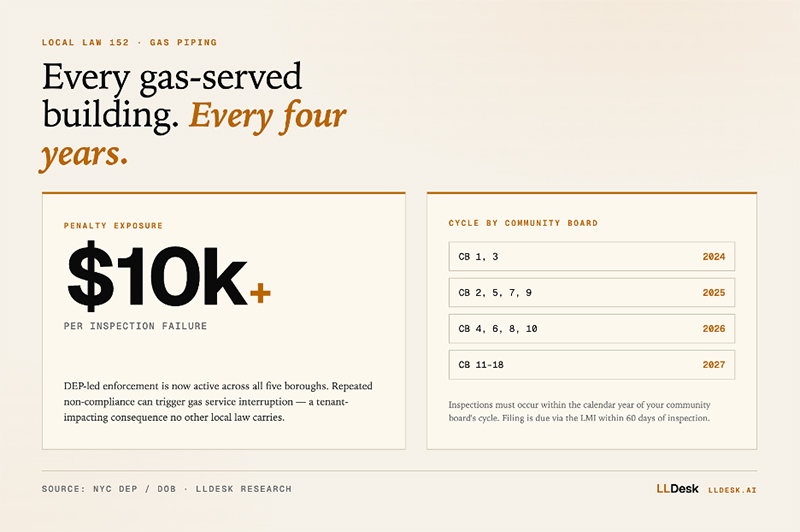
LL152 requires periodic inspections of gas piping systems in all NYC buildings served by gas, with one- and two-family homes exempt. A Licensed Master Plumber must inspect exposed gas piping in common areas from the meter up to tenant spaces, with results filed with the DOB within 60 days.
The four-year cycle is organized by community district, and the current Cycle 2 runs through 2028. That means different buildings are due in different years: community districts 4, 6, 8, 9, and 16 are due by December 31, 2026, while districts 11, 12, 14, 15, and 17 are due by December 31, 2027. There is no single citywide deadline.
Civil penalties reach $5,000 per building and recur annually if filings remain outstanding. More consequential is what happens when an unsafe condition goes unremediated: the DOB can trigger a gas shutoff. For occupied residential buildings, that means no heat and no hot water, which is an emergency, not a compliance matter.
Enforcement is actively escalating. The DOB began issuing Notices of Deficiency in January 2025 for missed Cycle 1 filings and expanded to current-cycle buildings by September 2025. The notices carry no immediate penalty, but they are a clear signal of where DOB attention is headed.
Local Law 11 / FISP Cycle 10: The Familiar Law With a New Wrinkle
Most owners of buildings over six stories know the Facade Inspection Safety Program (FISP),. Hire a qualified inspector, document facade conditions, file every five years. Cycle 10, running 2025 to 2029, introduces sub-cycle deadlines staggered by the last digit of your block number, meaning your filing window is specific to your block, not a general five-year horizon.
Missing that window triggers a $1,000-per-month late filing penalty plus a $5,000 annual failure-to-file fee. A building that slips its sub-cycle deadline by 12 months faces $17,000 in penalties before any facade condition is even addressed. Buildings carrying open SWARMP conditions from Cycle 9 enter Cycle 10 with compounding obligations.
The owners most exposed are not first-timers. They are experienced filers who assumed Cycle 10 worked the same way as Cycle 9.
The Real Problem Is the Calendar
LL97 reports are due May 1. LL126 parapet observations are due December 31, annually. LL126 parking inspections run on six-year sub-cycles. LL152 gas inspections run on four-year community district cycles. FISP runs on five-year block-based sub-cycles. None of these align.
The compliance failures we see most often are not caused by ignorance of the law. They are caused by the operational reality of tracking overlapping cycles across multiple buildings without a system built to handle it. The fines are not a surprise when they arrive. They are the predictable result of a compliance calendar that nobody was actually managing.
Lucas Giacalone is director of technology & compliance at KOW Building Consultants, and is also the founder of LLDesk, Manhattan, N.Y.
MORE FROM Spotlight Content
Participate in Developing New York Featuring Westchester County - November 24, 2026
Choose how you’d like to participate in this edition of NYREJ’s Developing New York series featuring Westchester County.




.png)



Columns and Thought Leadership

2026 Developing Long Island: ERG Commercial Real Estate launches its new Retail Leasing division
North Hempstead, NY ERG Retail Leasing is the dedicated leasing division of ERG Commercial Real Estate, an established full-service commercial real estate brokerage for over 35 years.

From vacancy to vitality: How adaptive reuse is reshaping Long Island’s CRE landscape - by Andrea Tsoukalas Curto
Adaptive reuse has become one of the most important conversations in commercial real estate today. Long Island has a large inventory of aging retail, office and industrial

2026 Developing Queens: Long Island Board of Realtors advances commercial growth and advocacy in Queens
The Long Island Board of Realtors (LIBOR) Commercial Network continues to play a key role in advancing opportunities and strengthening the commercial real estate landscape across Queens. Through targeted programming and global outreach

CRE Guide Featured Company: Merritt Environmental Consulting Corp.
Merritt Environmental Consulting Corp. (MECC) was established in June of 2009 after being part of a larger engineering firm for almost 20 years. The focus of the company is to assist lending institutions, attorneys, real estate investors, and property owners with environmental concerns. Today, MECC has offices in New York, Florida, and Vermont and has grown into a regional consulting firm serving clients along the East Coast.