



News:
Brokerage
Posted: April 14, 2015
Letter of Intent - Bridge Financing for Townhomes
Bridge lenders have started to move into a new territory to fill the need of townhouse developers in Manhattan. With the onslaught of international investment and the bounce-back of the market, savvy investors have taken advantage of a niche market only available to the wealthiest of homeowners, the townhouse. As prices have sky-rocketed in N.Y.C.'s most prestigious buildings, both local and overseas investors have started to source out their domicile in N.Y.C. by scouring the uber-tight townhouse market.
Over the past three months, Berko & Associates has had the opportunity to advise on and structure five bridge loans for townhouse developers. These investors need money available to them quickly in order to secure the most coveted assets, and bridge lenders are the answer. These transactions command a lot of attention from even the most discerning lenders, because the money comes back fast and furious. Most of these deals are smaller in square footage, and thus, a nice change from many of the construction-type deals that many bridge lenders are used to. The projects generally take less than a year from acquisition to sale, and in this market, they sell quickly.
Elliot Taub, a senior associate at Berko & Associates, who works with a bevy of clients who gear their attention specifically to this market, works on filling the capital stack so that his clients can keep their equity and transact more deals. In conjunction with Michael Korine and Andrew Milbank of the Berko Finance and Capital Markets Team, they achieved 85% LTC for the acquisition and construction with rates at or below 9% on the deals, allowing the investor to cut his equity injection in half and maximize his returns. These deals have become commonplace for us, utilizing our large network of lenders with the ability to analyze, structure, and close swiftly and efficiently.
The market is moving in all directions, this is just a slice that given steroids to the idea of the fix-and-flip, making sense of an asset type with the potential for huge gains in super-short periods of time.
Lee Silpe is the senior analyst at Berko & Associates, New York, N.Y.
Tags:
Brokerage
MORE FROM Brokerage
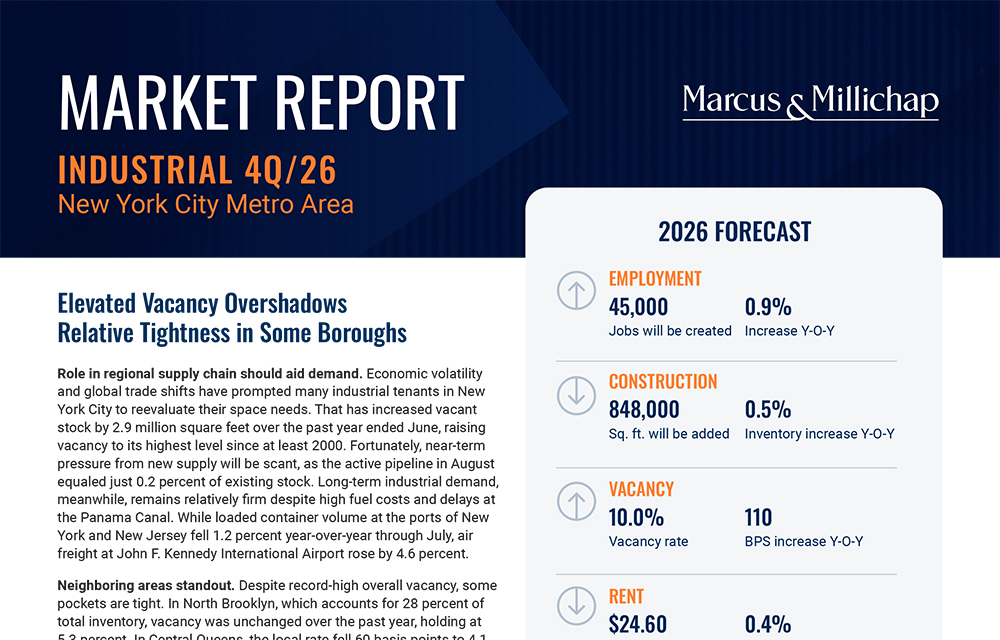
Marcus & Millichap releases fourth-quarter 2026 NYC industrial market report
Manhattan, NY Marcus & Millichap has published its fourth-quarter 2026 New York City Industrial Market Report. “New York City’s industrial market is showing a clear






 (2).gif)

Columns and Thought Leadership

Hunt CRE question and answer: Choosing a real estate agent - by David Hunt
First, we will only work with one agent exclusively. The primary reason is that we want that agent to legally represent our client’s interests. In New York State, a real estate agent has a fiduciary

New York’s streets are full again, and the retail numbers prove it - by Noam Aziz
Walk down any New York block this year and you can feel it. The sidewalks are crowded, the storefronts are lit, and the energy that defines this city is back at full volume.

Hunt commercial real estate question and answer: Fortune 500 wisdom - by David Hunt
Yes, there are lessons to be learned from the largest companies in America when comes to managing your real estate. But the decision to buy or lease real estate may not be one of

The art of investing in real estate - by Thomas Donovan
Real estate investing is as much an art as it is a skill. No one can time the market, or the factors that drive it, perfectly. Location, zoning, size, transportation, and neighborhood density give you a baseline for
.gif)