



News:
Brokerage
Posted: November 11, 2025
Lee & Assocs. NYC facilitates $32.3 million sale of Buffalo School of Culinary Arts & Hospitality Mgmt.
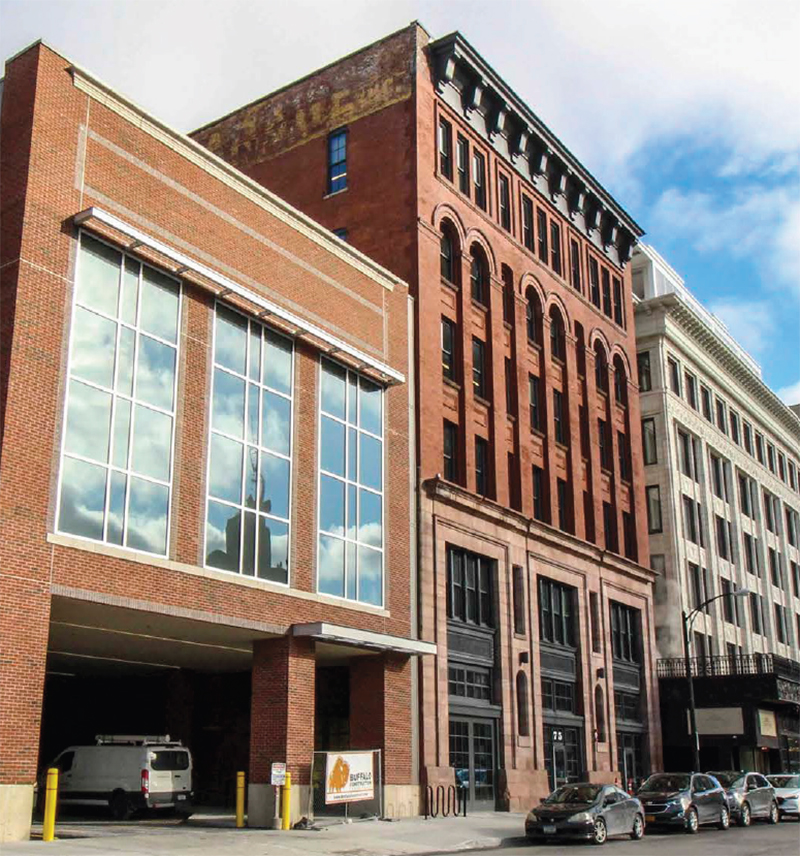 Buffalo, NY Lee & Associates NYC has facilitated a $32.3 million sale of 75 West Huron St. on behalf of McGuire Development Company. The 102,000 s/f, seven-floor building is occupied entirely by The Buffalo School of Culinary Arts & Hospitality Management, a public high school which combines academic education with vocational, career-focused training in culinary arts and hospitality, preparing students for direct entry into the food service industry or further education. The school will remain in the building under the new ownership of Mercer Street Partners.
This transaction was originally sourced by Lee & Associates Boston, who partnered with the Lee & Associates NYC team to win the listing. Dave Carswell and Ben Tapper of Lee & Associates NYC represented the seller, McGuire Development Company. Carswell, senior managing director at Lee & Associates NYC, also assisted the buyer, Mercer Street Partners, in procuring 70% acquisition financing from a local lender. Both offices were instrumental in getting this transaction closed.
“This unique institutional, educational, and historic asset is a great acquisition with a stable and community-enriching tenant. I want to highlight the outstanding work of Dave Carswell, who navigated the ever-changing capital markets to deliver superior results with a great local lender who shares the belief in the strong caliber of this opportunity,” said Tapper, executive managing director at Lee & Associates NYC.
Originally built in the late 19th century as a horse livery, 75 West Huron was later used as a multi-story parking garage before being transformed into a school. Despite being an adaptive re-use project, the development team was able to incorporate a full-size basketball gym, large library, and modern, specialized amenities including banquet facilities, multiple commercial kitchens, and a restaurant, all of which are fully student-operated.
“This is a truly one-of-a-kind building, and its sale is a testament to the significant growth of the Buffalo market,” said Carswell. “It was an honor to work with both the McGuire and Mercer teams, as well as my Lee & Associates colleagues in both NYC and Boston, to get this deal across the finish line.”
Tags:
Brokerage
Western NY
MORE FROM Brokerage

Adirondack Capital Partners arranges $45 million sale of West Chelsea development site to Toll Brothers
Manhattan, NY Adirondack Capital Partners (ACP) closed the $45 million sale of 126/128 Tenth Ave. and 456 W. 18th St. to Toll Brothers City Living. The acquisition forms part of a broader






 (2).gif)

Columns and Thought Leadership

Hunt commercial real estate question and answer: Fortune 500 wisdom - by David Hunt
Yes, there are lessons to be learned from the largest companies in America when comes to managing your real estate. But the decision to buy or lease real estate may not be one of

A guide to finding the right NYC property management company - by Sanjay Gandhi
Being a small to midsize landlord in NYC is an increasingly demanding endeavor. From navigating complex regulations, increased compliance demands to dealing with tenant issues and remediating violations. It is wise to enlist the assistance of a partner, a professional

New York’s streets are full again, and the retail numbers prove it - by Noam Aziz
Walk down any New York block this year and you can feel it. The sidewalks are crowded, the storefronts are lit, and the energy that defines this city is back at full volume.

Positive forecast for New York’s pro-housing push? - by Philip Butler
New York’s housing crisis remains a hot button topic despite growing consensus that varied and affordable housing is desperately needed statewide. Governor Hochul has recently introduced several initiatives to overcome N.Y.’s anti-housing
.gif)