



News:
Brokerage
Posted: March 30, 2026
Lee & Associates NYC Q4 2025 Report shows 11.6 million s/f quarterly leasing, falling availability and record Class B rents
Manhattan, NY Manhattan’s office market closed 2025 with its strongest quarterly leasing performance since late 2019, as tightening availability, rising rents and growing tech demand signal a more durable recovery entering 2026.
Lee & Associates NYC’s 2025 Q4 Manhattan Office Market Report shows leasing volume reached 11.6 million s/f in the fourth quarter, bringing full-year demand to 42 million s/f, up 7% over 2024. Availability declined for the seventh consecutive quarter to 13.9%, while net absorption remained positive at 3.7 million s/f.
“The office recovery is no longer theoretical, it’s measurable,” said Todd Korren, executive managing director and director of leasing at Lee & Associates NYC. “Tenants are committing to space at scale again, and fundamentals continue to tighten across the borough.”
Class B Asking Rents Reach Record Highs in Midtown as Leasing Momentum Broadens Beyond Trophy Buildings
Class A space accounted for more than 71% of quarterly leasing, driven by major commitments including Moody’s 461,567 s/f lease at 200 Liberty St. and Bloomberg’s 435,355 s/f renewal at 120 Park Ave.
But one of the quarter’s clearest signals came from Class B performance. In Midtown, Class B availability fell to 14.8% while rents rose to $55.65 per s/f and quarterly leasing surpassed 1 million s/f. In Midtown South, Class B rents increased to $63.05 per s/f even as availability declined. Borough-wide, Class B asking rents reached a record-high $68.61 per s/f.
“As prime supply tightens and new development remains limited, well-located Class B assets are capturing renewed attention,” said Korren. “Owners who have reinvested are competing effectively and tenants are responding.”
AI and Tech Tenants Help Drive Momentum
Technology and AI-driven firms played a visible role in fourth-quarter momentum. Downtown leasing nearly doubled quarter-over-quarter to 1.8 million s/f, supported by large-block commitments and expanding tech occupancy at One World Trade Center and One Madison Ave. Midtown South Class A leasing climbed to nearly 633,000 s/f, reflecting continued demand from fintech and AI tenants.
Lee & Associates’ Justin Myers and Dennis Someck completed a lease with AI company SceniX at 80 Eighth Ave. for 6,000 s/f.
“We’re seeing next-generation companies take meaningful space as they prioritize access to talent and high-quality environments,” said Justin Myers, principal & executive managing director. “That demand is reinforcing pricing and reducing availability in multiple submarkets.”
Conversions Reshape Supply, Reinforce Market Tightness
Office-to-residential conversions and limited new office development continue to reshape Manhattan’s long-term supply picture. With millions of s/f under construction and additional assets exiting inventory, overall availability continues to compress.
Midtown availability fell to 13.5%, its lowest level since 2020, while Downtown tightened to 14.1%. Midtown South recorded its sixth consecutive quarter of declining availability, falling to 15.0%.
“As conversions permanently reduce certain segments of supply, the remaining competitive inventory becomes more valuable,” said Korren. “That dynamic is contributing to rent growth and stronger positioning for quality assets across multiple vintages.”
Pricing Reflects Structural Improvement
Average Manhattan asking rents rose to $75.80 per s/f in Q4, with Class A averaging $87.54 per s/f. Office visitation also strengthened into year-end, reaching roughly 81% of December 2019 levels.
“The consistency of tightening across Midtown, Midtown South and Downtown points to a healthier and more balanced market,” said Woody King, senior managing director. “Heading into 2026, the conversation has shifted from stabilization to positioning.”
The full Q4 2025 Manhattan Office Market Report provides detailed submarket analysis, major lease activity and economic indicators. To view the report, visit https://www.lee-associates.com/new-york/wp-content/uploads/sites/42/2026/01/Q4-2025-Office-Market-Report.pdf
MORE FROM Brokerage
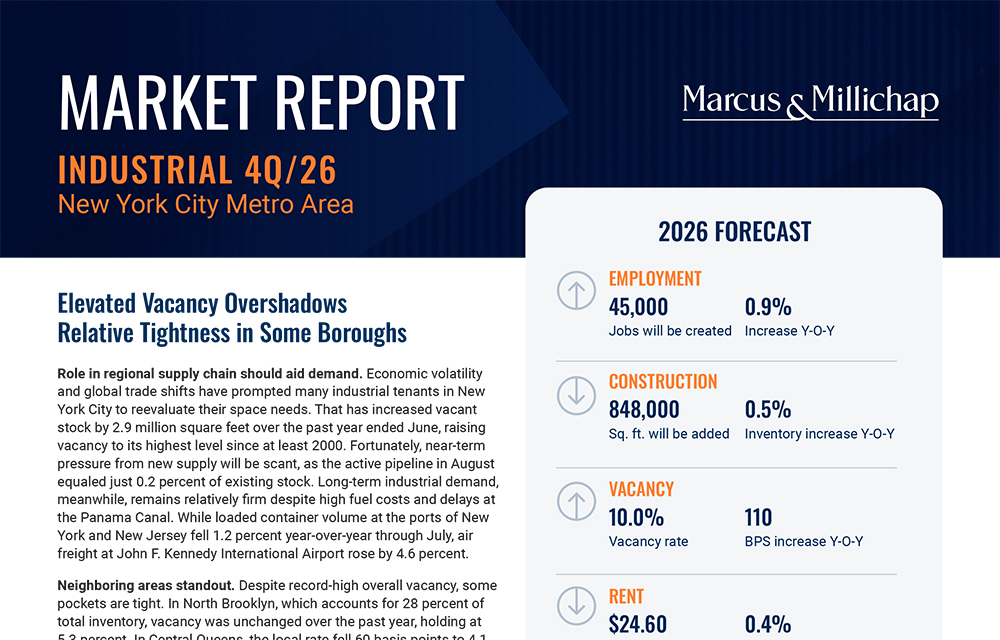
Marcus & Millichap releases fourth-quarter 2026 NYC industrial market report
Manhattan, NY Marcus & Millichap has published its fourth-quarter 2026 New York City Industrial Market Report. “New York City’s industrial market is showing a clear



Quick Hits
 (2).gif)

Columns and Thought Leadership

Hunt commercial real estate question and answer: Fortune 500 wisdom - by David Hunt
Yes, there are lessons to be learned from the largest companies in America when comes to managing your real estate. But the decision to buy or lease real estate may not be one of

New York’s streets are full again, and the retail numbers prove it - by Noam Aziz
Walk down any New York block this year and you can feel it. The sidewalks are crowded, the storefronts are lit, and the energy that defines this city is back at full volume.

Hunt CRE question and answer: Choosing a real estate agent - by David Hunt
First, we will only work with one agent exclusively. The primary reason is that we want that agent to legally represent our client’s interests. In New York State, a real estate agent has a fiduciary

The art of investing in real estate - by Thomas Donovan
Real estate investing is as much an art as it is a skill. No one can time the market, or the factors that drive it, perfectly. Location, zoning, size, transportation, and neighborhood density give you a baseline for
.gif)