



News:
Brokerage
Posted: January 10, 2017
Investment Sales: What does the yield curve really mean for real estate? By Miguel Jauregui
 Miguel Jauregui, Besen & Associates
With so much talk about the steepening yield curve, many investors have been laser-focused on how a rise in the 10-year Treasury rate (commonly accepted as the risk-free rate) could trigger a rise in cap rates, and therefore a fall in real estate values.
To provide some perspective, on December 1, 2016, the 10-year Treasury rate hit 2.45%, resulting in an increase of 85 bps over the running two month period beginning September 30, 2016. Other things equal, the 85 bps increase in the risk-free rate should increase cap rates by 85 bps.
For example, a property earning a $500,000 NOI priced at a 5% on September 30, 2016 would have lost $1.5 million in value over that two month period. This is intuitive given that investors expect to be compensated equally for their risk. However, investors must be cognizant of other variables in formulating their investment decisions in today’s environment.
Other factors to consider are capital and credit availability, inflation, supply-demand dynamics and the growth outlook. As for capital and credit availability, equity capital seems to be abundant as foreign money seems to flow to NYC as a safe haven market, however conventional credit is tightening and construction loans are almost non-existent. As for inflation, consider that real estate serves as a hedge against inflation in the form of increasing rent revenue, so in an inflationary environment real estate will be in greater demand. As for market supply, an investor must consider only “real” deals that are priced at or near market, seeing beyond the overwhelming amount of non-realistic deals out there. Investors agree that it’s rare to come across a “real” deal these days, and the few that are out there are getting aggressively chased by all-cash transactions. As such, most investors would agree that supply is low and demand is high. As for the growth outlook, an investor must consider the opportunity of an expanding market where potentially a rise in rent revenue could outpace the rise in cap rates, which in today’s NYC market is tough to make sense of.
No one can time the market with absolute certainty. However, taking into account the aforementioned, an investor could more confidently make the right buy and sell decisions. One thing is certain though, and that is that purchasing real estate at a cap rate near or below the risk-free rate is not sustainable. A wise man once told me that no one gets into real estate to lose money!
Miguel Jauregui is an investment sales director at Besen & Associates, New York, N.Y.
Tags:
Brokerage
MORE FROM Brokerage
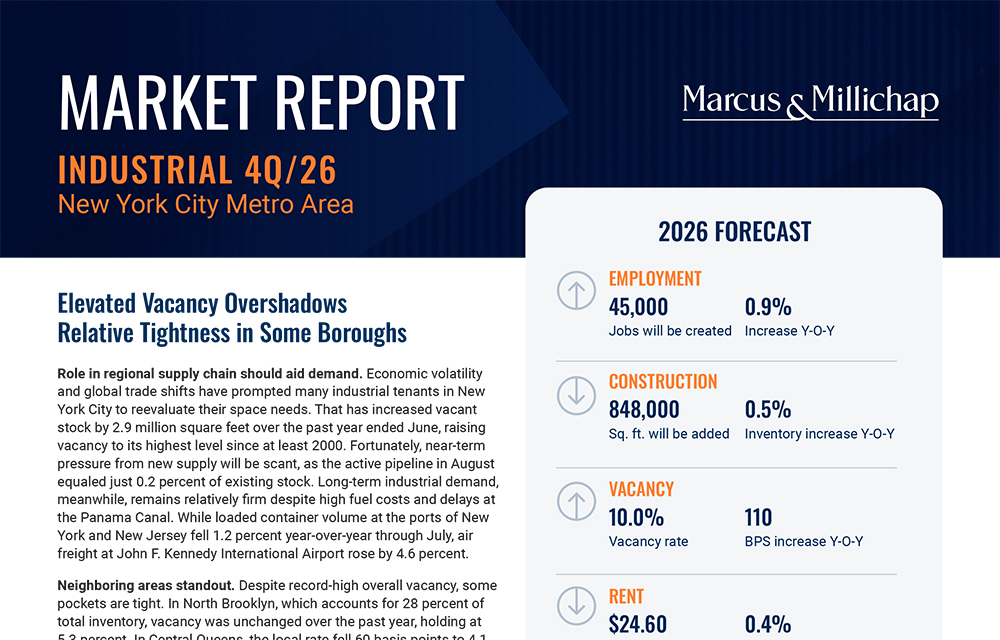
Marcus & Millichap releases fourth-quarter 2026 NYC industrial market report
Manhattan, NY Marcus & Millichap has published its fourth-quarter 2026 New York City Industrial Market Report. “New York City’s industrial market is showing a clear




Quick Hits

Columns and Thought Leadership

New York’s streets are full again, and the retail numbers prove it - by Noam Aziz
Walk down any New York block this year and you can feel it. The sidewalks are crowded, the storefronts are lit, and the energy that defines this city is back at full volume.

The art of investing in real estate - by Thomas Donovan
Real estate investing is as much an art as it is a skill. No one can time the market, or the factors that drive it, perfectly. Location, zoning, size, transportation, and neighborhood density give you a baseline for

Hunt commercial real estate question and answer: Fortune 500 wisdom - by David Hunt
Yes, there are lessons to be learned from the largest companies in America when comes to managing your real estate. But the decision to buy or lease real estate may not be one of

Hunt CRE question and answer: Choosing a real estate agent - by David Hunt
First, we will only work with one agent exclusively. The primary reason is that we want that agent to legally represent our client’s interests. In New York State, a real estate agent has a fiduciary
.gif)