


News:
Movers & Milestones
Posted: October 20, 2026
Wege Prize 2027 draws strongest, most diverse field to date in global design competition for the circular economy
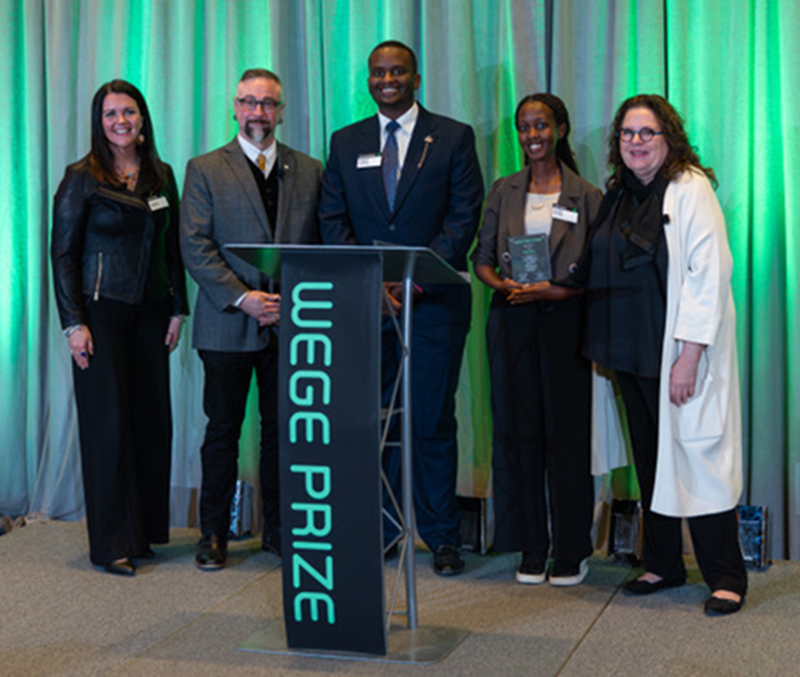 Grand Rapids, MI Wege Prize returns for its 14th year to inspire a record-setting global cohort of university students to develop game-changing solutions to some of the world’s most pressing problems.
The acclaimed international competition — organized by the Wege Center for Sustainable Design at Ferris State University’s Kendall College of Art and Design — fielded an unprecedented 175 team applications for 2027, the strongest and most diverse field of competitors in its history.
Wege Prize teams use their diverse perspective, skills, and experiences to collaboratively develop products and services that create unique value and solve real-world problems while benefiting people, businesses, and the environment. Each team consists of five members representing three or more academic disciplines from at least two institutions of higher education.
With an initial field of 90 accepted teams, Wege Prize 2027 welcomes 450 participants representing 51 countries, 209 institutions of higher education, and 206 unique academic disciplines — all record highs by a wide margin. The field includes 137 institutions and eight countries represented in the competition for the first time: Angola, Azerbaijan, Burkina Faso, Ecuador, El Salvador, Kazakhstan, Madagascar, Peru, and South Sudan.
“Circular thinking continues to expand on a global scale, and we’re excited to see it take stronger root across campuses in every kind of discipline, not just design,” said Wege Prize academic lead Gayle DeBruyn, a professor of design at Ferris State University. “That’s exactly what this moment needs — and exactly why Ferris State University is rising to meet it as an institution founded on the mission of creating opportunity for all. No single discipline can solve wicked problems alone, and Wege Prize brings students together across fields and borders to learn what it really takes to move circular solutions from idea to implementation.”
The Process: Innovation Through Iteration
Part competition, part global learning lab, Wege Prize immerses teams in an iterative design process. Teams hone an entry point into their chosen problem while developing a solution that’s rooted in the three core principles of the circular economy: eliminating waste and pollution, keeping products and materials in circulation, and regenerating natural systems.
As the competition progresses, teams refine their approach based on in-depth feedback from a multidisciplinary panel of expert judges, with five finalist teams ultimately invited to compete for cash prizes totaling $65,000 USD.
Past finalists have gone on to win further honors, gain wide recognition, and launch circular economy enterprises:
• 2025 winners AgPress were shortlisted for the 2026 Moonshot Idea Award after launching the final prototype of their closed-loop mealworm and maize farming system to fight malnutrition in Tanzania.
• 2023 winners Banofi had their bio-based leather alternative created from banana crop waste featured prominently at London Fashion Week 2026.
• 2018 winners Rutopia received two honors at the 2026 EY Entrepreneur Of The Year Mexico awards — Developing Company of the Year and Most Impactful Company of the Year—for their online platform that empowers indigenous communities to be players in the ecotourism industry without sacrificing environmental stewardship.
The Ideas: What 2027 Teams are Working On
Projects submitted to Wege Prize 2027 reflect the emerging global priorities for circular economy development articulated at this year’s Climate Week NYC and 2026 World Circular Economy Forum events. Those priorities include the following four categories.
Circularity as resilience and resource security – Many solutions focus on using circular design to withstand drought, heat, fire, supply shocks, and other destructive forces, including:
• A microalgae-driven pre-treatment process to make desalination 50% more energy efficient.
• A bio-based flame-retardant varnish for timber framing that leaves treated wood recyclable or biodegradable at the end of its life.
Moving from recycling to value retention – Other 2027 solutions aim to intervene before anything becomes waste, keeping food edible, equipment working, and critical materials usable for longer, including:
• A thin, flexible phase-change material affixed to solar panels to reduce operating temperature and prolong panel life.
• A biodegradable sachet that extends the shelf life of produce without refrigeration or chemicals.
Stronger metrics and clearer value propositions to drive investment – With finance remaining a formidable barrier to many circular businesses scaling beyond a pilot stage, other submitted solutions feature a built-in record of the measurable impacts of their circularity to enhance data reliability and validate standards and certifications, including:
• A GIS system to map building demolition sites as material repositories, creating a digital passport that matches each material to a best-fit reuse avenue.
• AI-powered software for EV battery producers to file accurate EPR data and more effectively assess and document the condition of retired batteries.
Products as services – Student teams also created solutions based on revenue models where companies retain ownership of materials throughout their life cycle, including:
• Biophotovoltaic cells that power farm sensors without lithium-ion batteries, offered as a subscription with equipment repair/replacement and technical support included.
• Bio-based, reusable protective food packaging that’s offered through a subscription model and circulates through a producer-controlled process.
The Perspective: Welcoming New Judges
Wege Prize’s preliminary judge panel welcomed five new members for the 2027 cycle, adding key expertise in materials, supply chain management, design, and systems thinking:
Kari Bliss – leader of sustainability strategy and market innovation at PADNOS, one of the most diversified industrial recyclers in the world, processing four billion pounds of metals, plastics, paper, and electronics annually.
Eugene Hooks – design consultant and 2025 Winston Churchill Fellow, fresh off a global tour engaging with designers, manufacturers, researchers, governments, educators, and innovators to explore what enables circular systems to move from ambition into practice.
Sam Simmons – global sourcing manager at General Motors, where he leads research and sourcing efforts focused on lower-carbon steel, aluminum, and resins — the latest role in a 15-year career spanning sustainable materials procurement, automotive program management, and international development.
Ann Verhey-Henke – collaboration design consultant and facilitation expert with over 25 years of experience helping organizations build capacity for collective impact. As co-founder of Campfire Gatherings, she works at the intersection of sustainability, public health, and energy — guiding diverse, multi-stakeholder groups in the co-creation of actionable strategies and visions.
Gabe Wing – vice president of sustainability at MillerKnoll, where he helps turn sustainability from aspiration into action. Since joining the company in 2001, he has worked across products, materials, operations, and partnerships to make sustainable design a driver of innovation.
Next Steps
Wege Prize’s preliminary judges will provide valuable feedback and expertise to all 90 accepted teams before advancing a selection of 30 teams to Phase 2 of the 2027 competition.
Ultimately, five finalist teams will present their fully developed solutions to the core judges and a live audience at the 2027 Wege Prize Awards on May 21, 2027.
MORE FROM Movers & Milestones
Wege Prize 2027 draws strongest, most diverse field to date in global design competition for the circular economy
Grand Rapids, MI Wege Prize returns for its 14th year to inspire a record-setting global cohort of university students to develop game-changing solutions to some of the world’s most pressing problems.



Quick Hits
 (2).gif)