


 (2).gif)
News:
Finance
Posted: March 21, 2011
How about a bail-out for legacy property owners?
For CRE owners who have weathered the economic downturn and are looking towards recouping their losses and becoming active once again, the underutilized tool of cost segregation can provide an upper hand in a market that is steadily growing more competitive.
As the economy continues to slowly shake off the recession, the mood at the recent CREF conference in San Diego was one of "cautious optimism." With the recovery underway, CRE Owners can now begin to change their focus from mere survival and carefully holding onto tenants, to expanding the base. Despite the economic progress, this is no easy task for many legacy property owners who bought at the height of the market and are now constrained by high vacancy rates, ongoing repairs and maintenance, and now the need to "entice" new tenants. Furthermore, as the Wall St. financing machine gears up and capital starts to flow once again, CRE properties will trade at lower values, putting more pressure on asking rents.
CRE Bailout = Cost Segregation
CRE Owners can get some relief in the form of cost segregation. In addition to streamlining all operating costs, cost segregation can increase cash flow from one of the most unlikely sources-the IRS. Over the last three years, the government has doled out, or more appropriately "bailed out," our private sector in excess of the GDP of countries like Australia, Italy, and of course, Greece.
What some owners overlook is that CRE's bailout has been here for a long time and comes in the form of the ability to accelerate depreciation on capital improvements. Over the last 12 years, through case law and economic stimulus measures, owners have had the ability to write-off improvements at an ever-increasing pace. If the most recent round of stimulus measures, including 100% bonus depreciation under IRC §168(k) or the expansion of expensing election under IRC §179 for qualified property does not work, what is the next step? Writing-off land and building in year one is not the solution.
How to Maintain
Property Competitiveness?
Whether you call it cost segregation, cost seg, or component depreciation, it all boils down to increasing the depreciation deduction "now." Through the use of cost segregation, an owner can segregate capitalized costs to shorter recovery periods, and in some cases write-off entire expenditures. This reduces taxable income and frees up capital for tenant improvements and/or rent concessions.
By segregating various building and tenant improvements into accelerated recovery categories, a taxpayer can significantly increase cash flow through the deferment of taxes. Why wait 39 years to recover costs compared to 15, seven or even five years?
What is Involved?
Cost segregation entails a thorough evaluation of all the building's depreciable improvements, reconciling their cost with the depreciable basis, and then segregating such costs into the appropriate asset classifications.
The norm is that an owner of a new construction or a recent acquisition will have a cost segregation study completed. However, it also applies to properties purchased as far back as 1987. A cost segregation study can provide the support to justify all of the missed depreciation in the current year without amending any returns. If an owner purchased a property that included paving, curbing, sidewalks, lighting, utilities, specialty electrical, plumbing, ventilation, cabinets, countertops, carpeting, vinyl tiling, specialty display lighting, etc., and is depreciating all of these improvements over 39 years, you have a candidate.
Part 2 of this article will appear in the April 19th Financial Digest.
Mark de Stefanis is the president of Construction Cost Recovery, Inc., White Plains, N.Y.
Tags:
Finance
MORE FROM Finance
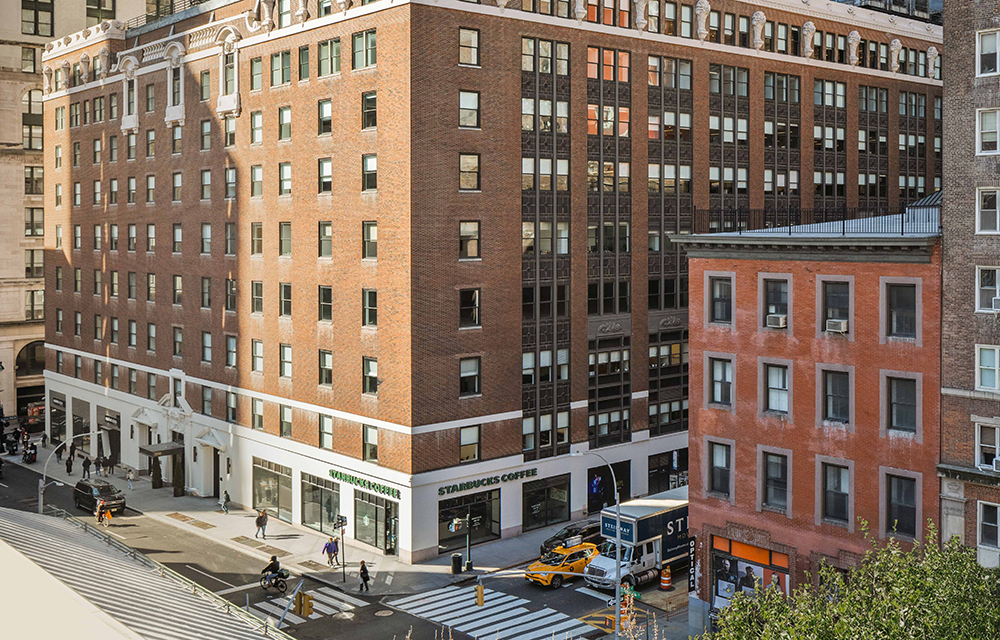
George Comfort & Sons completes $386 million refinance of 200 Madison Ave.
Manhattan, NY George Comfort & Sons, and its partners Loeb Partners Realty and Jamestown, completed a $386 million refinancing of 200 Madison Ave., its 750,000 s/f Grand Central district office

 (2).gif)

.jpg)

