



News:
Brokerage
Posted: February 18, 2011
Governor proposes decline in state spending in executive budget
There is some good news for all taxpayers in governor Andrew Cuomo's 2011-12 Executive Budget released on February 1. The Executive Budget closes a $10 billion deficit "without raising taxes or borrowing." The governor's budget totals $132.9 billion, a decrease of 2.7%, or $3.7 billion from last year's adopted budget. This proposed decline in state spending achieves an important REBNY priority for this year and represents the governor honoring a major campaign promise.
This is a critical first step in living within our means and in the long term effort to restore fiscal responsibility to state operations. Over the last decade, average state spending has increased 5.7% a year, exceeding the growth in tax receipts (3.8%), personal income (3.7%) or inflation (2.4%). In his budget address, the governor stressed that for New York to thrive we must "make hard choices and set our state on a new path toward prosperity."
One critical budget reform is to end formula-driven spending increases. In a New York Post article the day before the budget release, the governor explained that the "deficit" is the difference between the state's revenue and its projected growth in spending. What he highlighted in the article, however, is that in a number of areas (predominantly in education and Medicaid) the growth in annual spending is driven by formulas that are legislatively built into the programs. As a result, the growth in spending is not driven by costs, or by improvements in the quality of the services or in additional services. It is simply increased by the formula.
This year, the various formulas for Medicaid and education call for a 13% increase in each over last year's spending levels. This budget practice has, as the governor said, "Brought New York to the brink and it is why we are the highest 'spending and taxing' state in the nation with programs that fail to perform for the people. This all must end."
In addition to ending formula driven spending increases, the governor's Executive Budget calls for nearly a $1 billion reduction in Medicaid spending and a $1.5 billion reduction in education spending from last year's spending levels. The impact of these reductions will be difficult for all New Yorkers. However, the largest percentage cut (10%) in the budget will be in funding state operations, demonstrating that the state is prepared to tighten its belt and do its part.
Another concern with our spending on Medicaid and education, we spend too much and get too little in return.
According to the governor, "We are number one in spending on education and number 34 in results. We are number one in spending on healthcare and number 21 in results." Moving forward we must spend less, but spend it more wisely and productively.
The governor has recognized the need to promote job creation and has amended the recently enacted Excelsior Jobs Tax Credit program. He proposes to extend the current tax benefit period to 10 years from 5 years and remove the $5,000 cap on the jobs credit.
In addition, the governor has created Regional Economic Development Councils that would promote partnerships with the private sector and that would compete for funding based on the best jobs development plans.
To enact the important provisions in the 2011-12 Executive Budget, the governor will need the support of the legislature to reduce government spending, to hold the line on taxes and to bring about fiscal practices that produce structurally-balanced budgets for years to come.
As you know, REBNY and a handful of members have played a role in supporting the "Committee to Save New York." The advocacy of REBNY and the committee for a budget that matched spending with revenue without raising taxes was an important factor in the responsible budget presented by the governor.
This budget battle will continue to require the support of the business community. To lend your support, go to the REBNY Action Center (www.rebnyactioncenter.com) and contact your elected officials urging them to support the governor's budget.
Steven Spinola is the president of REBNY, New York, N.Y.
Tags:
Brokerage
MORE FROM Brokerage
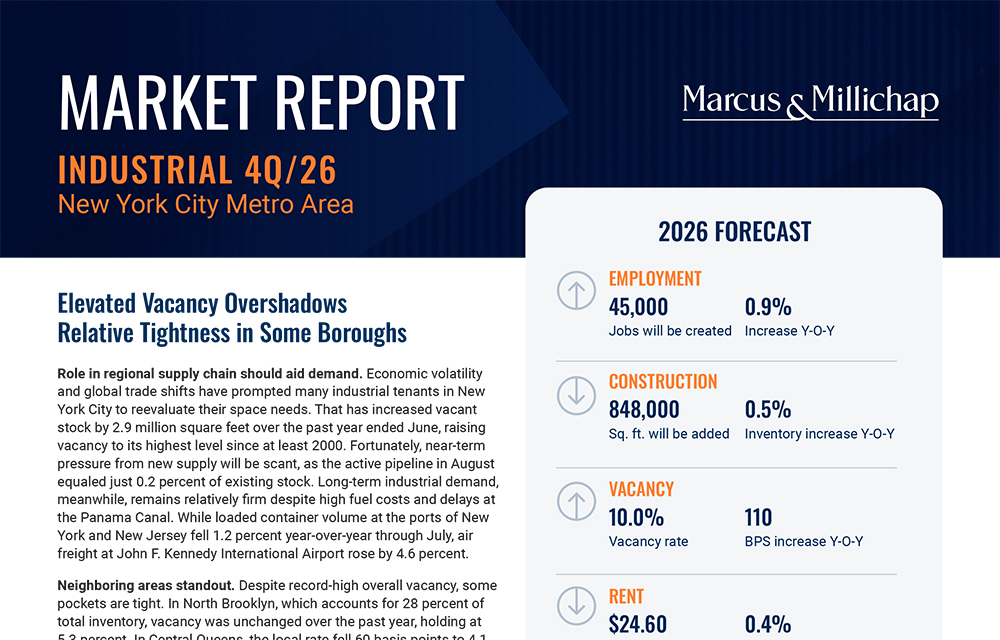
Marcus & Millichap releases fourth-quarter 2026 NYC industrial market report
Manhattan, NY Marcus & Millichap has published its fourth-quarter 2026 New York City Industrial Market Report. “New York City’s industrial market is showing a clear






Quick Hits

Columns and Thought Leadership

Hunt commercial real estate question and answer: Fortune 500 wisdom - by David Hunt
Yes, there are lessons to be learned from the largest companies in America when comes to managing your real estate. But the decision to buy or lease real estate may not be one of

The art of investing in real estate - by Thomas Donovan
Real estate investing is as much an art as it is a skill. No one can time the market, or the factors that drive it, perfectly. Location, zoning, size, transportation, and neighborhood density give you a baseline for

New York’s streets are full again, and the retail numbers prove it - by Noam Aziz
Walk down any New York block this year and you can feel it. The sidewalks are crowded, the storefronts are lit, and the energy that defines this city is back at full volume.

Hunt CRE question and answer: Choosing a real estate agent - by David Hunt
First, we will only work with one agent exclusively. The primary reason is that we want that agent to legally represent our client’s interests. In New York State, a real estate agent has a fiduciary
.gif)