



News:
Brokerage
Posted: November 25, 2013
Frame joins Massey Knakal's capital services division as a director
According to Massey Knakal Realty Services, Patrick Frame has joined the capital services division as a director. Frame will utilize Massey Knakal's deep relationships with the lending community to procure the most effective financing in the commercial real estate debt markets for assets located throughout the New York metropolitan market. His focus will be on Washington Heights and Inwood.
"We are delighted that Patrick has joined our team as we continue our expansion into the mortgage brokerage business," said Garrett Thelander, executive managing director of Massey Knakal's capital services division.
Prior to Massey Knakal, Frame was a portfolio manager at E1 Asset Management in Manhattan. In this role, he traded large cap companies for both short and long term investment goals utilizing a fundamental value approach. Together with his groups emphasis on macro economic strategy he analyzed capital market data and developed research reports in the energy, oil and gas, and equity markets. Frame built and maintained relationships with a network of both international and domestic clients including high net worth individuals, C-level executives and corporate clients. He also evaluated client portfolio variance risk, specializing in CAPM (Capital Asset Pricing Model) for individual client risk profiles and to determine appropriate return for aggregate asset classes against systematic risk. During his tenure his aggregate trailing twelve month performance achieved approximate 20% return on investment.
Earlier, Frame was a field marketing representative at Jetro Holdings Inc. in College Point, where he brought in 200+ new clients during his first quarter of employment and increased Mid-Atlantic sales volume and regional customer base by 30% in the foodservice sector He also spent time at Bruno Scheidt, Inc. in Manhattan, an import/export and distribution company, as a sales associate, summer credit analyst, and summer accounting analyst.
Frame studied political science at LaSalle University, where he was VP and secretary of Phi Kappa Theta. He earned his bachelor of arts degree in Economics with a minor in Business Administration from Fordham University. He achieved three varsity letters for Division I swimming and he is fluent in Spanish. He can be reached in the Manhattan office.
Tags:
Brokerage
MORE FROM Brokerage
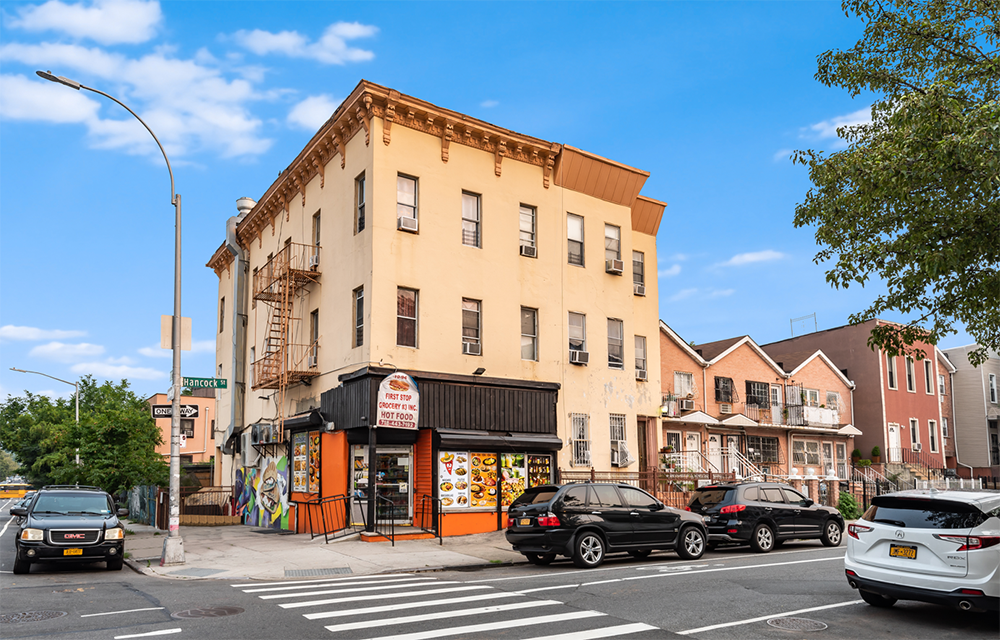
Investment Property Realty Group closes $1.75 million sale of 1094 Hancock Street in Brooklyn
Brooklyn, NY Investment Property Realty Group (IPRG), a New York-based commercial investment firm, has closed the sale of 1094 Hancock St., a mixed-use building in the Bushwick section, for $1.75 million.




Columns and Thought Leadership

Hunt commercial real estate question and answer: Fortune 500 wisdom - by David Hunt
Yes, there are lessons to be learned from the largest companies in America when comes to managing your real estate. But the decision to buy or lease real estate may not be one of

Hunt CRE question and answer: Choosing a real estate agent - by David Hunt
First, we will only work with one agent exclusively. The primary reason is that we want that agent to legally represent our client’s interests. In New York State, a real estate agent has a fiduciary

A guide to finding the right NYC property management company - by Sanjay Gandhi
Being a small to midsize landlord in NYC is an increasingly demanding endeavor. From navigating complex regulations, increased compliance demands to dealing with tenant issues and remediating violations. It is wise to enlist the assistance of a partner, a professional

New York’s streets are full again, and the retail numbers prove it - by Noam Aziz
Walk down any New York block this year and you can feel it. The sidewalks are crowded, the storefronts are lit, and the energy that defines this city is back at full volume.
.gif)