



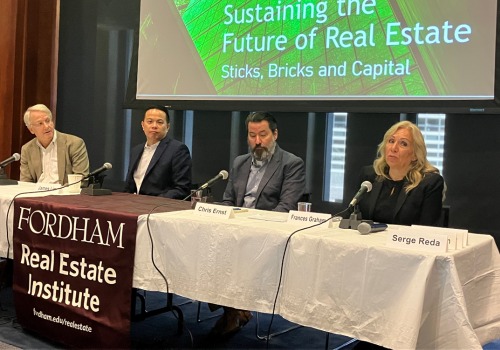
New York, NY Fordham Real Estate Institute (REI) hosted the “Sustaining the Future of Real Estate” at Fordham University’s Lincoln Center campus Oct. 6, both in-person and virtually.
The first panel, “Sustainable Design, Architecture and Construction,” was moderated by Serge Reda, chair of the REI Curriculum Committee and director of development and construction at Cedar Realty Trust. The panel featured Chris Ernst, AIA, LEED AP, and principal at Perkins Eastman; Rob Willis, head of construction at MAG Partners; James Lin, P.E., LEED AP, CPHD, and associate partner at Jaros, Baum & Bolles; and Frances Graham, RA, LEED AP ID+C, WELL AP, senior managing director-project manager for the Northeast Region at Newmark.
Ernst remarked that a project’s efficiency is now a measure of design quality but it’s important to remember “we’re being graded on a curve that keeps changing.” He predicts “an understanding of building performance will become increasingly important across our industry.”
Willis said, “Despite economic pressures and tension in terms of cost, it’s better to pivot from conventional ways to make sure buildings won’t be obsolete in five years.”
Graham said Local Law 97 in New York City has made it so there is “more accountability on everyone involved in a project,” including eventual end users. “It’s important to educate tenants on energy use so that there is a lesser burden of fines passed on to them.”
“We’re finding the fines are significant – about one to two percent of the annual total operating cost,” said Lin. “However, the majority of operating costs are utilities so if you’re able to ratchet the energy usage down, you not only decrease the fines – you make the building less expensive to operate overall.”
“Smart property owners should review the building’s performance annually,” said Willis. “Once we design, construct, and do initial commissioning, we turn it over and it's up to the operator and it’s their responsibility from there.”
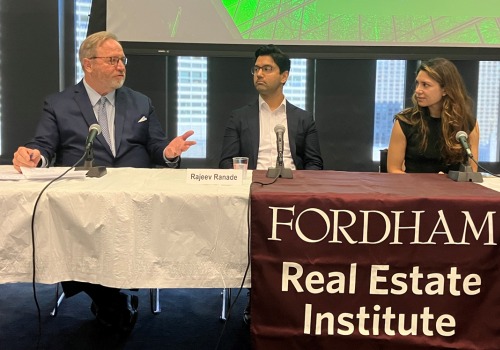
The second panel, “Sustainable Lending and Investing,” was moderated by Melissa Reagen, managing director and portfolio manager at Nuveen LLC. The panel featured Stephen Ceurvorst, CEO and managing partner at Lord Capital and LordCap Green; Alexandra Cooley, CIO and co-founder at Nuveen Green Capital; and Rajeev Ranade, partner at Climate Core Capital LLC.
Cooley explained what C-PACE (Commercial Property Assessed Clean Energy) financing is for attendees. “C-PACE is a very senior assessment on a piece of real property that simplifies the standardized credit equation to finance energy, efficiency and solar in commercial real estate,” he said.
“The ESG (environmental, social, and governance investing) movement will continue to grow C-PACE’s popularity, because we’re impact investors and can show that we’re financing energy efficiency to deliver better buildings to our society,” said Ceurvorst.
The panel spent time discussing some common misconceptions.
“The education on C-PACE is very fragmented. As a user of this financing, if you’re going to get a senior loan and the lender sees C-PACE as equivalent to mezzanine financing, that’s a very different conversation as someone who sees it as a special assessment for the improvement of the building’s long-term viability. We see it in the latter bucket,” said Ranade.
Ceurvorst said, “C-PACE is a public-private partnership that allows our private capital to partner with local tax authorities in the form of a property tax on the special assessment so that we’re not taking all the risk of a commercial mortgage provider. We are the kind of taxes that everybody loves because we’re voluntary, and we have data to support exactly what we’re financing.”
The event included an introduction from Neil Madsen, principal at Madsen Advisors, and part of the Real Estate Institute’s Executive Advisory Committee.







.gif)