



News:
Brokerage
Posted: May 26, 2015
Common stinging insects - commercial pests in New York
When stinging insects infest your place of business, you face a problem with the potential to seriously impact your bottom line. Bees, wasps, hornets and yellow jackets can become a real problem for employees, tenants and customers.
Some of the more aggressive species can become downright dangerous. A disturbed nest could trigger a swarm of thousands of individual insects.
More common are everyday nuisances. Hives near store doors, will drive customers away. Bees and wasps within work spaces disrupt employees. A serious infestation can be grounds for a tenant to break a lease or get rent abatement. Commercial real estate managers need to take stinging insects seriously.
Don't be tempted to take on bees and wasps on your own. While employees cowering from bees in the lunch room may make you want to break out a can of insecticide and start spraying, don't do it for the following reasons:
1) It is illegal in New York (and most other states) for a non-licensed person to treat any kind of insect or rodent pest in a commercial building.
2) Training is what gives the professional the knowledge to choose the treatment appropriate to the specific pest. The right product needs to be applied the right way at the right time in the right place. Used properly, pest control methods are not risky for pets or people. Misuse, however, can cause serious harm.
3) Stinging insects are particularly difficult to treat on your own. You run the risk of getting stung - or provoking a swarm attack. Common sprays kill the individuals you see, but rarely impact the entire nest. And if you don't stop the problem at its root and close off nesting sites and access, the hive can return.
It is imperative to get professional help when dealing with stinging insects in a commercial environment. To make sure you find competent help here are some key things to look for:
1) Accreditation by the Better Business Bureau means the company has met certain standards of trustworthiness, with validated truth of claims, record of honoring promises, responsiveness to customers, and safeguarding the privacy of customer data.
2) State certificates are up to date and complete.
3) Companies that have more than the minimum certification. Ratings like Quality Pro by the National Pest Management Association are earned by a small fraction of providers who have gone the extra mile in hiring and employee screening, environmental stewardship, and most importantly, comprehensive training.
4) Green pest management certification and a use of an Integrated Pest Management (IPM) approach. IPM is an environmentally sensitive philosophy that makes use of a variety of tools in combination to maximize effectiveness and minimize impact on people.
5) Availability of a comprehensive 12 month service contract. If you have one kind of pest, you are likely to have others. A service contract often pays for itself in finding and eliminating pests before they grow into big problems.
Arthur Katz is CEO of Knockout Pest Control, Uniondale, N.Y.
Tags:
Brokerage
MORE FROM Brokerage
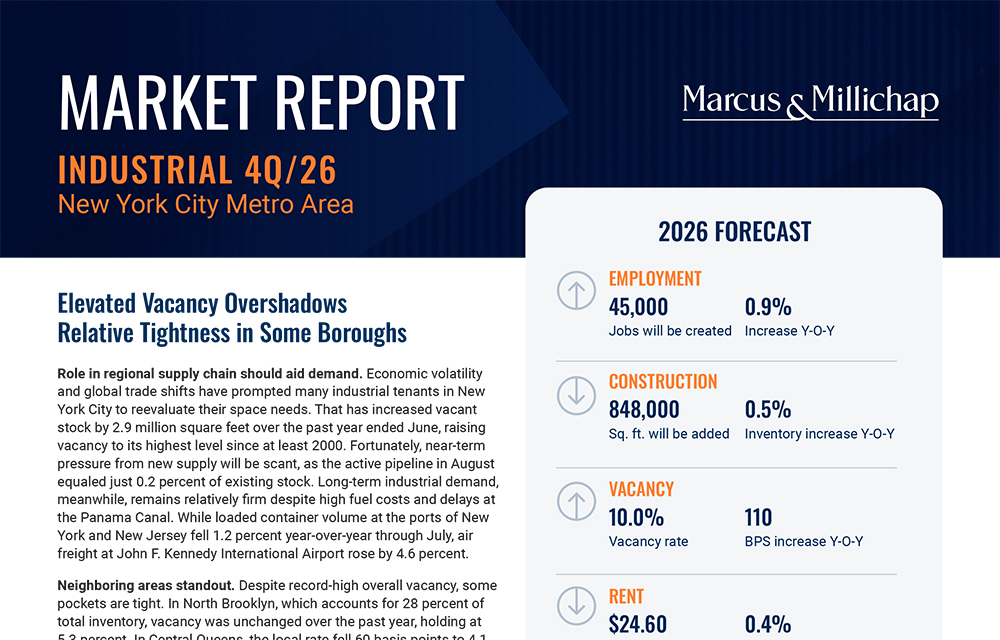
Marcus & Millichap releases fourth-quarter 2026 NYC industrial market report
Manhattan, NY Marcus & Millichap has published its fourth-quarter 2026 New York City Industrial Market Report. “New York City’s industrial market is showing a clear





Quick Hits
 (2).gif)

Columns and Thought Leadership

New York’s streets are full again, and the retail numbers prove it - by Noam Aziz
Walk down any New York block this year and you can feel it. The sidewalks are crowded, the storefronts are lit, and the energy that defines this city is back at full volume.

Hunt commercial real estate question and answer: Fortune 500 wisdom - by David Hunt
Yes, there are lessons to be learned from the largest companies in America when comes to managing your real estate. But the decision to buy or lease real estate may not be one of

Hunt CRE question and answer: Choosing a real estate agent - by David Hunt
First, we will only work with one agent exclusively. The primary reason is that we want that agent to legally represent our client’s interests. In New York State, a real estate agent has a fiduciary

The art of investing in real estate - by Thomas Donovan
Real estate investing is as much an art as it is a skill. No one can time the market, or the factors that drive it, perfectly. Location, zoning, size, transportation, and neighborhood density give you a baseline for
.gif)