


News:
Owners Developers & Managers
Posted: June 15, 2026
Assemblymember Braunstein, senator Stavisky, co-op leaders celebrate expansion of J-51 Program
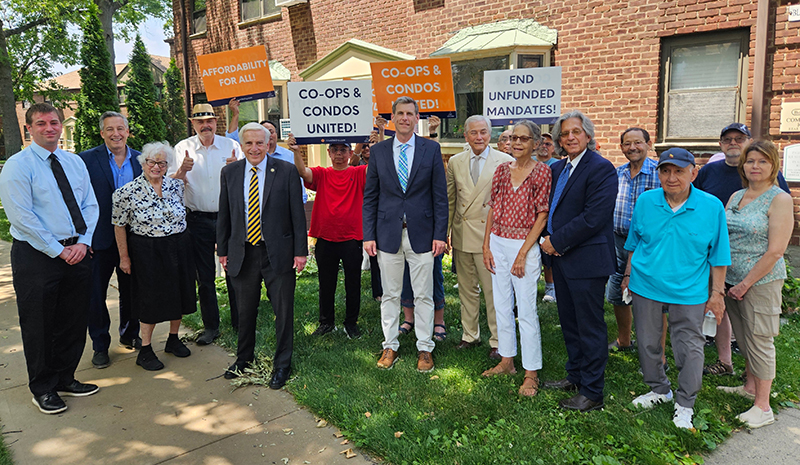
Douglaston, NY Assemblymember Braunstein joined local co-op leaders, shareholders, and elected officials to celebrate the renewal and expansion of the J-51 program: a longstanding New York City tax incentive that helps offset the costs of capital improvements, such as heating system replacements, plumbing and electrical upgrades, and energy efficiency measures, in eligible rent-regulated rental buildings, cooperatives, and condominiums.
The state legislature renewed and expanded New York City’s J-51 program as part of the Enacted NYS Budget. The program was renewed for 10 years, and the average assessed value eligibility threshold was raised from $45,000 to $60,000. The eligibility threshold will increase annually based on changes to the consumer price index. The new version of the program also allows co-ops to use the abatement to cover the J-51 application fees.
These positive changes will ensure that more middle-class co-ops, including Beech Hills, can apply for this vital tax relief to support capital repairs. An estimated 1,500 co-op and condo properties citywide are newly eligible.
“I have been a longtime supporter of the J-51 program, which offers residential buildings essential tax relief to support capital repairs,” said Braunstein. “Co-ops are a cornerstone of middle-class housing in Queens, and by renewing and expanding the J-51 program, we are helping to preserve affordable homeownership in New York City. This is a major victory for our middle-class co-ops, and I thank governor Hochul, senator Stavisky, and all of the co-op and condo advocates who partnered with me to make it possible.”
“Across New York City, co-ops and condos are facing an aging infrastructure and rising construction costs at the same time,” said senator Toby Ann Stavisky. “J-51 helps these buildings make essential repairs without passing the full cost on to residents. The expansion raises the eligibility threshold, indexing it to inflation, increases the benefit, and lowers the cost of applying, so more buildings can qualify and keep homeownership affordable. We fought and negotiated for this reform because protecting the long-term stability of our co-ops and condos protects the families who live in them. I thank assemblymember Braunstein, my colleagues in the legislature, and the governor for helping to keep housing affordable.”
“Affordability is the number one issue facing families across our region, and that includes the thousands of co-op owners who are struggling with rising costs,” said congressman Tom Suozzi. “The renewal and expansion of the J-51 program will help buildings make critical repairs, modernize infrastructure, improve energy efficiency, and meet environmental goals without placing an even greater burden on residents. I commend assemblymember Braunstein for his leadership and his continued efforts to strengthen this program for middle-class homeowners.”
“The passage of the J-51 program is a critical lifeline for residents of co-ops and condos facing significant costs to comply with New York City’s climate mandates,” said council member Linda Lee, chair of the committee on finance. “Since the passage of Local Law 97, residents have expressed concerns about being priced out of their homes due to the expense of necessary repairs and building upgrades. I am grateful to assemblymember Braunstein for his leadership in advancing this legislation, as well as to the PCCC and our co-op and condo communities for their tireless advocacy on this important issue. Together, alongside initiatives being pursued at the city council level, I remain committed to supporting policies that protect affordability and preserve our cooperative housing communities.”
“We are excited about the new J-51 program. It is a big deal and means more middle-income and affordable co-ops, like Glen Oaks Village and Beech Hills, will now qualify for its tax abatement benefits,” said Bob Friedrich, co-president of the Presidents Co-op & Condo Council (PCCC) and president of Glen Oaks Village. “By helping our residential co-op communities afford those urgent capital improvement projects, this new J-51 program will keep NYC’s aging residential housing stock in good condition. In addition, the previous J-51 program’s high application costs have now been capped and can be included as part of the capital improvement project cost that will be refundable as tax abatements over a multi-year period. Even the value of the abatement under the new J-51 has increased significantly from covering 70% of the capital improvement costs to 100%. This is the type of legislation that may not be the headline-grabbing news flash or the intrigue of a who-done-it crime story — but rather, it’s a story of keeping buildings standing, structurally sound and helping working-class communities remain stable and safe.”
“I would like to thank assemblymember Edward Braunstein and senator Toby Ann Stavisky for their leadership in expanding eligibility for the J-51 program,” said Geoffrey Mazel, executive member, Co-ops & Condos United of New York (CCU). “These changes will make capital improvements more affordable for many working and middle-class cooperative and condominium communities and help preserve the affordability of homeownership throughout New York City.”
“The renewal and expansion of the J-51 program is a massive victory for middle-class housing in Queens,” said Warren Schreiber, co-president of the Presidents Co-op & Condo Council (PCCC) and president of Bay Terrace Cooperative Section I, Inc. “These tax incentives are a financial lifeline, allowing co-ops to fund critical infrastructure upgrades without passing unsustainable costs onto hardworking shareholders. We are incredibly grateful to assemblymember Braunstein for his unwavering leadership in protecting housing affordability.”
MORE FROM Owners Developers & Managers

76% of flex operators plan to expand in the next 12 months driven by increasing occupancy, according to Workthere survey
Manhattan, NY Savills flexible office specialist Workthere, has revealed that more than three quarters (76%) of the flex operators surveyed worldwide as part of its 2026 Flexmark



Quick Hits
 (2).gif)

Columns and Thought Leadership

New York City’s historic rent freeze now rests with the courts - by Ron Cohen
New York City’s first-ever two-year rent freeze is now in the hands of a state Supreme Court judge, and the decision could reset income for owners of roughly one million rent-stabilized apartments housing some 2.4 million residents.

Hunt Commercial Real Estate Q&A: Location, location, location? - by David Hunt
In working with our clients, we break down our search objectives into two categories. The first category involves the specific needs of your business such as warehouse height, amount of office space and number of loading
NYC's Community Opportunity to Purchase Act is back - and multifamily owners should pay attention - by Ron Cohen
New York City’s Community Opportunity to Purchase Act (COPA) is back, and this latest version could have a much better chance of becoming law. The proposal would give qualified nonprofit organizations

Don’t leave severance damages behind - by Sebastian Jablonski
When the government takes a portion of a landowner’s property, most assume just compensation stops at the value of the land taken. However, in partial takings, that is only half of the equation.