



News:
Brokerage
Posted: January 25, 2022
2022 multifamily strategy: Buy in New York, sell in the south - by Lev Mavashev

New York’s multifamily investment sales sector is emerging, battered and bruised, from what has been its most tumultuous bear market in recent history - and investors are gearing up to flip the format on a trend that has seen money stream into southern markets to bring it back to the Big Apple.
Investors with faith in the city are employing palliative strategies to cash in on the supercharged Sunbelt and reinvesting their profits in the city’s multifamily sector where they see opportunity for rapid growth, diversification, stability and limited risk in a market showing signs of its old self.
According to the November 2021 apartment leasing report from Douglas Elliman, leasing rates here increased over 11 consecutive months following the initial shock of the global pandemic. Sales in the fourth quarter rose to their highest total for a fourth-quarter in 32 years, according to the brokerage.
Yet when it comes to investment sales, almost all of this year’s top-ranked multifamily markets are in faster growing southern and western regions, according to PWC. Growth has been explosive in areas including Phoenix, Charlotte and Nashville where harried investors chased the masses we read were leaving behind big cities for more space and cheaper living costs.
But the multifamily rush has caused investors to flood those markets, creating intense competition and elevated pricing that has now driven cap rates to record lows. I too am an investor in those markets, and I am barely seeing any deals above a 4%-Cap range.
Meanwhile, the big cities like New York that previously dominated the multifamily investment sector have seen cap rates swell to their highest levels in years. COVID worsened a blight that started with the 2019 Housing Stability and Tenant Protection Act (HSTPA) and drove many investors to mine outlier regions for profit.
But now they are coming back. As one client told me, “I’m selling a multifamily complex at a 3.7% Cap - I just don’t know what buyers see here. I’d rather buy a 5% Cap in New York City.”
Indeed, he and many others like him are now actively bidding on deals in Manhattan and Brooklyn as they look to capitalize on the red hot market in the south to reinvest in New York City. Institutional investors are also circling NYC looking to relieve COVID-weary local landlords of assets. In October, Carlyle Group acquired the six-story Knitting Factory Lofts in Clinton Hill for $34 million and, a month later, 22-22 Jackson Ave., one of Long Island City’s newest apartment buildings, for $85 million. HUBBNYC paid $105 million for the 141-unit rental building at 56 West 125th St. last September and a group of institutional investors sold a 71 percent stake in 5,881-unit Starrett City in a September deal that valued the complex - now known as Spring Creek Towers - at $1.8 billion and clocked in as the biggest property trade in the city since 2018.
These big investors are taking advantage of the COVID upheaval to go against the tide to lock down stable investments in a market with traditionally high rental demand before they read in the news that New York’s recovery is well underway. While it’s yet to become a massive national movement, it’s a trend I am seeing, and one I am sensing we will see more of in 2022. Despite all the investment activity in the south, NYC is still the country’s largest multifamily market, with over two million apartment units, and its proving to be resilient.
Big cities such as New York still have the most job opportunities, entrepreneurial and investment opportunities and history has shown us that every time there is a dip, big cities come roaring back with a vengeance.
When Newmark examined past market shocks, including the 9/11 terrorist attacks and the global financial crisis, the company’s report demonstrated New York’s resilience. The downturn caused by 9/11 lasted 13 quarters, according to Newmark, and it took nine quarters for the market to recover and indeed, surpass pre-9/11 numbers. For six quarters during the financial crisis, Manhattan asking rents fell to $71.26 per s/f. That recovery took 22 quarters but, by 2015, asking rents had rebounded to $72.56 per s/f.
We’ve seen many buyers enter the market this year after we hit what is now recognized as the bottom in 2020. They are buying because they are excited about NYC again and, if the trend continues, we’re likely to see 4% cap deals again in 2022. What I am telling my clients is not to wait until they read about recovery in the news because, by that time, the trend will be stale. Fear has created a window in the NYC market and the key for investors is to take advantage of that before the inevitable recovery occurs.
Furthermore, with the expectation of rising rates, investors are starting to remember that NYC multifamily values will hold well during a rising interest rate environment. That multifamily complex in the south, historically have been very sensitive to interest rate changes. An increase in 50 basis points can shoot up the cap rate tremendously. NYC multifamily historically has hardly seen a drop in values during rising interest rates.
HSTPA and COVID have created record high cap rates on multifamily assets in New York City but now, they are starting to compress as prices increase and the rental market recovers. Relatively speaking, cap rates are still higher than they were before COVID when we were selling assets at sub-four percent caps. Currently, we are selling fully free market buildings in decent locations at around 5% cap and rent stabilized buildings at mid-to-high 5% caps. I have clients selling multifamily assets in FL and GA sub-4% caps and buying over 5% cap deals in New York City
These numbers are telling us that reports of NYC’s death have been greatly exaggerated. People really want to be here – and shrewd investors are following them.
Lev Mavashev is principal at Alpha Realty, New York, N.Y.
Tags:
Brokerage
MORE FROM Brokerage
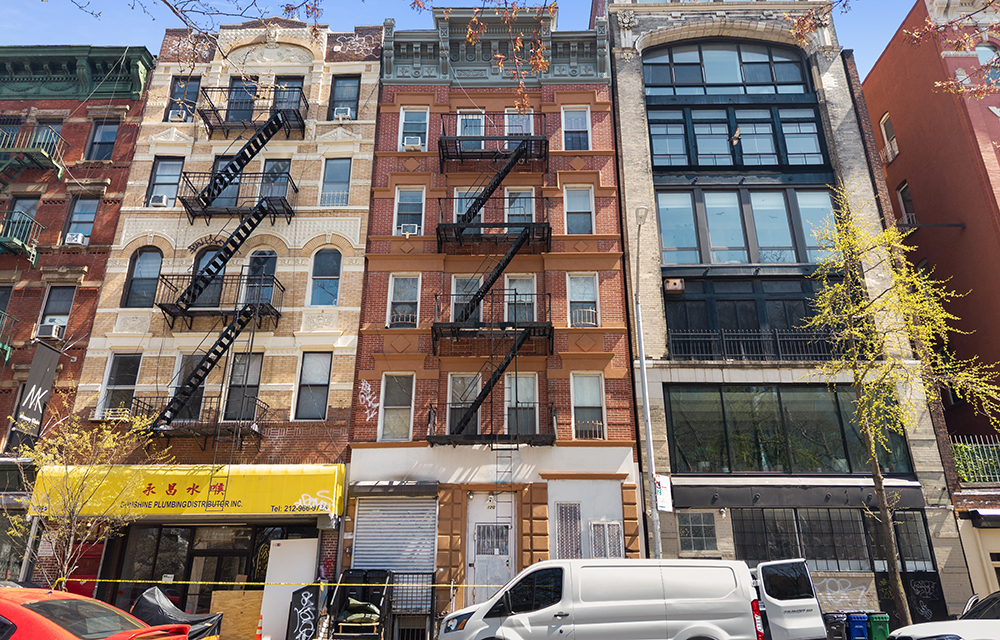
Investment Property Realty Group sells 120 Forsyth St. for $1.35 million
Manhattan, NY Investment Property Realty Group (IPRG) closed the sale of 120 Forsyth St., a mixed-use building located in the Lower East Side section of the city, for $1.35 million.



Quick Hits

Columns and Thought Leadership

Hunt commercial real estate question and answer: Fortune 500 wisdom - by David Hunt
Yes, there are lessons to be learned from the largest companies in America when comes to managing your real estate. But the decision to buy or lease real estate may not be one of

New York’s streets are full again, and the retail numbers prove it - by Noam Aziz
Walk down any New York block this year and you can feel it. The sidewalks are crowded, the storefronts are lit, and the energy that defines this city is back at full volume.

A guide to finding the right NYC property management company - by Sanjay Gandhi
Being a small to midsize landlord in NYC is an increasingly demanding endeavor. From navigating complex regulations, increased compliance demands to dealing with tenant issues and remediating violations. It is wise to enlist the assistance of a partner, a professional

Positive forecast for New York’s pro-housing push? - by Philip Butler
New York’s housing crisis remains a hot button topic despite growing consensus that varied and affordable housing is desperately needed statewide. Governor Hochul has recently introduced several initiatives to overcome N.Y.’s anti-housing
.gif)