



News:
Brokerage
Posted: March 28, 2019
Avison Young New York and Akerman LLP host “Why Amazon Should Stay” event on March 21st
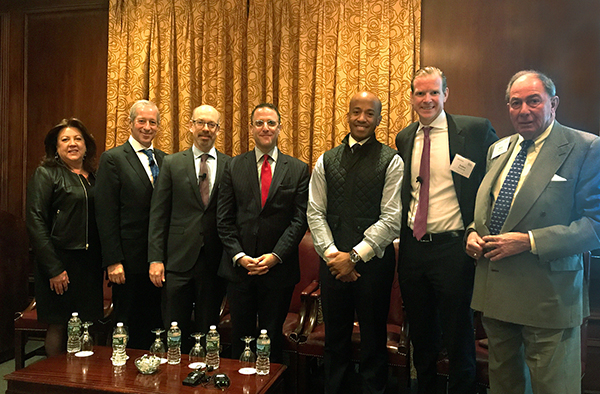
New York, NY On March 21, Avison Young New York and Akerman LLP hosted a panel at the Harvard Club in Manhattan on real estate incentives and how they are often misconstrued by the public. This was particularly true in the case of Amazon looking to build its new headquarters in Long Island City, according to panelists from across the real estate industry.
The exclusive event began with a presentation given by Steven Polivy, chair economic development and incentives practice, Akerman and Beth Zafonte, director of economic development services, Akerman highlighting the many tax credit programs and incentives currently available in New York City.
A panel discussion followed, which was moderated by James Nelson, head of Avison Young’s Tri-State Investment Sales Group, and featured a distinguished group of experts that included Polivy, Seth Pinsky, EVP RXR Realty, Eric Clement, senior vice president, Strategic Investment Group NYCEDC, and Andrew Rein, president, Citizens Budget Commission.
In light of the continued industry deliberation regarding Amazon’s decision to cancel plans to build its HQ2 in New York City, this panel took an in-depth look at the overall history of real estate incentives, their benefits and what the future holds for incentive programs.
Real estate development incentives are both about what is given, and what the city and resi-dents get back over the long term. Incentives have been in place for decades and have played an important role in building New York City – the new Hudson Yards was cited as a prime ex-ample. This transformational project received substantial public sector support, and it’s bringing new housing (including affordable options), commercial office space and retail to the region that will make the neighborhood a major economic engine for years to come.
Other highlights of the panel discussion included:
• There are still many misunderstandings about government incentives; most business and development incentives, including the ones offered to Amazon, are performance based.
• Incentives and subsidies are important to attract businesses to New York City, but not the only tool the city uses to attract businesses to come here; other offerings such as NYC sponsored seed funding programs are available for use by all companies.
• New York City is still booming with record population and job growth despite the high cost of living. Talent is the city’s major resource and we have created a place that remains a magnet for an educated workforce because of all that the city offers. The outer boroughs have also been doing incredibly well, even before Amazon was considering their move to Long Island City.
• Several properties in NYC are being asked to take on unnecessary tax burdens and yet there are other properties that aren’t properly assessed and likely paying less than they should be – the overall tax code for commercial real estate needs to be reexamined and updated.
• The overall infrastructure in New York City is outdated. The city must make in-vestments in all types of infrastructure, including transportation, housing, commercial office, etc. to help New York City remain an attractive destination for businesses and residents.
• More development throughout the entire city is also needed today and in the future. The city can be “pro-affordability and pro-development” at the same time. Some affordable housing advocates are opposed to further development but the reality is if we don’t continue developing, we will never be able to keep the city affordable.
Tags:
Brokerage
MORE FROM Brokerage

Island Associates negotiates lease extension for 2,160 s/f restaurant operated by Beef O’ Brady Bar and Grill at Lake Harris Square
Leesburg, FL Roger Delisle and Robert Monahan of Island Associates negotiated a lease extension for 2,160 s/f restaurant operated by Beef O’Brady Bar and Grill at Lake Harris Square located at






Quick Hits

Columns and Thought Leadership

Hunt commercial real estate question and answer: The total cost of relocation - by David Hunt
You have a right to be concerned. I am always surprised at the companies that will negotiate the price of their new facility down to the last dollar, without thoroughly analyzing their
Hunt commercial real estate question and answer: Fortune 500 wisdom - by David Hunt
Yes, there are lessons to be learned from the largest companies in America when comes to managing your real estate. But the decision to buy or lease real estate may not be one of

New York’s streets are full again, and the retail numbers prove it - by Noam Aziz
Walk down any New York block this year and you can feel it. The sidewalks are crowded, the storefronts are lit, and the energy that defines this city is back at full volume.

The death of the generic offering memorandum: What buyers expect in 2025 - by Kimberly Zar Bloorian
There was a time when an offering memorandum (OM) was pretty bare bones, some photos, a few bullet points on income, and a rent roll thrown in at the back. That used to get the job done. Not anymore. In 2025, buyers are sharper, faster, and more selective. They’re looking
.gif)
September Promotion
