



News:
Brokerage
Posted: December 9, 2014
Letter of Intent - Brooklyn's Office Excitement
Brooklyn has long been a "second choice" for commercial development, as residential developers can achieve north of $65 per s/f and commercial developers can only recoup around $40 per s/f on average. In 2004, Downtown Brooklyn was rezoned to include 4,500,000 s/f of commercial space, yet only 300,000 s/f of that amount has actually been completed, with the overwhelming majority of developments swaying towards luxury residential buildings. Currently, Downtown Brooklyn's office stock has a 6% vacancy rate, and the lack of space is beginning to hurt the neighborhood's progress. Downtown Brooklyn is full, DUMBO has become a mecca for incubators who can pay top dollar for space, and Williamsburg has become expensive no matter what you're looking for, so what next?
Industrial Brooklyn, the next frontier: Gowanus, Bushwick, East Williamsburg, Cobble Hill, and Sunset Park. Why not? The trains aren't as crowded as the 4 and 5 Trains, yet transportation is bountiful and efficient. Artist lofts are charging $60 per s/f for small spaces; tech companies are paying $35 per s/f for big spaces. Developers are taking advantage of a bustling office loft market in some of the more "fringe" areas of Brooklyn, where industrial buildings and office loft buildings have begun to trade at substantially higher than "average" numbers and are being renovated into a bevy of different types of office and creative workspaces to cater to the needs to a generation yearning for a space that fits their needs, their very specific needs.
Gowanus sees $50-$60 per ft. for 180 s/f spaces with no windows. Bushwick sees $35 per ft. for huge open spaces with high ceilings. Movie studios, tech spaces, and creative types are actively pursuing spaces to work in the areas that they live and play. How far will this push go into tertiary office markets remains to be seen, but for now, the uptick in activity continues to increase.
Lee Silpe is the senior analyst at Berko & Associates, New York, N.Y.
Tags:
Brokerage
MORE FROM Brokerage
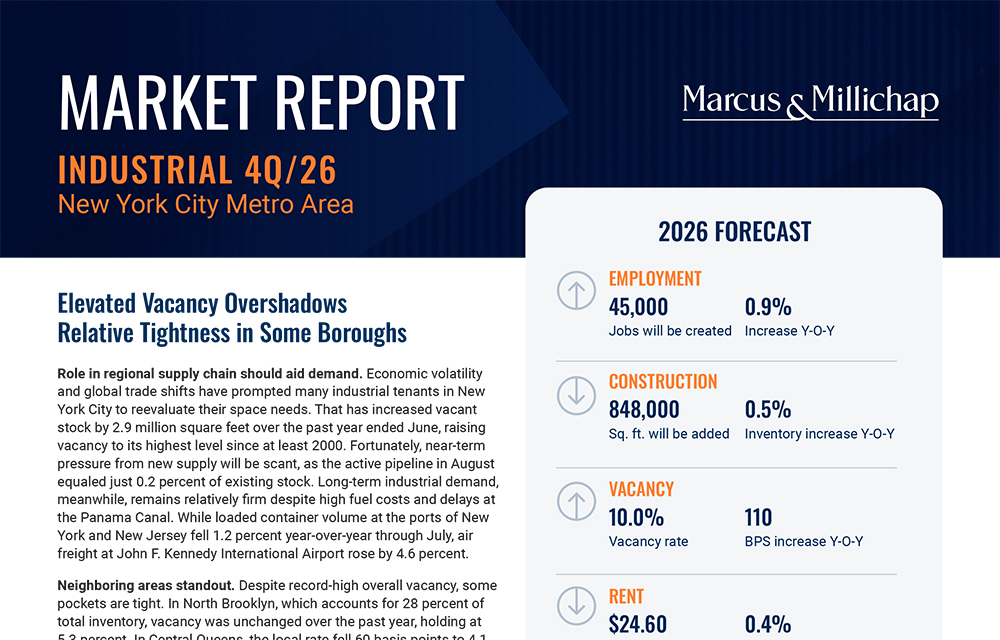
Marcus & Millichap releases fourth-quarter 2026 NYC industrial market report
Manhattan, NY Marcus & Millichap has published its fourth-quarter 2026 New York City Industrial Market Report. “New York City’s industrial market is showing a clear



Quick Hits
 (2).gif)

Columns and Thought Leadership

New York’s streets are full again, and the retail numbers prove it - by Noam Aziz
Walk down any New York block this year and you can feel it. The sidewalks are crowded, the storefronts are lit, and the energy that defines this city is back at full volume.

Hunt commercial real estate question and answer: Fortune 500 wisdom - by David Hunt
Yes, there are lessons to be learned from the largest companies in America when comes to managing your real estate. But the decision to buy or lease real estate may not be one of

The art of investing in real estate - by Thomas Donovan
Real estate investing is as much an art as it is a skill. No one can time the market, or the factors that drive it, perfectly. Location, zoning, size, transportation, and neighborhood density give you a baseline for

Hunt CRE question and answer: Choosing a real estate agent - by David Hunt
First, we will only work with one agent exclusively. The primary reason is that we want that agent to legally represent our client’s interests. In New York State, a real estate agent has a fiduciary
.gif)