



News:
Brokerage
Posted: April 22, 2013
Village retail continues to strengthen amid robust trends
Low vacancy and relative optimism about the economy, as well as several major construction projects characterized the first quarter retail market in Greenwich Village, the East Village, the Meatpacking District, and NoHo. Having developed a consistent and rigorous method to determine these statistics, the report was released last week and is the only study focusing specifically on the neighborhood in such depth.
The study tracked an 11.6% increase in average asking rent over the first quarter of 2012. Given the exuberance in the market that has been present over the last year, this comes as no surprise. Tenants continue to have a huge appetite for these neighborhoods and many of them thrive thanks to the favorable and continuously strengthening demographics throughout the area.
Additionally, several major construction projects have begun driving up retail asking and taking rents in the neighborhood, and they will continue to do so for the foreseeable future. While several of these projects are controversial for their aesthetic effect on the neighborhood, it is undeniable that they lend a tremendous amount of strength and viability to both small retail businesses and the landlords who own the properties that house those businesses. This direct benefit to the local economy comes through the dramatic increases in foot traffic that these initiatives will bring to their immediate vicinity.
The projects that are having such a significant effect on the area include NYU's 2 million s/f expansion south of Washington Sq., the New School's nearly complete 350,000 s/f University Center on 14th St., the redevelopment of St. Vincent's on Seventh Ave., the Whitney Museum's 200,000 s/f Meatpacking District outpost, and the renovation of Astor Place, which includes the construction of the 400,000 s/f 51 Astor Place office building by Minskoff Equities.
These projects are driving increased foot traffic to the areas that surround them, and hundreds of businesses and landlords stand to benefit from their construction. As a result, we predict that the vacancy rate will continue to remain low in years to come. The retail market study indicated that the vacancy rate throughout the entire area from Houston St. to 14th St., west of Ave. A has hovered just below 5% for the last year. Within these submarkets, the tightest supply is in the quickly-changing NoHo area, where vacancy has dipped to just 4% and fashion tenants continue to search for new spaces. Meanwhile, the highest vacancy rate of nearly 9% was the Meatpacking District where a number of factors (including the large size of spaces, the difficulty of obtaining a liquor license, and an evolving retail identity) pose challenges to landlords looking to lease their stores.
Retail leasing activity, unlike sales activity, has remained relatively stable over the last year. While sales activity saw a major spike, given the increase in capital gains tax that became effective at the beginning of 2013, retail leasing activity has remained strong but stable. Many retailers have announced expansion plans, given the perceived strength in the economy, even in spite of concerns that ecommerce and entailing would shrink retailers' appetites for brick-and-mortar space.
Brendan Gotch is the director of retail leasing at Massey Knakal Retail Leasing Services, New York, N.Y.
Tags:
Brokerage
MORE FROM Brokerage
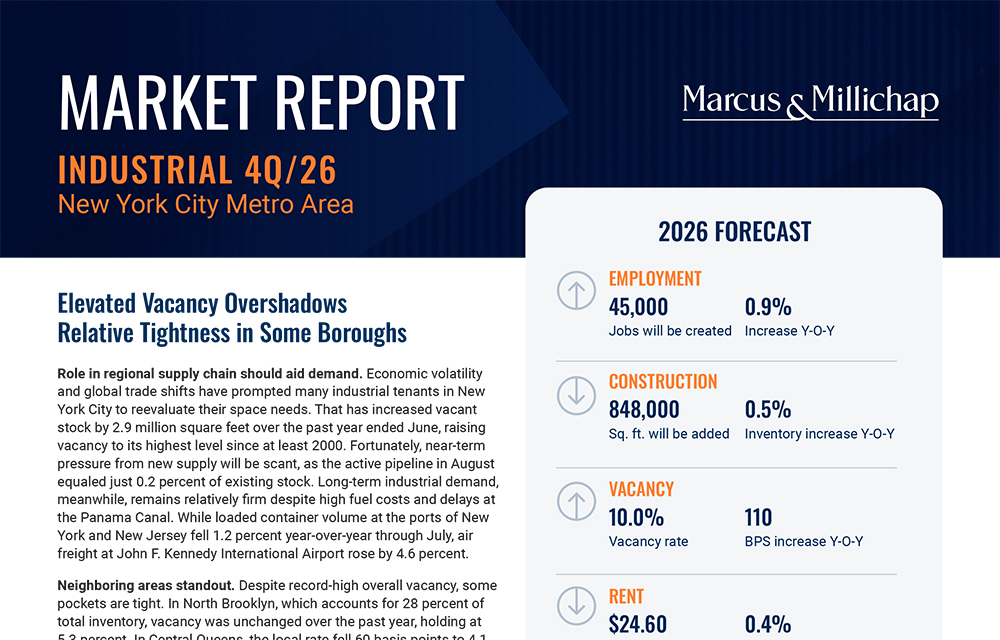
Marcus & Millichap releases fourth-quarter 2026 NYC industrial market report
Manhattan, NY Marcus & Millichap has published its fourth-quarter 2026 New York City Industrial Market Report. “New York City’s industrial market is showing a clear



Quick Hits
 (2).gif)

Columns and Thought Leadership

Hunt commercial real estate question and answer: Fortune 500 wisdom - by David Hunt
Yes, there are lessons to be learned from the largest companies in America when comes to managing your real estate. But the decision to buy or lease real estate may not be one of

Hunt CRE question and answer: Choosing a real estate agent - by David Hunt
First, we will only work with one agent exclusively. The primary reason is that we want that agent to legally represent our client’s interests. In New York State, a real estate agent has a fiduciary

The art of investing in real estate - by Thomas Donovan
Real estate investing is as much an art as it is a skill. No one can time the market, or the factors that drive it, perfectly. Location, zoning, size, transportation, and neighborhood density give you a baseline for

New York’s streets are full again, and the retail numbers prove it - by Noam Aziz
Walk down any New York block this year and you can feel it. The sidewalks are crowded, the storefronts are lit, and the energy that defines this city is back at full volume.
.gif)