



News:
Construction Design & Engineering
Posted: June 30, 2026
Urbahn Architects, Selldorf Architects and Scalamandre-Tully JV proceed on $121 million Harper St. DOT project
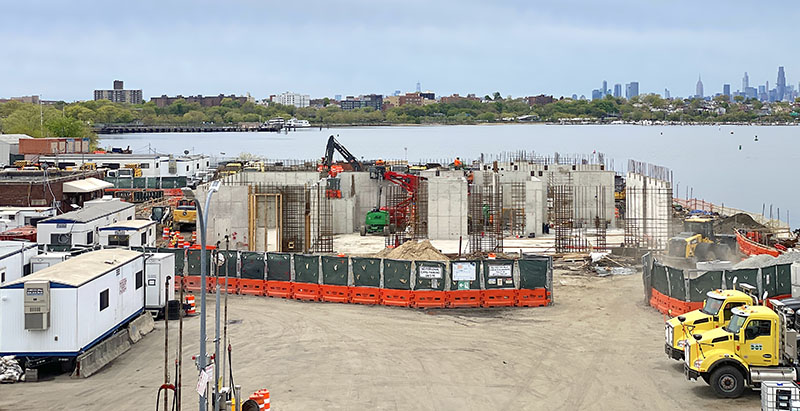
Queens, NY The New York City Department of Design and Construction (DDC), New York City Department of Transportation (DOT) and the design-build team of lead architect Urbahn Architects, design excellence architect Selldorf Architects and builder Scalamandre-Tully JV continue construction work for the $121 million Harper Street DOT administration building and yard redevelopment project at 32-11 Harper St. in the Willets Point section of the borough, adjacent to Flushing Bay. Scalamandre-Tully JV is a joint venture of Peter Scalamandre and Sons, Inc. and Tully Group. Arup serves as owner’s representative.
To replace obsolete and deteriorated facilities built in 1934 that no longer met modern operational, safety, or resiliency standards, NYC DOT is redeveloping its existing 160,000 s/f Queens Roadway Repair and Maintenance & Fleet Services maintenance yard by constructing a new administration building, wash-bay and security building; implementing resiliency and sustainability upgrades; regrading; reconstructing the perimeter bulkhead; improving circulation and reconstructing the site’s waste and stormwater conveyance systems.
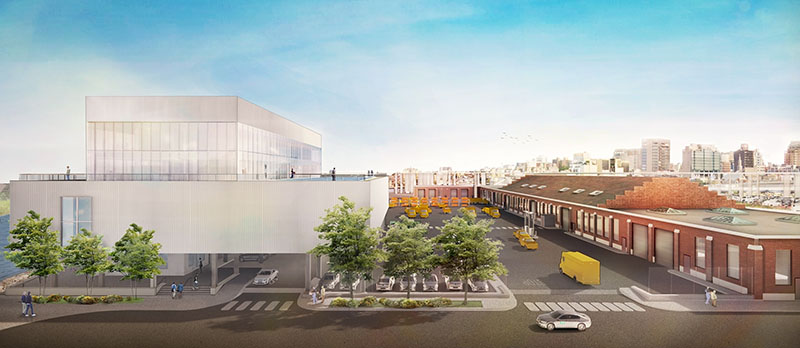
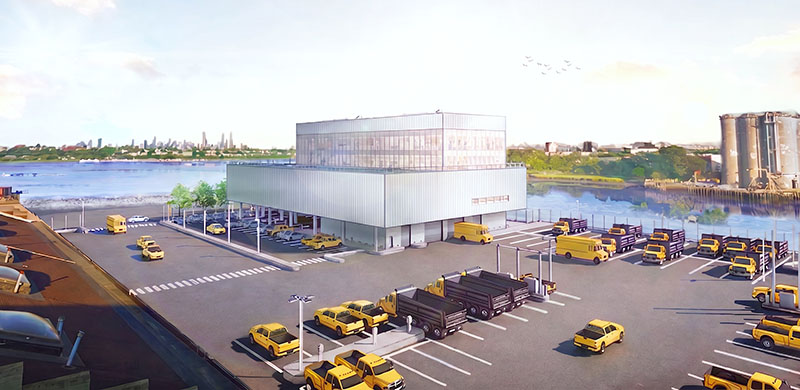
The project includes the design and construction of three new buildings: a 72,820 s/f, five-story administration and personnel building and warehouse; an 1,849 s/f, two-story wash-bay structure; and a 100 s/f precast concrete flood- and storm-resistant security booth. The new administrative building will feature a larger, two-story base – or the “plinth” – and a smaller footprint, three-story office section above.
“The DOT’s 160,000 s/f yard operates 24/7 and houses over 300 roadway repair & maintenance, and fleet services field employees, including warehousing and administration personnel,” said Urbahn Associate principal Ijeoma Iheanacho, NOMA, AIA, LEED AP, “The redesigned facility will address the current deficiencies and limitations, including creating more efficient workflows and traffic pathways, increasing on-site safety for pedestrians and vehicles, increasing protection from flooding and implementing sustainable strategies to meet LEED Gold certification. The site’s existing maintenance/repairs building and fuel monitoring and fueling stations will not undergo renovations, however three other structures will be demolished and replaced.”
According to Scalamandre design-build project manager Prince Shah, CCM, “Construction is taking place in phases to ensure that the yard can continue its critical operations without interruptions. To achieve this, the construction team developed a detailed safety and logistics plan. Once the project is complete, all the DOT’s maintenance components, equipment and supply storage will be housed in one location and the yard will operate as a highly functional and sustainable complex. A labor force of approximately 400 people will take part in the construction.”
The project team also includes landscaping architect Quennell Rothschild & Partners, HVAC engineer Legacy Engineering, plumbing and electrical engineer Collado Engineering, sustainability consultant WSP, lighting designer Lumen Architecture, and civil/structural/geotechnical/flood resilience/traffic engineer McLaren Engineering Group.
The architectural team includes Urbahn Design principal in-charge Rafael Stein, AIA; associate principal Ijeoma Iheanacho; NOMA, AIA, LEED AP and project architect Michael Sheedy, AIA as well as Selldorf principal Annabelle Selldorf, FAIA; partner Kevin Keating, AIA; project manager Andy Kim, RA; project architect Matthew Fischer, RA and architectural designer Immanuel Went.
The Harper Street Yard contained structures dating back to 1934 that were in severely deteriorated condition and no longer capable of supporting modern operational, safety, or resiliency requirements. Continued reliance on these obsolete buildings posed increasing risks to personnel, equipment, and the reliability of mission-critical operations. This redevelopment replaces failing infrastructure with a resilient, modern facility capable of safely supporting DOT’s essential public services.
The DDC, which manages New York City’s municipal design and construction undertakings, contracted the project in the design-build method, a process in which a client retains an entire team of contractor, architect and engineers to deliver both the design and construction under one contract. This method streamlines and accelerates the work, provides one point of responsibility, and improves collaboration. Both Scalamandre and Urbahn have experience with public design-build projects, with Urbahn serving as the designer of New York City’s first municipal design-build project in history: the Queens Municipal Garage.
In May 2022, the DDC issued a design-build request for proposals (RFP) for the project and, in January 2023, selected the team of Scalamandre-Tully, lead architect Urbahn and Selldorf Architects, recognizing the functional and design quality of their plan. The final contract for the project was awarded in April 2023.
Since the site needs to remain fully operational during the construction process, the work will proceed in phases. Administrative personnel will be temporarily relocated to the existing maintenance and fueling control buildings, which will remain on the site and will not undergo renovations. Phases 3 and 4 will include extensive site improvement work and construction of the new buildings.
“Despite its utilitarian function, the redeveloped yard will showcase attractive architectural design, as required by the DDC’s RFP. It was also vitally important to the team to future-proof the administrative building and the entire facility, so it remains disaster resilient, new technology-ready and utilizes maximum amount of sustainable design concepts, systems and materials,” said Urbahn principal Rafael Stein, AIA.
The site plan reflects user input gathered through a collaborative design process with findings focused on a safe and efficient layout to maximize parking, ease of vehicular circulation and well-defined pedestrian access to the new building and around the site.
Commenting on the design, Selldorf Architect’s partner, Kevin Keating, AIA said, “Designing a building that supports the day to day needs of DOT staff, while also engaging those who observe it from its surrounding context, elevates this type of infrastructure project. It demonstrates the power of architecture and how thoughtful design can contribute to a more resilient and sustainable city.”
The building’s materials were selected with economy, durability and ease of maintenance in mind. There are three main exterior materials deployed in balance with one another: concrete, metal panel and glass.
At the ground floor, with limited programming of interior occupied space, the volumes that form the base of the building will mostly have opaque concrete surfaces with added fenestrations and openings providing vehicle access. The plinth is clad in vertically oriented corrugated, anodized Galvalume metal panels that emphasize crisp simplicity and clarity. The continuous floor-to-ceiling unitized glazing panels that clad the administrative/office program spaces on all sides provide optimal daylight and panoramic views for staff, with individual and collaborative work areas located at the perimeter of the floorplate. The structure will be crowned with a second, narrower band of Galvalume panels.
The exterior color palette of grays references neighboring industrial sites, while the interiors feature pops of green and yellow drawn from DOT traffic signage, which will aid wayfinding for staff and visitors.
The DOT vehicle traffic will flow through the site from east to west. The new administrative building will be located on the northwest corner of the site and a new sidewalk on the east side of Harper Street will provide safe pedestrian access to the site via a cross walk over Marina Rd. East and west entries provide vehicular and pedestrian access to the yard, while an additional entry from Harper Street on the west side provides direct access to the supervisor parking lot and entry to the new administrative building. There will be a separate parking area for employees south of Marina Rd. with a separate entrance.
The administrative building’s height reaches 91-ft., which is below the FAA’s maximum height limit of 96 feet and four inches. In addition to the FAA and client organizations, the project team coordinated with a high number of other public agencies, including the U.S. Army Corps of Engineers (USACE), which oversees work related to public waterways.
The area around the administrative building entry is covered by the overhanging second floor of the plinth, which provides a sheltered gathering space for the staff. Precast concrete benches as well as bicycle racks in this location will be anchored to concrete pavement to resist flooding. On the north side of the building, a planted area with birch trees will frame the views of Flushing Bay from the lobby. To the east, the site will house additional plant beds for use by employees to plant their own vegetables and flowers, with more benches and picnic tables located in this area. This idea was developed in response to the existing employee garden, located in the same location, where site workers have installed makeshift planters and shade elements overlooking the bay. The overhang of the building plinth will provide some shade to this location, allowing for seating in either sun or shade.
New plants on the site will include river birch and willow oak trees, inkberry bushes, no-mow grass, shrubs, and sedum plantings. The new trees will decrease the urban heat island effect and improve air quality. All plants in the design are native to the region and were selected for their ability to thrive in urban waterfront conditions.
With the goal of a high level of sustainability and LEED Gold certification, the site and the buildings were designed for a 40% reduction in indoor annual water usage and will include onsite rainwater management system. The main new building’s design maximizes daylight and views and will use increased fresh air ventilation, low-embodied carbon and low-emitting materials and high-efficiency HVAC systems. Sustainability features will also include a new geothermal heating system of 32 wells that will extend 400-ft. deep. The building is designed to meet New York City’s and New York State’s electrification requirements and will feature 38 new EV charging stations.
The administrative building’s ground floor will include an entrance vestibule, elevator lobby, stair landing and mechanical room in the RRM core and a 2,627 s/f CAS maintenance area, 1,528 s/f RRM vehicle maintenance area, receiving room, landing area for one freight elevator and one material lift and stair, and 1,344 s/f loading area that extends to the 14,161 s/f warehousing storage space on the second floor. The remainder of the ground floor footprint will serve as parking.
The loading docks will be located on the east side of the warehousing section and the second floor will be accessible with forklifts. The warehousing/storage section was located on the second floor to allow for any potential flood water to flow through the lower section of the building without damaging the interiors, stored supplies or the building infrastructure. The double-height warehouse will stretch to the third floor. The second floor will also include a 1,060 s/f double-height muster room/training room with an adjacent pantry and lobby with views of the skyline through extensive glazing that’s intended for meetings and department events, a lactation room, an interfaith prayer room, MEP rooms and locker rooms.
The third floor will house multiple locker rooms and a locker room corridor intentionally located alongside the building’s perimeter to allow for views outside through oversized windows. On the south side, this floor will be open to the voluminous warehouse space.
The fourth floor will house offices for both units, small conference rooms and entrances to the wrap-around, employee-accessible terrace. The fifth floor will feature offices and a conference room.
To maximize access to views of Flushing Bay and natural light from almost all the offices, the interiors will feature a lot of glazing and open workspace layouts. The interiors will feature metal, plastic and glass industrial-type wayfinding signage designed by Studio 397. The signage is understated and elegant, visually referencing the function of the site.
MORE FROM Construction Design & Engineering
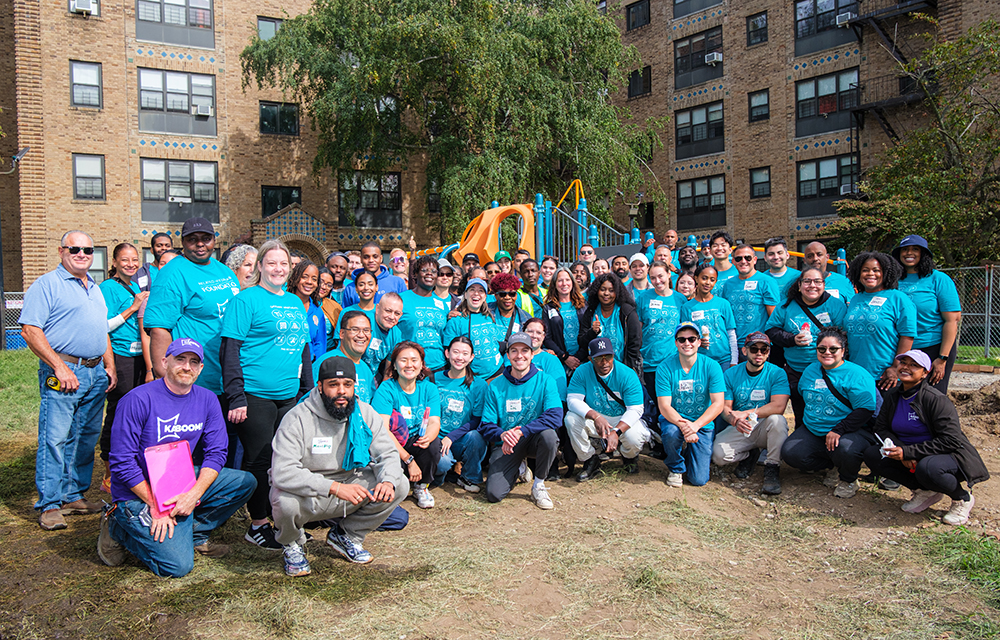
Related Affordable Foundation and KABOOM! build two playspaces at Gateway Apts. in Far Rockaway
Queens, NY Related Affordable Foundation and KABOOM!, a national nonprofit committed to ending playspace inequity, hosted a volunteer build for two new playspaces at Gateway Apartments, a 365-unit affordable housing community in Far Rockaway.





Columns and Thought Leadership

We support green construction. Just not this kind - by Tammy Smith
Most people think of St. Patrick’s Day as a fun footnote on the calendar. In construction logistics, however, it’s a full-scale operational variable — especially if your work touches major metro areas with major parades and, let’s call it what it is, enthusiastic celebrants.

The façade is no longer just a finish. It’s a risk strategy. - by Bentley Zhao
Twelve-billion-dollar weather disasters have already hit the U.S. through the first half of 2026, causing at least $31.9 billion in damage, according to Climate Central, the nonprofit that now maintains the disaster database NOAA discontinued.

Premium experiences, proven returns: The New revenue playbook for sports venues - by Terry McIntyre
Investing in the Fan Experience as a Revenue Strategy The sports and entertainment venues that bet on premium experiences years ago are now seeing those investments pay off in packed seats, increased revenue, and industry recognition.
