


 (2).gif)
News:
Finance
Posted: December 15, 2008
The what of buying commercial properties: An insight of multi-tenanted office buildings
I believe it is time to open up to the idea of diversification in our real estate portfolios. It is important to understand that assets classes you are unfamiliar with can offer distinctly different risk and reward profiles than properties you've owned in the past. Commercial real estate is traditionally divided into five sectors or asset classes: multifamily, office, industrial, retail and alternative (hotels, golf courses, marinas, etc.) We will now explore the pros and cons of owning and operating multi-tenant office buildings.
Traditionally, multi-tenant office buildings are separated into two distinct classes: urban highrise and suburban lowmidrise.
Office space is typically classified as class A, B, or C, but there is no definitive grading system. An A building in Harrisburg, Penn. may be a B building in N.Y.C. Generally speaking, a class A office property is relatively new, well situated, has modern HVAC systems, and is of top-quality construction. During a downturn, class A buildings are generally more resilient and tend to remain leased. Class B space is less well located, smaller, older, and has fewer amenities. Class C office buildings represent the remainder of the properties. B and C properties are great to own during times of economic expansion and in tight markets where their ability to be very competitive on price can keep them well occupied.
Multi-tenant office space offers numerous advantages to its owners. Office buildings, especially those that are considered class A, are highly desirable by investors of all types. Pension funds, insurance companies, REITs, all own significant amounts of office properties across the country.
All classes of multi-tenant office property can attract tenants of significant financial means. In fact, class A and class B office properties are frequently filled with tenants that have household names and significant corporate guarantors.
One of the greatest advantages to owning office buildings comes in the form of an office tenant's typical lease. That is, they are usually longer in duration than leases in a residential or industrial property. A typical office lease is signed for 5 to 10 years plus renewals. In addition, most significant office leases include rent escalators based on CPI or a flat percentage increase per year (typically 2 to 3%). This helps an owner's rental rates to keep up with inflation. Furthermore, many office leases are fully triple net with the burden of operating expenses and maintenance borne by the tenant. An owner can also usually pass along the cost of common area maintenance (CAM) to the building's tenants as well.
Inherent in the nature of owning a multi-tenant building, multi-tenant office properties offer an owner an ability to stagger the rollover of tenants. This is a major advantage over most single tenant properties, as an owner can strategically create a stabilized tenant base and minimize his/her risk that their building's occupancy will drop below a certain level at any given point. This also gives an owner the ability to mark rents to market fairly often.
Of course, nothing is perfect. Compared to most residential and retail tenants, office tenants tend to occupy larger blocks of space. This means that even with well-planned tenant rollover, an owner may still be subject to a large block of vacancy if a tenant chooses not to renew. Office space is not nearly as easy to divide into smaller leasable spaces as is industrial or flex. The tenant improvement costs can also be much higher for office tenants and their owners than with other classes of real estate.
In recent years, office owners have been fortunate to take advantage of shrinking vacancies and increasing rental rates. That trend seems to have come to a grinding halt and in many areas office vacancies have been inching upwards as rents have come down.
Some of the most significant gains as well as some of the most devastating losses I've witnessed owners and investors participate in were directly associated to ownership of multi-tenant office assets. This asset class is not one for the novice real estate investor. Owning a small multi-tenant office building is a great way for investors to break out from the mold of solely owning residential properties. There is usually a wide variety to choose from including both stabilized and value-add in one's own backyard.
Josh Slaybaugh is the chief operating officer at Trade Up 1031, Inc., West Chester, Penn.
Tags:
Finance
MORE FROM Finance
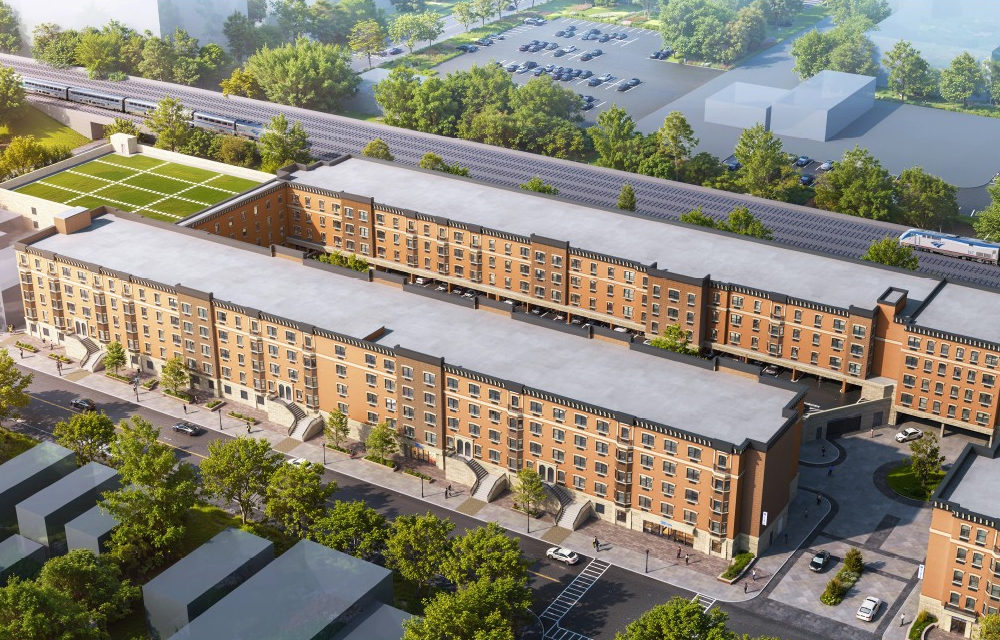
SCALE Lending issues $67.5 million construction loan for Meridia Rahway Brownstones Phase II
Rahway, NJ SCALE Lending has finalized a $67.5 million construction loan for Capodagli Property Company (Capodagli) for the development of Meridia Rahway Brownstones Phase II, a five-story multifamily building.



 (2).gif)

.jpg)

