


 (2).gif)
News:
Finance
Posted: April 14, 2009
The state of the commercial real estate mortgage market: 2009-2010 will be a difficult year
The U.S. is a $15 trillion economy as measured by GDP. Our biggest banks have trillions of assets under management and the U.S. stock market, as measured by corporate equities, hovered just above $15 trillion at the end of 2008.
According to the latest data from the Federal Reserve's Flow of Funds released last Thursday, there are some $3.5 trillion of commercial and multifamily mortgage loans on the balance sheets of financial institutions and in CMBS markets. This compares with $11.03 trillion of residential mortgages outstanding.
Approximately 25% of commercial real estate debt is securitized. However, the CMBS market has been closed since last year; Issuance stalled at 12.1 billion in 2008, down more than 90% from the $230 billion that the sector issued in 2007.
And experts predict that only about $11B of CMBS will be issued this year. This would be the lowest level of issuance since 1991. Importantly CMBS lenders had accounted for about third of all new commercial mortgage activity so the closed market is causing a severe undersupply of credit.
Meanwhile, pension funds, banks and insurance companies are increasingly focusing on maturing loans with their existing customers, and are loathe to take on new clients, further tightening the commercial mortgage credit spicket.
The situation is further exacerbated by two phenomena: A) AAA CMBS 10-year credit spreads are at all time highs; and, B) Delinquencies keep shooting up. With respect to spreads, CMBS spreads virtually preclude the creation of new loans because lenders would have to charge rates in the teens to support current bond yield requirements. Such pricing does not leave enough loan proceeds for most borrowers to pay off their maturing loans. Hence, the pricing and valuation issues that the CMBS market is having are resulting in marked illiquidity.
With respect to delinquency, a delinquent loan is one that is at least 30 days past due and still accruing interest. Delinquencies among rated CMBS ended the year at 1.17%. The dollar amount delinquent was $6.86 billion which was much more than the $3.98 billion that was reported delinquent in 2003. Rating agencies like Fitch see CMBS delinquency rates climbing to 2% for 2009. S&P sees delinquency rates climbing to 3% in 2009. Moody's has been even more conservative. It has downgraded over $60 billion of CMBS recently and is applying new assumptions about falling property cash flows and stressed capital rates when considering the rating of CMBS bonds.
Moody's believes that cumulative losses on CMBS issued between 2006 and 2008 will be around 5% because it expects a significant decline in future property cash flows on higher tenant defaults, bankruptcies and sharp declines in lease-renewal rates.
Part of the spike in delinquencies in the fourth quarter of 2008 was due to the failure of a $104 million note backed by a portfolio of two hotel properties in Tucson, Az. and Hilton Head, S.C. as well as the default on a $125.2 million loan secured by a shopping center in Corona, Calif.
In this regard, retail and hotel properties as well as office buildings are struggling amid the credit crunch and global recession:
* Hotels: $874 million in loans were reported delinquent in the 4th Qtr, a 375% year-on-year increase.
* Retail: $1.9 billion in loans were reported delinquent in the 4th Qtr, representing an annual increase of 318%.
* Office: saw $1.10 billion in loans reported as delinquent in the 4th quarter, with national office vacancies increasing to 14.5% in the same quarter.
According to Foresight Analy-tics, some $160 billion-$400 billion of commercial mortgages is set to mature this year. Loans maturing face a CMBS market that has been shut down since the latter part of 2008 and a banking industry that is already saddled with bad assets from the residential sector.
Based on the unpaid principal balance of loans (UPB), delinquency rates for each group at the end of the fourth quarter were as follows:
*CMBS: 1.17% (30+ days delinquent or in REO);
* Life company portfolios: 0.07% (60+days delinquent);
* Fannie Mae: 0.30% (60 or more days delinquent)
* Freddie Mac: 0.01% (90 or more days delinquent);
* Banks and thrifts: 1.62% (90 or more days delinquent or in non-accrual).
While a 3% commercial delinquency rate would be the highest since 1996, it would remain far lower than the 7.5% registered at year-end 1991.
There is also another ominous trend. Commercial banks are carrying more and more CMBS on their books. At year end 2008 commercial banks held over $1.5 trillion of CMBS on their balance sheets, or 44% of the current total CMBS outstanding.
While much has been made of this exposure, the Mortgage Bankers Association reported last week that delinquency rates must be put in context. Of the 35,069 commercial/multifamily loans in life company portfolios, with a total unpaid principal balance of $253 billion, only 33 loans with an aggregate unpaid principal balance of less than $168 million were 60+ days delinquent at the end of the quarter. Similarly at FDIC-insured banks and thrifts, of $1.3 trillion of commercial /multifamily mortgages outstanding, only $21 billion was 90+ days delinquent.
In short, 2009-2010 will be very difficult years for the CMBS market and for potential issuers to borrow and refinance. However, we at Wawona Worldwide Capital stand ready to assist our customers during these volatile times.
Michael Kondracki is chairman, president and CEO of Wawona Worldwide Capital, LLC, Stamford, Conn.
Tags:
Finance
MORE FROM Finance
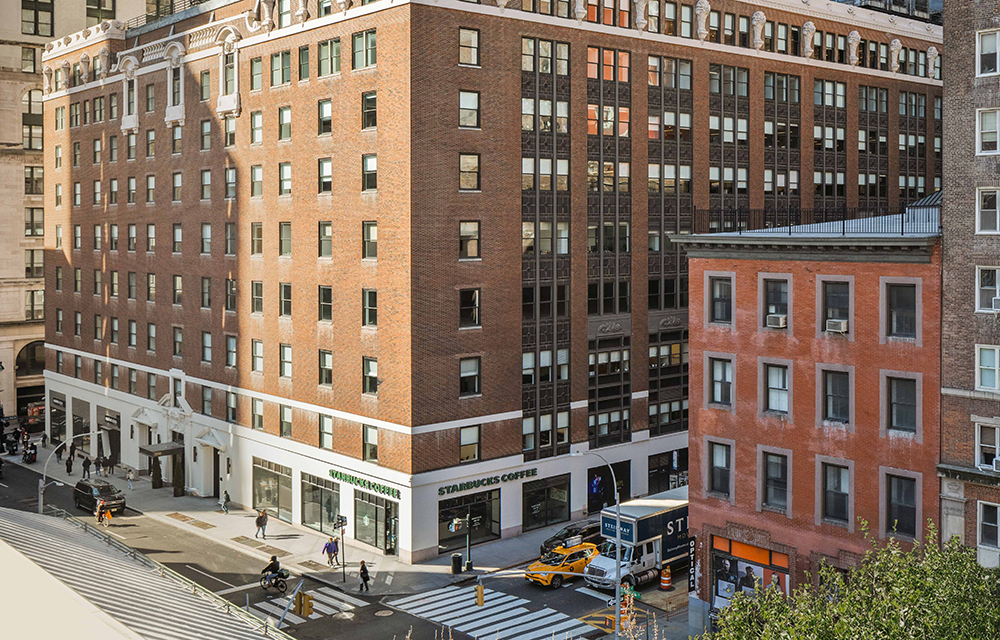
George Comfort & Sons completes $386 million refinance of 200 Madison Ave.
Manhattan, NY George Comfort & Sons, and its partners Loeb Partners Realty and Jamestown, completed a $386 million refinancing of 200 Madison Ave., its 750,000 s/f Grand Central district office


 (2).gif)

Quick Hits
.jpg)

