



News:
Brokerage
Posted: February 12, 2013
The Consumer Financial Protection Bureau - The new rules issued
Lenders should not set up the consumer to fail. This is the underpinning of new rules issued by the U.S. Consumer Financial Protection Bureau instituted after the recent housing bubble burst.
The rules which take effect January 10, 2014 will require a lender to consider whether a consumer has the ability to repay the home loan before extending the borrower credit. The emphasis of the new rule is to require lenders to overcome lax practices that led to mortgages that were made without regard to the consumer's ability to repay. Under the new rule, lenders must consider at least eight specific criteria, including a borrower's income, assets, credit history, debt obligations, and employment status. Lenders must verify and document this information. The rule also tells lenders what to look at, but not how to evaluate if the borrower has the ability to repay—such is up to the lender's judgment.
The second part of the law creates a new category called a "qualified mortgage." To be considered "qualified," mortgages must follow specific product and underwriting criteria. The rule seeks to eliminate some of the particularly bad practices that led to the home lending disaster. For example, terms should not be longer than 30 years, keep fees and points to not more than 3% of the loan, and for underwriting criteria, the borrower cannot have a debt-to-income ratio above 43%, meaning they cannot spend more than 43% of their monthly income paying debts, including mortgages, credit cards and child support.
The new rules will generate industry comment and may get fine tuned before actually taking full effect.
Brian Sahn, Esq., is a partner at Forchelli, Curto, Deegan, Schwartz, Mineo & Terrana LLP, Uniondale, N.Y.
Tags:
Brokerage
MORE FROM Brokerage
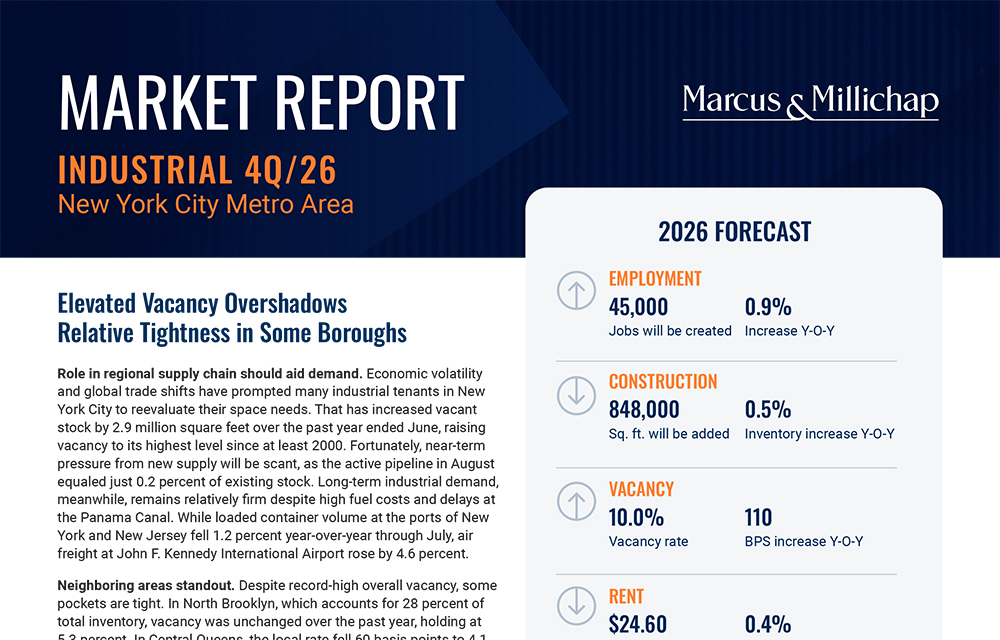
Marcus & Millichap releases fourth-quarter 2026 NYC industrial market report
Manhattan, NY Marcus & Millichap has published its fourth-quarter 2026 New York City Industrial Market Report. “New York City’s industrial market is showing a clear






Quick Hits

Columns and Thought Leadership

The art of investing in real estate - by Thomas Donovan
Real estate investing is as much an art as it is a skill. No one can time the market, or the factors that drive it, perfectly. Location, zoning, size, transportation, and neighborhood density give you a baseline for

Hunt CRE question and answer: Choosing a real estate agent - by David Hunt
First, we will only work with one agent exclusively. The primary reason is that we want that agent to legally represent our client’s interests. In New York State, a real estate agent has a fiduciary

New York’s streets are full again, and the retail numbers prove it - by Noam Aziz
Walk down any New York block this year and you can feel it. The sidewalks are crowded, the storefronts are lit, and the energy that defines this city is back at full volume.

Hunt commercial real estate question and answer: Fortune 500 wisdom - by David Hunt
Yes, there are lessons to be learned from the largest companies in America when comes to managing your real estate. But the decision to buy or lease real estate may not be one of
.gif)