



News:
Brokerage
Posted: December 6, 2016
Taking the guesswork out of telecom connectivity (Part 2) by Robert Bianco
 Robert Bianco, Windstream
Part 1 appeared in the November 15th issue of the New York Real Estate Journal
In Part 1 of this article, I discussed how building connectivity and telecommunications infrastructure has become a top buying/leasing factor for commercial space in New York, which has created the need for real estate brokers and property owners to better understand those technical issues and market their buildings’ technical capabilities. WiredScore has addressed that need by developing an international standard for measuring Internet connectivity in buildings; providing owners, asset managers and leasing brokers with a critical tool to market their properties and to answer the questions they get from prospective tenants. In this second part of the article, I will discuss how WiredScore’s methodology works and how this is an indispensable asset for the commercial real estate industry.
WiredScore’s certification process begins with a survey measuring connectivity and is followed by a review of the building by a team of accredited technicians who validate the accuracy and completeness of the connectivity data. What I love about WiredScore is that it looks so closely at the key issues that I advise clients to evaluate, including:
• Fiber density, which ensures that there is a wide range of immediately available fiber that serves the building;
• Multiple providers, which ensures that tenants have options and can get competitive pricing;
• Redundancy and resiliency options, evaluating whether there are diverse entries and risers within the building;
• Fixed wireless availability, which provides a technology that ensures business continuity even in the event of a major outage that affects traditional in-ground fiber; and
• Readiness, the ability to easily support bringing new providers into the building.
WiredScore takes that analysis and then produces a very easy to understand 100-point scale to rate buildings on their connectivity, infrastructure, and readiness, sorted into four certification levels: Platinum, Gold, Silver, and Certified. The scoring gives even the most tech-unsavvy people a simple to understand analysis, plus it gives more telecom-savvy people a layer of detail behind that that is incredibly helpful.
The scoring by WiredScore is proving to be a compelling marketing tool for properties as more prospective tenants look closely at telecom infrastructure and connectivity. WiredScore’s clear and transparent methodology makes it simple for building owners and their brokers to pursue a higher score, however, which brings me back to a subject I discussed in my last column for the New York Real Estate Journal: The value of Fixed Wireless for providing businesses with another form of connectivity that ensures that operations can stay up even with a fiber outage.
In WiredScore’s 100-point scoring system, a technology like Fixed Wireless adds a hefty 9 points to a building’s overall score because of the way it eliminates the single point of failure that underground fiber can represent. That alone can elevate a property from Gold to Platinum certification, opening up a new class of potential tenants in the process. That is true not only for buildings in traditional commercial centers in New York, but also for buildings in up-and-coming areas outside of Manhattan where commercial-grade fiber can be difficult to find in buildings that were previously warehouses or factories before being renovated into office space.
Having a high WiredScore rating is a powerful tool for marketing a property, plus it gives brokers and property owners clear guidance about how to increase their scores and make their buildings more desirable with services like Fixed Wireless.
To learn more about Wired Score, visit www.wiredscore.com.
To learn more about Windstream’s services in the tri-state market, visit www.windstreambusiness.com.
Robert Bianco is a regional director for Windstream in New York, N.Y.
Tags:
Brokerage
MORE FROM Brokerage
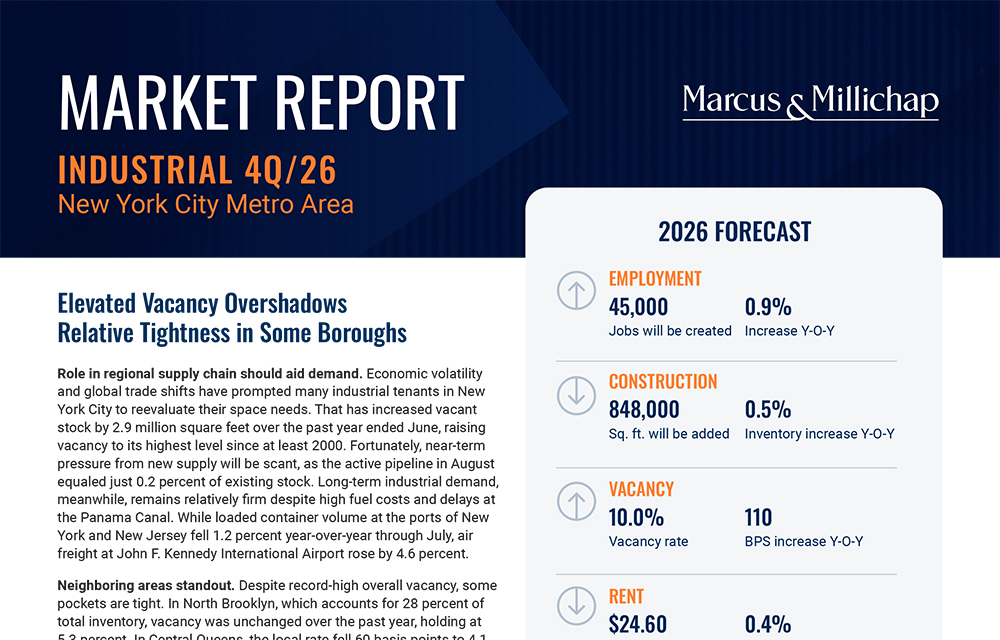
Marcus & Millichap releases fourth-quarter 2026 NYC industrial market report
Manhattan, NY Marcus & Millichap has published its fourth-quarter 2026 New York City Industrial Market Report. “New York City’s industrial market is showing a clear





Quick Hits
 (2).gif)

Columns and Thought Leadership

The art of investing in real estate - by Thomas Donovan
Real estate investing is as much an art as it is a skill. No one can time the market, or the factors that drive it, perfectly. Location, zoning, size, transportation, and neighborhood density give you a baseline for

Hunt commercial real estate question and answer: Fortune 500 wisdom - by David Hunt
Yes, there are lessons to be learned from the largest companies in America when comes to managing your real estate. But the decision to buy or lease real estate may not be one of

Hunt CRE question and answer: Choosing a real estate agent - by David Hunt
First, we will only work with one agent exclusively. The primary reason is that we want that agent to legally represent our client’s interests. In New York State, a real estate agent has a fiduciary

New York’s streets are full again, and the retail numbers prove it - by Noam Aziz
Walk down any New York block this year and you can feel it. The sidewalks are crowded, the storefronts are lit, and the energy that defines this city is back at full volume.
.gif)