



News:
Spotlight Content
Posted: April 27, 2015
Riverside Developers renames 260,000 s/f hotel development "The William Vale"
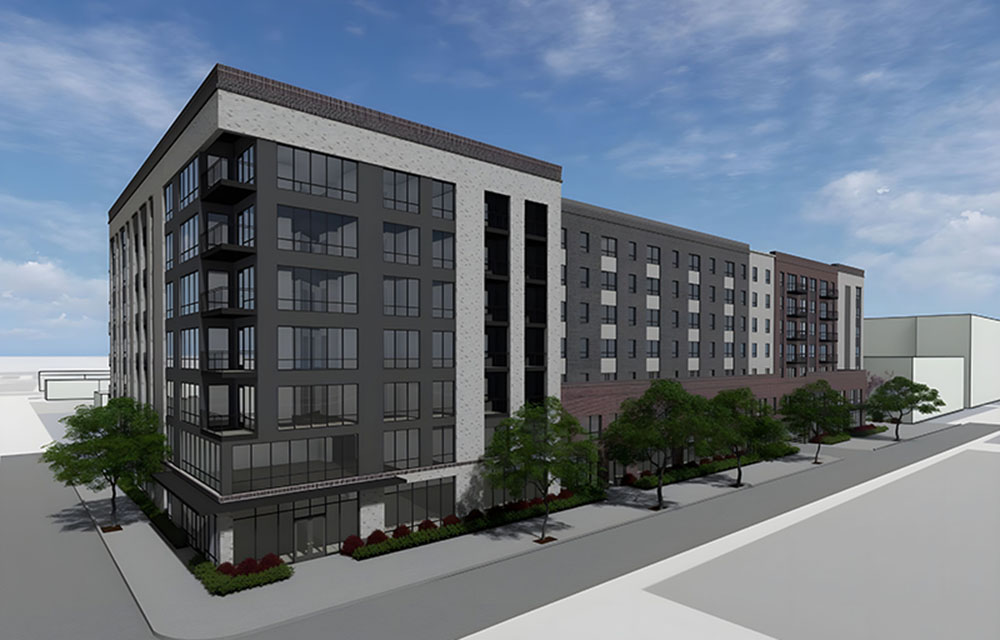
Riverside Developers revealed its newly created brand identity and name for its latest 260,000 s/f hotel development located in the borough's Williamsburg neighborhood, on Wythe Ave. between North 12th and North 13th Sts. Formerly known as "Level Hotel," the project has been renamed, "The William Vale," paying tribute to the history of the site. From architectural firm Albo Liberis, the 21-story hotel will redefine the Brooklyn skyline and is slated for completion in early 2016.
"'The William Vale,' is derived from the name of a mid-1800s Brooklynite whose property boundaries encircled the location of the site. The name serves as a historical cornerstone as we balance our project's forward looking nature in terms of architecture and design," said Mordy Steinfeld, director of operations and development with Riverside Developers. "We're confident we'll be regarded as a desired destination in the community with our new brand, shopping space, public outdoor walkway and incoming restaurateur."
The William Vale will be comprised of 183 rooms, including 25 suites, each with an adjoining balcony, conference and meeting space, ballroom that can hold nearly 300 people and rooftop pool. In addition, the project brings a 20,000 s/f public green space for pedestrians and approximately 20,000 s/f of retail to market.
"To complement our new name and concept, we're actively pursuing opportunities to recruit brands that align well with our overall aesthetic and lifestyle," said Steinfeld. "We know incoming tenants will recognize the long-term value opportunity to be a progressive member of an evolving neighborhood."
Located in the heart of Brooklyn's Williamsburg neighborhood, on Wythe Avenue between North 12th and North 13th Streets, The William Vale is close to notable entertainment venues including Brooklyn Bowl, Brooklyn Brewery and Output, as well as recognized dining destinations on the popular Bedford Avenue. Williamsburg can be accessed by subway on the L, G, J, M, and Z lines, with Manhattan just a short ride away. Buses include the B13, B24, B39 (runs to/from Manhattan), B43, B44, B47, B54, B57, B59, B60, and the B61.
Tags:
Spotlight Content
MORE FROM Spotlight Content

NYREJ's 2026 Developing Long Island Spotlight is here!
This spotlight showcases projects completed and currently under construction across Long Island as well as highlights improvements made to the region through Industrial and Economic Development Agencies and BIDs.


.png)



Columns and Thought Leadership

2026 Developing Queens: Long Island Board of Realtors advances commercial growth and advocacy in Queens
The Long Island Board of Realtors (LIBOR) Commercial Network continues to play a key role in advancing opportunities and strengthening the commercial real estate landscape across Queens. Through targeted programming and global outreach

Properly serving a lien law Section 59 Demand - by Bret McCabe
Many attorneys operating within the construction space are familiar with the provisions of New York Lien Law, which allow for the discharge of a Mechanic’s Lien in the event the lienor does not commence an action to enforce following the service of a “Section 59 Demand”.

CRE Guide Featured Company: Merritt Environmental Consulting Corp.
Merritt Environmental Consulting Corp. (MECC) was established in June of 2009 after being part of a larger engineering firm for almost 20 years. The focus of the company is to assist lending institutions, attorneys, real estate investors, and property owners with environmental concerns. Today, MECC has offices in New York, Florida, and Vermont and has grown into a regional consulting firm serving clients along the East Coast.

From vacancy to vitality: How adaptive reuse is reshaping Long Island’s CRE landscape - by Andrea Tsoukalas Curto
Adaptive reuse has become one of the most important conversations in commercial real estate today. Long Island has a large inventory of aging retail, office and industrial