



News:
Brokerage
Posted: February 6, 2018
REBNY donates historical documents to LaGuardia Community College
Queens, NY According to LaGuardia Community College and the Real Estate Board of New York, (REBNY) REBNY’s papers, and other historical items from the late 19th century through the present, have been donated to the LaGuardia and Wagner Archives.
Housed on the LaGuardia campus in Long Island City, the Archives serves as a repository of collections that illuminate the social and political history of the city. The REBNY collection will be made available for examination to LaGuardia students, as well as for researchers, policy makers, journalists, urban planners, and more.
“We are pleased to donate our documents and artifacts to the LaGuardia Community College. This collection of New York City real estate history will now be available to students, researchers, and the general public for generations to come,” said Real Estate Board of New York president John Banks. “The addition of REBNY’s records to the other historical collections housed by LaGuardia, together present important snapshots of key moments in New York City’s history.”
“REBNY’s decision to contribute their collection to our college’s LaGuardia and Wagner Archives is monumental,” said LaGuardia Community College president Gail Mellow. “Researchers seeking understanding about New York City will have more than 125 years of documentation about land use, ownership, design trends, and building codes—revealing the people who have built our city and lived, worked, and visited here, as well as signals about what the future may hold. And as an educational tool, our students will have the rare privilege of studying from original documentation—an experience that should deepen their understanding of our city’s history, and how it’s linked to their current lives. It becomes an intellectually alive process—showing the students that they’re a part of history.”
The REBNY Collection will exist alongside the mayoral and personal papers of nine former New York City mayors, as well as the records of the New York City Housing Authority (NYCHA), the New York City Council, and the additional collections of the LaGuardia and Wagner Archives.
“Having the REBNY collection exist next to the records of both NYCHA and the City Council is entirely apposite,” said Richard Lieberman, PhD, professor of history and director of the LaGuardia and Wagner Archives. “Researchers will have a single source from which to access New York City’s public and private real estate history for the past 125 years, and to examine the legislative policies from the City Council that impacted this history. Both NYCHA and REBNY, representing public and private housing, are essential parts of New York City’s story—together revealing how our neighborhoods were shaped, community revitalizations, and much more.”
Highlights of the collection include the REBNY Diary and Manual, an annual book that compiles changes in building codes and zoning updates, reflecting major issues facing industry each year, and tracks REBNY membership comprised of New York City’s leading real estate professionals. It also features more than 300,000 property cards for houses, buildings, and other private properties located in Manhattan from the 1920s through the 1990s (after which time these records were continued by the New York City Department of Buildings). Each card contains information about property ownership, sales prices, and more.
Many of these documents will be digitized, allowing the documents to live both online to ensure global access, and in the physical space at the Archives on the LaGuardia Community College campus located in Long Island City, Queens.
The LaGuardia and Wagner Archives has a total of more than 2.3 million documents available for download and study on its website, from its 14 total collections. More than half of these documents, greater than 1.3 million, are documents of the City Council. Recent City Council documents filmed and digitized include files of vice chairman/majority leader Thomas Cuite, speaker Peter Vallone Sr., as well as the printed bill and other documentation related to newly introduced legislation.
The Archives encourages New York City architects, urban planners, real estate developers, and builders, who also contributed to shaping New York City, to consider donating their archival records to the LaGuardia and Wagner Archives for posterity. Those interested should contact Archivist Douglas Di Carlo at (718) 482-5065 or [email protected].
Tags:
Brokerage
MORE FROM Brokerage
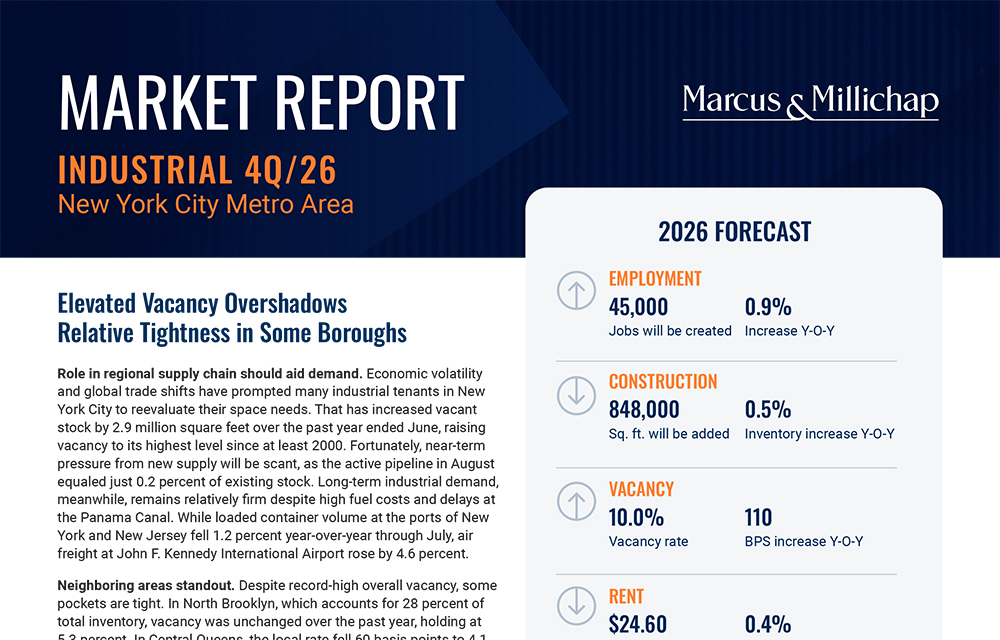
Marcus & Millichap releases fourth-quarter 2026 NYC industrial market report
Manhattan, NY Marcus & Millichap has published its fourth-quarter 2026 New York City Industrial Market Report. “New York City’s industrial market is showing a clear



Quick Hits

Columns and Thought Leadership

Hunt CRE question and answer: Choosing a real estate agent - by David Hunt
First, we will only work with one agent exclusively. The primary reason is that we want that agent to legally represent our client’s interests. In New York State, a real estate agent has a fiduciary

Hunt commercial real estate question and answer: Fortune 500 wisdom - by David Hunt
Yes, there are lessons to be learned from the largest companies in America when comes to managing your real estate. But the decision to buy or lease real estate may not be one of

New York’s streets are full again, and the retail numbers prove it - by Noam Aziz
Walk down any New York block this year and you can feel it. The sidewalks are crowded, the storefronts are lit, and the energy that defines this city is back at full volume.

The art of investing in real estate - by Thomas Donovan
Real estate investing is as much an art as it is a skill. No one can time the market, or the factors that drive it, perfectly. Location, zoning, size, transportation, and neighborhood density give you a baseline for
.gif)