


News:
Movers & Milestones
Posted: July 30, 2026
Nine transformative projects honored in ULI’s 2026 Americas Awards for Excellence
Washington, DC Nine developments from across the Americas have been selected as winners of the Urban Land Institute’s (ULI’s) 2026 ULI Americas Awards for Excellence.
This year, 93 projects and programs from across the Americas region were submitted. From that impressive field, the 15-member jury, composed of development, finance, planning, and varied design experts, selected 16 finalists and ultimately nine winners.
The 2026 ULI Americas Awards for Excellence winners include:
Highland Phase II, Austin, Texas With creative financing and extensive community engagement, Highland Phase II offers a replicable model for converting dormant malls into vibrant, mixed-use community anchors. Highland Phase II transformed a vacant shopping mall into Austin Community College’s flagship 5,000-student campus. The 420,000 s/f adaptive reuse project incorporates salvaged building components, including structural steel, to create specialized spaces informed by input from over 16 departments. The newly designed Paseo breaks down the mall’s former pedestrian barriers to improve walkability and public access.
Line 5 Eglinton, Toronto, Ontario Line 5 Eglinton is Toronto’s largest transit expansion in decades, weaving 11.8 miles and 25 stations to link 22 communities along a vital east-west spine. The high-demand line connects to 54 bus routes, three subway stations, and two GO rail lines, and is projected to serve around 123,200 daily passengers by 2027. Each station integrates seamlessly with its surrounding neighborhood, while passive ventilation, adaptable entrances, and natural-light canopies are shared across the transit line.
Mission Rock Phase One, San Francisco, California Raised to accommodate 66 inches of sea level rise, the project sets a new standard for resilient waterfront development. Mission Rock Phase One converted a former industrial waterfront and surface parking lot into a vibrant publicly accessible neighborhood. Delivered through a unique public/private partnership and over 17 years of planning and community engagement, the development enhances the city’s connection to the Bay, supporting residential towers, commercial buildings, and local retail, all anchored by the five-acre China Basin Park.
Parrott Creek, Oregon City, Oregon Parrott Creek reimagines residential treatment and support services for youth and their families by integrating trauma-informed design, ecology, and cultural restoration. The 22,410 s/f campus is set within an 80-acre property and features programmed outdoor space alongside three primary buildings containing therapeutic spaces, residential bedrooms, shared learning areas, recreational facilities, staff operations, and a cultural ecology space. Developed in partnership with youth, universities, community organizations, and Indigenous community members, the campus offers a model for how residential care facilities can center safety, dignity, and belonging.
Presidio Tunnel Tops, San Francisco, California Presidio Tunnel Tops reclaimed highway infrastructure as 14 acres of new national park land, bridging the tunneled Presidio Parkway to reconnect San Francisco’s Presidio Main Post to the Bay for the first time in generations. The park has hosted nearly six million visits since opening and supported visits by 500+ community organizations and 1,000 school groups. Shaped by community and public feedback, the development beautifully weaves together trails, transit access, education spaces, and gathering areas, replacing a former pedestrian barrier with a new civic destination.
Riverlife’s Shore Thing, Pittsburgh, Pennsylvania Riverlife’s Shore Thing pioneers a connection between Pittsburghers and the Allegheny riverfront with a 4,800 s/f, solar-powered floating platform. Securing unprecedented interagency approvals for the area, the project opened to the public just three years after planning started and drew over 50,000 visitors in its first year. Positioned between two bridges and adorned with public art, the modular, reconfigurable barges create a flexible gathering space that hosts a slate of free and open-to-the public programs from yoga to performing arts, as well as a beer garden, hammock nets, and a lounge area. With a total project cost of $1.3 million, Shore Thing offers an affordable, replicable model for riverfront cities nationwide.
The Eliza + Inwood Library - Joseph and Sheila Rosenblatt Building, New York City, New York The Eliza artfully pairs a bright, light-filled public library with 174 units of affordable housing in New York City’s Inwood neighborhood. Shaped by input from Inwood residents, community organizers, elected officials, and nonprofit organizations, the development supports a “live, work, play” model with a Universal pre-K school, a teaching kitchen, and job training and placement services. The well-used and highly visited project reflects a new standard for collaboration between the City, nonprofit developers, and the New York Public Library.
The Victor, St. Louis, Missouri The Victor transforms a 735,000 s/f vacant warehouse into a vibrant mixed-use redevelopment supporting 384 apartments, parking, tenant amenities, and retail. Distinguished by its scale and sophistication of its capital stack, anchored by state and federal historic tax credits, the $130 million project reinvigorates St. Louis’s downtown west neighborhood by reactivating an entire city block and serving as a catalyst for nearby development. The design honors the area’s garment district’s rich architectural heritage while demonstrating how thoughtful adaptive reuse investment can generate both profit and impact.
Wadaag Commons, Minneapolis, Minnesota Wadaag Commons is a 39-unit affordable housing project that completes the transit-oriented mixed-use Seward Commons redevelopment. Built with a focus on cultural sensitivity, the development offers affordable one- to four-bedroom units with intentional design features such as high-flow air circulation and floor drains, to accommodate mixed-generation, primarily East African families. The $26 million project includes six townhomes, a sensory-sensitive playground, a green roof, and EV charging stations, serving as a model for walkable, transit-accessible neighborhoods where families can thrive.
ULI began the Awards for Excellence program in 1979 to recognize superior development efforts in the private, public, and nonprofit sectors. Winning projects represent the highest standards of achievement in land use and encompass a wide range of project types, sizes, investments, and geographic locations. The awards are open to projects and programs in the ULI Americas region that are substantially complete, financially viable, and in stable operation. The program evaluates submissions on overall excellence, including achievements in marketplace acceptance, design, planning, technology, amenities, economic impact, management, community engagement, innovation, and sustainability, among others.
All submissions for the 2026 ULI Americas Awards for Excellence are available in an online gallery.
“This year’s competition brought forward an exceptional cross-section of development from across the Americas, and narrowing an outstanding field of finalists to this year’s winners was no small task,” said Robyn Brown, 2026 ULI Americas Awards for Excellence jury chair. “What struck the jury most was the range of partnership structures behind these projects: public, private, and nonprofit partners coming together in ways that wouldn’t have been possible for any one of them to deliver alone. We also saw real innovation in how teams approached sustainability and funding, finding creative capital stacks and design solutions to get ambitious projects built in a genuinely difficult market. These winners show what’s still achievable when partners bring discipline, creativity, and a shared commitment to the communities they’re building for.”
ULI Americas Awards for Excellence finalists were selected by a multidisciplinary jury of ULI members, including experts in development, finance, planning, urban design, architecture, and landscape architecture.
In addition to Brown, the 2026 jury included Robert Acuña-Pilgrim, principal and managing director of planning, TBG Partners, Dallas; Ese Aihie, president, Admiral Legacy, Dallas-Fort Worth; Kacey Cordes, vice president and director of operations, U.S. Bancorp Impact Finance, St. Louis; Peter Dennehy, principal, advisory, Zonda, San Diego; Aron Gooblar, executive vice president, Washington Square Partners, New York City; Kona Gray, principal, EDSA, Fort Lauderdale; Jackie Knight, president, Ackerberg, Minneapolis; Willie Lanier, managing partner, Lanier United, Kansas City; Juan Mullerat, principal, Plusurbia Design, Miami; Julia Murphy, partner, Skidmore, Owings & Merrill, New York City; Gautami Palanki, vice president, sustainability, AvalonBay Communities Inc., Washington, D.C.; Eduardo Ramos, director and principal, Gensler, Mexico City; May So, partner, Mithun, Seattle; and Rebecca Tudor, principal, Twinrose Investments, Dallas.
MORE FROM Movers & Milestones
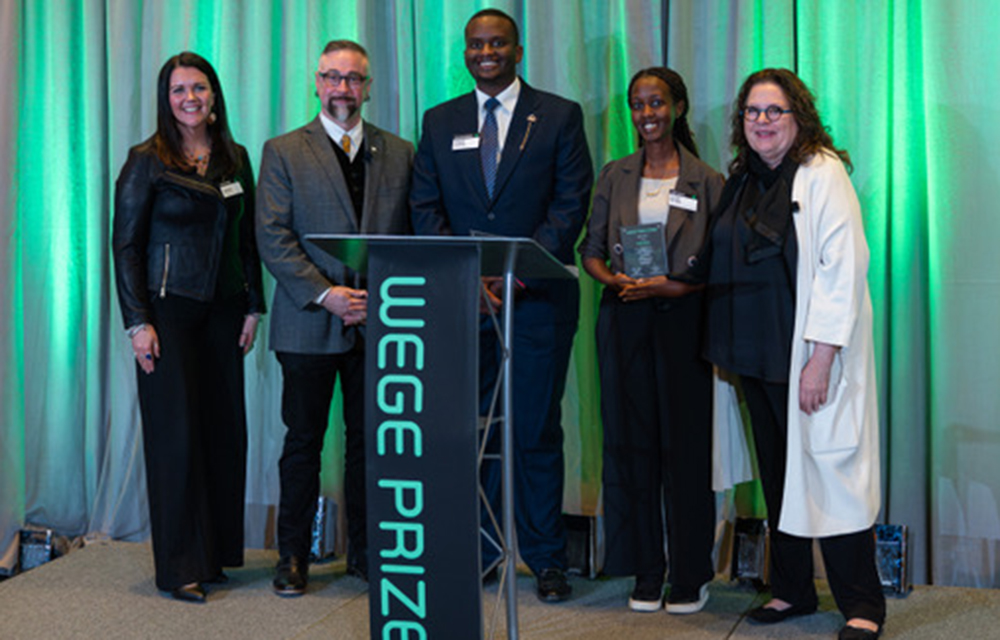
Wege Prize 2027 draws strongest, most diverse field to date in global design competition for the circular economy
Grand Rapids, MI Wege Prize returns for its 14th year to inspire a record-setting global cohort of university students to develop game-changing solutions to some of the world’s most pressing problems.




Quick Hits
 (2).gif)
